
Calculator
The LT & HT cable sizing calculator is an essential electrical engineering tool used to determine the correct cable size for safe and efficient power transmission.
LT & HT Cable Sizing Calculator
Professional Electrical Engineering Tool | Low Tension (up to 1.1 kV) & High Tension (3.3 kV – 33 kV)
Click here for more Electrical Calculators
You can also follow us on Facebook and Linkedin to receive daily updates.
Proper cable sizing calculation ensures that cables can handle load current, withstand short circuits and maintain voltage within acceptable limits.
This online calculator tool follows primary standards such as
- IS 3961 current ratings,
- IEC 60502 power cables,
- IS 7098, IS 1554 and IEC 60949 short circuit formula
making it highly reliable for industrial, commercial and infrastructure projects.
Applicable Standards & Codes
- IS 3961
- IS 1554 / IS 7098
- IEC 60502
- IE Rules 1956
- IS 732
- IEC 60949
Voltage & System Configuration
Selecting the correct voltage class is mandatory to ensure insulation integrity, dielectric strength and regulatory compliance.
Voltage Levels: LT and HT Classification
Electrical power distribution systems are classified as
- Low Tension (LT) and
- High Tension (HT)
based on the nominal system voltage.
- LT systems operate at nominal voltages up to 1100 V (1.1 kV) as per IE Rules 1956, Rule 2(b).
- The standard LT three phase distribution voltage is 415 V (line-to-line) 50 Hz.
- Single-phase LT supply is typically 230 V (line-to-neutral) derived from a 415 V three phase system.
- HT systems in India operate at standardized voltages: 3.3 kV, 6.6 kV, 11 kV, 22 kV and 33 kV.
- Cables for HT systems must comply with IS 7098 (XLPE) (or) IS 1554 Part 2 (PVC) for the appropriate voltage class.
- The voltage rating of an HT cable is expressed as Uo/U where Uo is conductor to earth voltage and U is conductor to conductor voltage.
Phase Configuration
- Three phase systems are standard for industrial, commercial and HT distribution applications.
- Single phase systems are used for residential supplies and small loads below approximately 5 kW.
- The phase configuration directly affects the full load current (FLC) calculation formula used in cable sizing.
- For three-phase balanced loads, FLC = kVA x 1000 / (√3 x VLL), where VLL is the line-to-line voltage.
- For single phase loads, FLC = kVA x 1000 / VLN, where VLN is the line to neutral voltage.
Supply Frequency
- India and Europe operate at a nominal supply frequency of 50 Hz.
- The USA, Canada and parts of the Americas operate at 60 Hz.
- Frequency affects the inductive reactance (X = 2πfL) of the cable which influences voltage drop calculations.
- Higher frequency slightly increases reactance affecting voltage drop more significantly for the longer cable routes.
System Earthing
The system earthing method determines the fault current magnitude and protection.
| Earthing System | Description | Application | Fault Current Level |
| TN-S | Separate protective earth and neutral conductors throughout | Industrial & commercial LT systems | High (limited by source impedance) |
| TN-C-S | Combined PEN conductor up to distribution board, then split | Residential supplies, utility networks | High (similar to TN-S) |
| TT | Independent earth electrodes at source and load | Rural supplies, temporary installations | Low (limited by earth electrode) |
| IT | Source neutral unearthed or impedance earthed | Hospitals, mines, offshore platforms | Very low (first fault only) |
- TN-S systems provide the lowest earth fault loop impedance enabling the fast fault clearance.
- IT systems allow continuous operation during a first earth fault making them suitable for important loads such as hospital operating theatres.
- The earthing system affects the selection and sizing of the protective earth conductor in multi core cables.
Load Parameters
Accurate load parameter entry is the base of correct cable sizing.
Connected Load (kW)
- Connected load is the total rated power of all the electrical equipment connected to the circuit.
- It is expressed in kilowatts (kW) and represents the nameplate (or) design power consumption.
- The connected load should be obtained from equipment datasheets, motor ratings (or) load schedules.
- For motor loads the connected load equals the mechanical output power on the motor nameplate.
Power Factor (cos φ)
- Power factor is the ratio of active power (kW) to apparent power (kVA) in an AC circuit.
- Power factor affects the current drawn for the given kilowatt load that is directly influencing the cable sizing.
- A low power factor results in a higher current for the same useful power output that is requiring a larger cable.
- Typical power factors which includes induction motors 0.80–0.92, resistive heating 1.0, mixed industrial loads 0.85–0.90.
- Power factor correction capacitors can be utilized to improve the system power factor and reduce cable current.
Demand Factor
Demand factor is the ratio of maximum demand to the total connected load of a system.
A demand factor of 1.0 assumes that all electrical loads operate simultaneously at their rated capacity.
Typical demand factors: industrial workshops 0.70–0.85 & commercial buildings 0.60–0.80 & residential 0.40–0.70.
Using an appropriate demand factor prevents over sizing of cables and reduces capital cost.
Load / Motor Efficiency
- Motor efficiency is the ratio of mechanical output power to electrical input power.
- The electrical input power (kVA) to a motor is higher than its mechanical output (kW) due to losses.
- Efficiency should be accounted for to correctly calculate the actual current drawn by the motor.
- Standard IE3 motors have efficiencies of 88-96% depending on the rating as per IS 12615.
- For purely resistive loads such as heaters & incandescent lamps efficiency is taken as 100%.
Starting Current Multiplier
- The starting current multiplier is the ratio of motor starting current to the rated full load current.
- It is used to verify that the cable and protection device can withstand the starting transient without damage.
- Direct-On-Line (DOL) starting produces starting currents of 6–7 times the full load current.
- Star-delta starting reduces the starting current to approximately 2–2.5 times full load current.
- Soft starters limit starting current to 2–3 times full load current through progressive voltage ramp-up.
- Variable Frequency Drives (VFDs) limit starting current to 1.1–1.5 times full load current.
- Non-motor loads such as resistive heaters do not have significant inrush; multiplier of 1.0 is applied.
Load Types
| Load Type | Characteristics | Starting Current | Typical PF |
| Motor (Inductive) | Rotating machinery, induction loads | 6-7 x FLC (DOL) | 0.80 – 0.92 |
| Resistive | Heaters, incandescent lamps, ovens | 1.0 x FLC | 0.95 – 1.00 |
| Mixed / General | Combination of motor and resistive loads | 3-5 x FLC (average) | 0.85 – 0.90 |
| UPS / Critical | Uninterruptible power supplies, server rooms | 1.5-2.5 x FLC | 0.85 – 0.95 |
| VFD / Inverter Drive | Variable speed drives, HVAC systems | 1.1-1.5 x FLC | 0.90 – 0.98 |
Cable Route & Installation Details
Cable route and installation conditions determine the thermal environment of the cable.
Cable Route Length
- Cable route length is the actual physical length of the cable run from the source to load.
- It is used to calculate the voltage drop & resistive power loss in the cable.
- For underground cables the route length must include any bends, diversions and termination tails.
- A longer cable route increases voltage drop which is often requiring a larger cable size than current rating alone would dictate.
- Route length also influences the total cost of the cable installation and must be minimized where practicable.
Installation Methods and Correction Factors
The installation method determines the ability of the cable to dissipate heat to its surroundings.
| Installation Method | Correction Factor | Notes |
| Underground – Direct Buried in Soil | 0.90 | Best heat dissipation, recommended for long HT runs |
| Underground – In Conduit / Duct (Ground) | 1.00 | Reference condition; slightly higher thermal resistance |
| Above Ground – Cable Tray / Ladder (Free Air) | 1.00 | Reference condition; good air circulation |
| Underground – Grouped in Duct Bank | 0.85 | Mutual heating from adjacent cables |
| Above Ground – Grouped Cables on Tray | 0.70 | Significant mutual heating; allow adequate spacing |
| Clipped Direct to Wall / Surface | 0.95 | Limited air circulation around cable |
Ambient / Soil Temperature
- The current-carrying capacity of a cable decreases as ambient temperature increases.
- IS 3961 and IEC 60502 publish current ratings at a reference temperature of 30°C for air and 20°C for ground.
- A temperature correction factor must be applied when actual ambient temperature differs from the reference value.
- In India, air temperatures of 40–50°C and ground temperatures of 30–45°C are common in summer months.
- The correction factor formula for XLPE cables (90°C max conductor temperature) is: Kt = √[(250 – Tamb) / (250 − 90)].
- For PVC cables (70°C max conductor temperature), the correction factor is: Kt = √[(230 – Tamb) / (230 − 70)].
Grouping of Cables
When multiple cables are installed together, mutual heating reduces the current capacity of each cable.
A grouping correction factor Cg is applied to account for the reduced heat dissipation from adjacent cables.
The grouping factor assumes all cables in the group carry the same current at full load.
| No. of Cables in Group | Grouping Factor (Cg) | Effective Capacity (%) |
| 1 (single cable) | 1.00 | 100% |
| 2 | 0.87 | 87% |
| 3 | 0.79 | 79% |
| 4 | 0.75 | 75% |
| 5 | 0.73 | 73% |
| 6 | 0.72 | 72% |
| 7–10 | 0.70–0.71 | 70–71% |
| > 10 | 0.65 | 65% |
Cable Material & Construction
Cable construction defines its electrical, mechanical, and thermal performance characteristics.
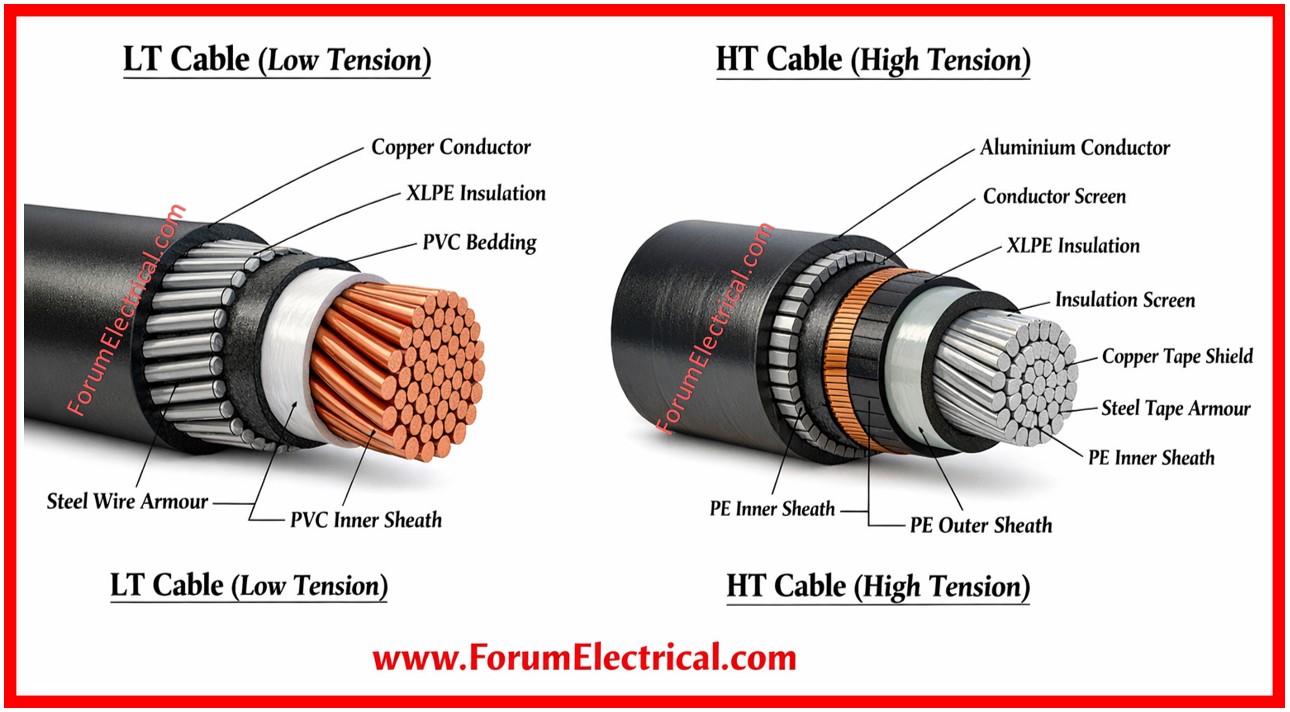
Each layer of the cable serves a specific engineering function and should be selected to match the installation environment and service conditions.
Conductor Materials: Copper vs Aluminium
| Property | Copper (Cu) |
| Resistivity (Ω·mm²/m) | 0.0172 (lower is better) |
| Relative Conductivity | 100% (reference) |
| Density (kg/m³) | 8,900 (heavier) |
| Minimum Size (IS) | 1.5 mm² for power cables |
| Current Capacity | Higher for same cross-section |
| Termination | Easy; standard lugs & connectors |
| Joints | Simple; no special precautions |
| Cost | Higher (market price dependent) |
| Applications | Motors, switchgear, critical loads, control panels |
| Standard | IS 8130, IS 1554, IS 7098 |
| Property | Aluminium (Al) |
| Resistivity (Ω·mm²/m) | 0.0282 (64% conductivity) |
| Relative Conductivity | 61% of copper |
| Density (kg/m³) | 2,700 (lighter — 30% of copper) |
| Minimum Size (IS) | 16 mm² for power cables |
| Current Capacity | ~60–65% of copper for same size |
| Termination | Requires bi-metallic lugs, anti-oxidant compound |
| Joints | Requires special compression connectors |
| Cost | Lower (approx. 30–40% cheaper) |
| Applications | HT transmission, overhead lines, large power feeders |
| Standard | IS 8130, IS 1554, IS 7098 |
Insulation Types
| Property | XLPE | PVC | EPR |
| Full Name | Cross-Linked Polyethylene | Polyvinyl Chloride | Ethylene Propylene Rubber |
| Max Conductor Temp (Normal) | 90°C | 70°C | 90°C |
| Max Conductor Temp (Short Circuit) | 250°C | 160°C | 250°C |
| Dielectric Strength | Excellent | Good | Excellent |
| Water Resistance | Excellent | Good | Very Good |
| Flexibility | Good | Good | Excellent |
| Thermal Ageing | Excellent | Moderate | Excellent |
| Chemical Resistance | Excellent | Good | Good |
| Current Rating Advantage | Higher (+20–25% vs PVC) | Reference | Similar to XLPE |
| Standard | IS 7098, IEC 60502 | IS 1554, IEC 60502 | IEC 60502 |
| Preferred Application | HT cables, industrial, outdoor | LT indoor wiring, commercial | Flexible HT, marine, offshore |
Voltage Drop & Fault Level Parameters
Voltage drop and fault level calculations are the two most critical checks after current-carrying capacity.
An undersized cable may pass the thermal check but fail on voltage regulation or short-circuit withstand.
Calculation
The cable sizing calculation follows a systematic sequential process. Each step builds on the previous result.
The cable size is selected as the largest size required by any of the following three criteria: current-carrying capacity, voltage drop and short-circuit withstand.
Step 1: Load Current (Full Load Current – FLC)
The full load current is the fundamental basis for all cable sizing calculations.
IFLC = (kW x Demand Factor x Growth Factor) / (√3 x VLL x PF x Efficiency) [3-Phase]
IFLC = (kW x Demand Factor x Growth Factor) / (VLN x PF x Efficiency) [1-Phase]
Step 2: Total Derating Factor
The total derating factor combines all applicable correction factors that reduce the cable’s current-carrying capacity from its rated value.
Dtotal = Ktemp x Kgroup × Kinstall
Where
Ktemp = Temperature correction factor
Kgroup = Grouping/bunching factor
Kinstall = Installation method factor
Ktemp (XLPE, 90°C) = √[(250 − Tamb) / (250 − 90)]
Tamb = Actual ambient or soil temperature in °C
Ktemp (PVC, 70°C) = √[(230 − Tamb) / (230 – 70)]
Step 3: Design Current and Cable Selection by Current
Idesign = IFLC / Dtotal
Idesign = Current that the cable must be rated to carry after derating.
Select standard cable size with Iz ≥ Idesign.
Step 4: Voltage Drop Check
After selecting the cable by current the voltage drop should be verified. If it exceeds the limit the next larger cable size is selected.
ΔV = √3 x I x (R·cosφ + X·sinφ) x L [3-Phase, V]
R = Conductor resistance (Ω/km)
X = Conductor reactance (Ω/km)
L = Route length (km)
cosφ = power factor
sinφ = √(1 − cos²φ)
ΔV = 2 × I × (R·cosφ + X·sinφ) x L [1-Phase, V]
%VD = (ΔV / Vnominal) × 100
Select a larger cable size if %VD exceeds the allowable limit specified in IS 732 (or) IE Rules 1956.
Step 5: Short-Circuit Withstand Check (IEC 60949)
The cable should be capable of withstanding the thermal energy injected during a short-circuit until the protection device clears the fault.
Amin = (Isc × √t) / k [mm²]
Isc = Symmetrical short-circuit current at source (A)
t = Fault clearance time (s)
k = Material factor (Copper XLPE: 143 & Copper PVC: 115 & Aluminium XLPE: 94 & Aluminium PVC: 74)
Common Points to Avoid in Cable Sizing
- Do not use nameplate motor output kW as the cable design current without correcting for power factor and efficiency.
- Do not ignore grouping derating when multiple cables share the same tray or duct.
- Do not apply ambient temperature correction based on outdoor temperature when cables are installed in a hot control room.
- Do not select cable size based only on current rating; always check voltage drop for long routes.
- Do not assume the nearest standard cable size is adequate without verifying all three sizing criteria.
- Do not neglect future load growth on main feeders and infrastructure cables.