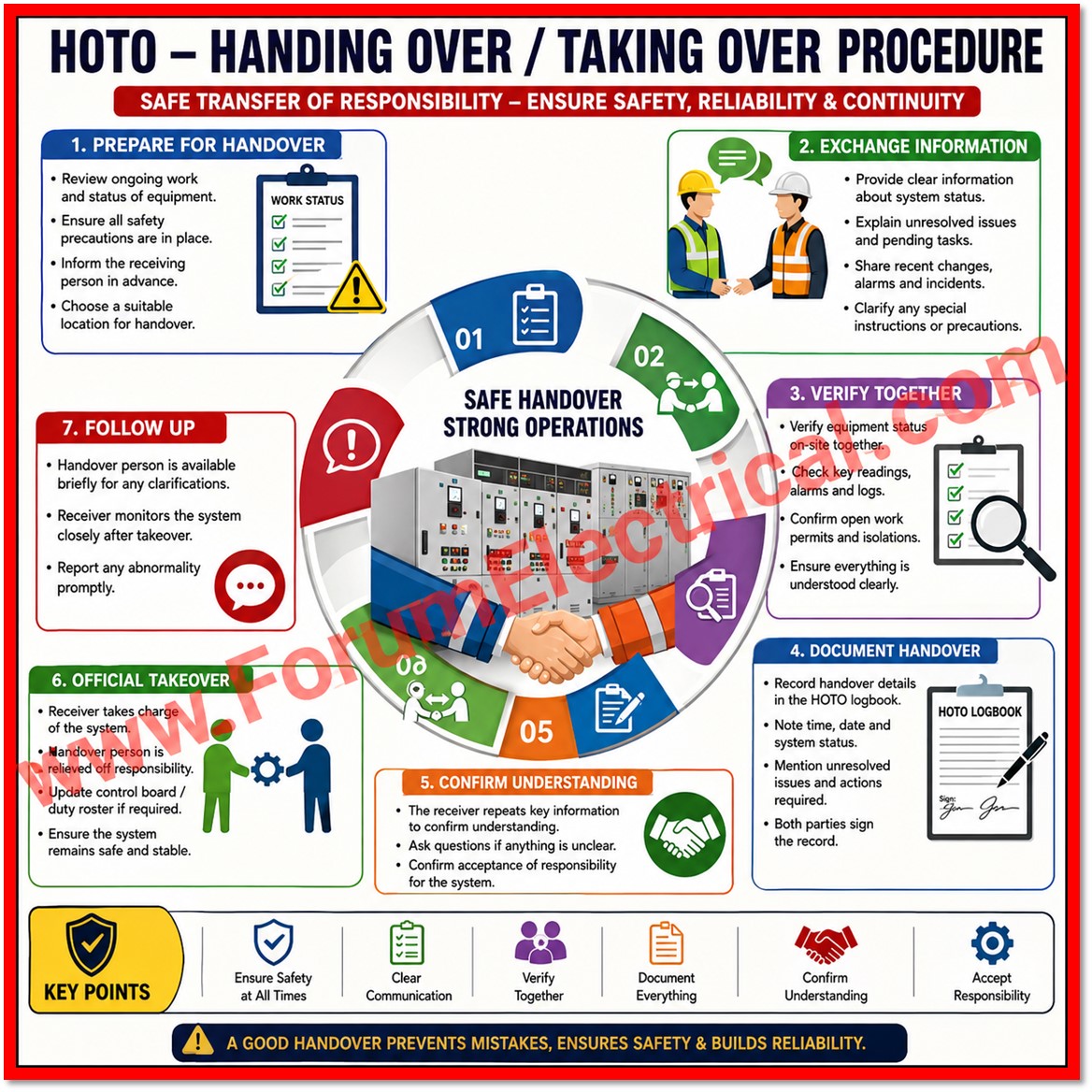
In electrical and solar power projects, HOTO stands for Handing Over and Taking Over.
It is the formal procedure through which completed work, equipment, systems, documents and responsibilities are transferred from the contractor or EPC (Engineering, Procurement and Construction) team to the client, the Operation & Maintenance (O&M) team or a designated authority.
HOTO marks the formal boundary between the construction phase and the operational phase of a project and it protects both parties by clearly establishing what has been delivered, what has been verified and from which date operational responsibility starts.
Purpose
The HOTO procedure serves several important objectives that protect the interests of both the contractor and the client.
These objectives are:
- Confirm that the work has been completed as per approved drawings and specifications.
- Verify that all the required inspections & tests have been completed.
- Transfer responsibility for the completed system from the contractor to the client/O&M team.
- Ensure all defects & punch points are closed (or) formally recorded with a plan for closure.
- Transfer technical documents and test records necessary for future operation and maintenance.
- Establish the date from which O&M responsibility starts which is also typically the reference date for warranty and performance guarantee periods.
HOTO Procedure
HOTO is not a single event but the final step of a structured sequence that begins at construction and ends with the system entering the O&M phase.
Each stage in this sequence must be completed and verified before moving to the next ensuring that nothing is handed over prematurely or without adequate verification.
Construction → Inspection → Testing → Commissioning
Punch Point Closure → Documentation → HOTO → O&M
Each stage builds upon the previous one.
Construction work is first physically completed after which it is subjected to inspection against approved drawings & standards.
Testing then verifies the electrical & mechanical performance of the installed systems.
Commissioning confirms that the system operates as intended under live conditions.
Any deficiencies identified along the way are logged as punch points which must be closed or formally accepted before proceeding.
Once documentation is compiled and verified the HOTO itself takes place after which the system formally enters the O&M phase.
Important Documents for HOTO
A complete and well organized documentation package is one of the most critical components of a successful HOTO.
These documents provide the O&M team with the technical basis required to operate, maintain, and troubleshoot the system and they also serve as the official record of the condition of the asset at the time of transfer.
| Document | Purpose / Description |
|---|---|
| Approved As-Built Drawings | Reflect actual constructed layout and routing |
| Inspection Test Plan (ITP) | Defines inspection/hold/witness points and acceptance criteria |
| Inspection Reports | Records of stage-wise inspections carried out |
| Test Reports (General) | Consolidated results of all field and factory tests |
| IR / Megger Test Reports | Insulation resistance of cables and equipment |
| Continuity Test Reports | Verification of conductor continuity |
| Cable Test Reports | HV/LV cable testing prior to energisation |
| Transformer Test Reports | Ratio, winding resistance, oil tests, etc. |
| Relay Testing Reports | Protection relay settings and functional checks |
| CT/PT Test Reports | Current and potential transformer accuracy/ratio tests |
| VCB/Switchgear Test Reports | Vacuum circuit breaker and switchgear functional tests |
| Earthing & Earth Resistance Reports | Soil/earth pit resistance values |
| Torque Reports | Bolt/connection torque values as per specification |
| Cable Route/Layout Drawings | Physical routing of cables across the site |
| Equipment Datasheets & Manuals | OEM technical data and O&M instructions |
| Calibration Certificates | Instrument/meter calibration traceability |
| Manufacturer Test Certificates (MTC) | Factory-issued material/equipment certificates |
| Warranty Certificates | Equipment and workmanship warranty coverage |
| Commissioning Reports | Records confirming successful commissioning |
| Punch-list Closure Records | Evidence of punch point rectification/closure |
| O&M Manuals | Operating and maintenance procedures |
| Spare-parts List | Recommended spares with part numbers |
| Training Records | Evidence of O&M team training/handover briefing |
HOTO in a Solar Power Plant
For a solar power plant HOTO is typically carried out system by system, since each subsystem has its own construction, testing and inspection requirements.
The following systems are commonly covered under a solar plant HOTO:
- PV module and mounting structure
- DC cable
- MC4 connector
- String Combiner Box (SCB)
- Inverter
- AC cable
- Transformer
- HT panel / VCB
- SCADA system
- Weather Monitoring System (WMS)
- Earthing and lightning protection
- Auxiliary power system
- Metering yard
- Switchyard
- Transmission Line (TL)
Site Verification before HOTO
Before signing the HOTO, the client (or) O&M team normally carries out a structured site verification.
This verification generally follows the sequence below as
Physical Condition → Workmanship → Safety → Testing → Documentation → Punch Points
Particular attention should be given to the following items, since these are the most common sources of long term operational and safety issues if not properly verified:
- Proper cable laying and dressing
- Correct cable termination and lug crimping
- Tightness/torque of electrical connections
- Proper earthing connections
- Cable identification and ferruling
- Warning/caution tape and route markers
- Equipment labels
- Panel cleanliness
- Proper gland and sealing
- Availability of fire and safety equipment
- No exposed/live hazardous parts
- Correct equipment ratings
Punch Point
Any incomplete or defective work identified during inspection or site verification is recorded as a punch point.
Punch points must be tracked to closure and each one should be assigned a responsible party and, where applicable, a target completion date.
Common punch points observed on electrical and solar projects include:
| Punch Point | Description |
|---|---|
| Improper lug crimping | Loose or badly formed cable lugs at termination points |
| Missing cable tags / ferruling | Cables not identified per drawing/cable schedule |
| Loose termination | Electrical connections not torqued to specification |
| Damaged cable sheath | Physical damage to cable insulation/outer jacket |
| Missing warning tape | Underground cable route not marked with warning/caution tape |
| Incomplete earthing | Earthing connections not fully installed or tested |
| Missing equipment labels | Panels, boxes or equipment not labelled as per standard |
| Pending test report | Required test (IR, continuity, earth resistance, etc.) not submitted |
| Drawing not updated | As-built drawing does not reflect actual site condition |
| Oil leakage from transformer | Visible oil seepage from transformer body, valves or radiators |
The HOTO record should clearly identify, for every punch point, whether it is closed, pending (or) accepted with a defined target completion date.
Equipments accepted with a pending closure date should be tracked separately even after HOTO is signed to ensure they are not forgotten once the O&M phase begins.
HOTO Certificate
After satisfactory verification of physical condition, workmanship, safety, testing, and documentation, and after all punch points have been closed (or) formally accepted, both parties sign a HOTO Certificate (or) HOTO Protocol.
This certificate confirms that the specified system, equipment, or project has been formally handed over by the contractor/EPC and taken over by the client/O&M team and it establishes the effective date from which O&M responsibility, and typically the warranty period gets started.
In summary HOTO can be understood through the following equation:
HOTO = Technical Completion + Testing + Documentation + Punch-Point Closure + Transfer of Responsibility
A well executed HOTO procedure reduces the risk of disputes, protects warranty entitlements and gives the O&M team a complete and reliable technical foundation to safely and effectively operate the plant for the duration of its operational life.

