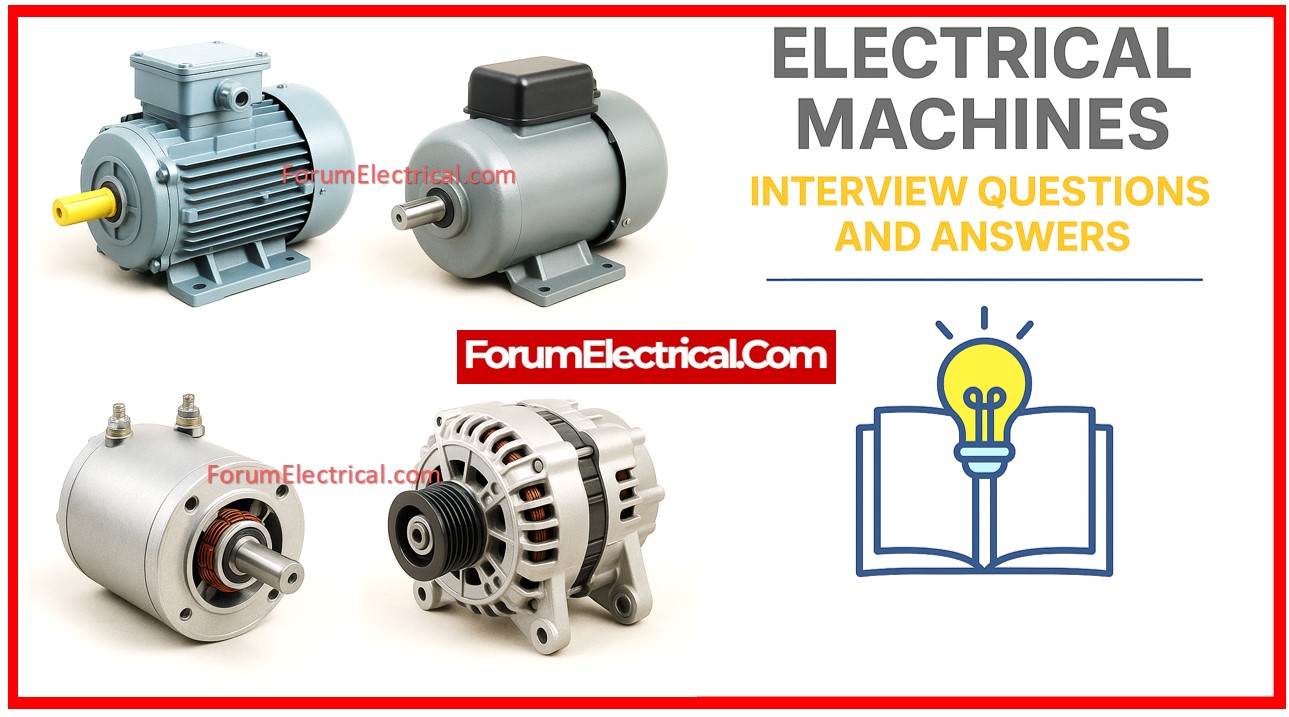
1). What is an Electrical Machine?
A device that converts electrical energy into mechanical energy (motors), motors that convert mechanical energy into electrical energy (generators), or transformers that transfer electrical energy from one circuit to another is referred to as an electrical machine.
Static machines, also known as transformers, and rotating machines, which include
- Motors and
- Generators,
are the two primary categories.
2). What is the difference between Motor and Generator?
| Parameter | Motor | Generator |
| Function | Converts electrical energy into mechanical energy | Converts mechanical energy into electrical energy |
| Output | Torque & rotation | Voltage & current |
| Example Use | Fans, pumps | Power plants |
3). What are the types of Electrical Machines?
- Transformers (static machines).
- Rotating Machines:
- AC machines include induction and synchronous motors.
- DC machines include DC motors and generators.
4). Explain the working principle of a Transformer
A transformer depends on Faraday’s Law of Electromagnetic Induction.
When an alternating current passes through the primary coil, it generates a magnetic flux that connects to the secondary coil through a magnetic core, producing voltage in the secondary coil without requiring a direct electrical connection.
5). Why is the transformer rated in kVA not kW?
Transformer losses are based on
- Voltage (core loss) &
- Current (copper loss), not the load power factor.
As a result, the rating in kVA is used to describe the apparent power without taking consideration of power factor.
6). What is the EMF equation of a Transformer?
E = 4.44×f×N×Φ
Where
E – Induced EMF
f – Frequency (Hz)
N – The number of turns
Φ – Maximum flux in Weber.
7). What are Hysteresis & Eddy Current Losses?
Hysteresis Loss: The amount of energy wasted as the magnetization reverses.
Eddy Current Loss: Loss refers to the circulation of currents in the core caused by changing magnetic fields. Mitigated with CRGO steel & laminated cores.
8). What’s the difference between Induction and Synchronous Motors?
| Induction Motor | Synchronous Motor |
| < Ns | = Ns |
| Self-starting Motor | Not self-starting |
| Has Squirrel cage/slip ring rotor | Has Salient/non-salient rotor |
9). Explain the operation of a 3-phase induction motor
A three-phase supply generates a rotating magnetic field (RMF) in the stator. The rotor conductors cut the field, inducing current (by Faraday’s Law), which interacts with the RMF to generate torque (via Lenz’s Law).
10). What is slip in an induction motor?
Slip refers to the difference between synchronous speed (Ns) & rotor speed (Nr).
S= [(Ns−N r)/Ns] x 100 %
11). Why is the induction motor self-starting?
The stator’s revolving magnetic field causes EMF in the rotor, resulting in rotor current and torque during startup, making the motor self-starting.
12). Explain the Torque-Slip characteristics
- At low slip, torque increases approximately linearly.
- At critical slip, maximum torque (or) breakdown torque.
- Torque drops cause instability.
- Used to evaluate motor performance under the load.
13). What is Starting Torque?
Starting torque is the torque a motor produces at zero speed.
Important for applications such as compressors, cranes, and conveyors.
14). How does the Star-Delta starter work?
Start in Star:
Voltage = 1/√3 × Line Voltage = Low Current.
Then switch to Delta mode: full voltage & torque for running.
Used to minimize inrush current in motors with more than 5 HP.
15). What is Synchronous Speed?
Ns = 120 x f/P
Where:
f – Frequency (Hz)
P – The number of poles.
16). What is the relationship between the number of poles & speed?
- Higher number of poles = lower speed.
- Lower number of poles = higher speed.
This is essential for motor selection in the speed control applications.
17). What is the back EMF in a DC motor?
As the motor turns, the armature cuts magnetic flux, creating a voltage (EMF) opposite to the supply, known as back EMF (Eb).
It regulates armature current and guarantees proper operation.
18). Why is a Commutator employed in DC Machines?
The commutator converts the induced AC in the armature winding to unidirectional (DC) current at the terminals. It also provides torque in one direction.
19). Describe the operation of a DC Generator.
The process is as follows: mechanical energy rotates the armature, cutting the flux. EMF is then induced in coils, converted to DC by the commutator, and collected by brushes.
20). What are the different types of DC motors?
- Shunt Motor have Constant Speed,
- Series motors have high starting torque,
- Compound motor ensures balanced performance.
21). What is the armature reaction in a DC Machines?
Armature current causes distortion of the primary field flux, resulting in sparking, poor commutation, and lower performance.
22). Where are Synchronous Machines utilized?
- Alternators in power plants.
- Constant-speed drives
- Power factor correction (synchronous condensers).
23). What are the advantages of Brushless DC motor (BLDC)?
- High efficiency.
- Reduced maintenance (no brushes)
- Accurate speed control
- Used in electric vehicles (EVs), fans, drones, and robots.
24). How is the efficiency of an Electrical Machine calculated?
η = (Output Power / Input Power) X 100
High efficiency is accomplished by reducing losses and utilizing high-quality materials.
25). What are the conditions for a Transformer’s Maximum Efficiency?
Maximum efficiency occurs when
Copper Loss = Iron Loss
This is utilized in transformer designs to optimize the load.

