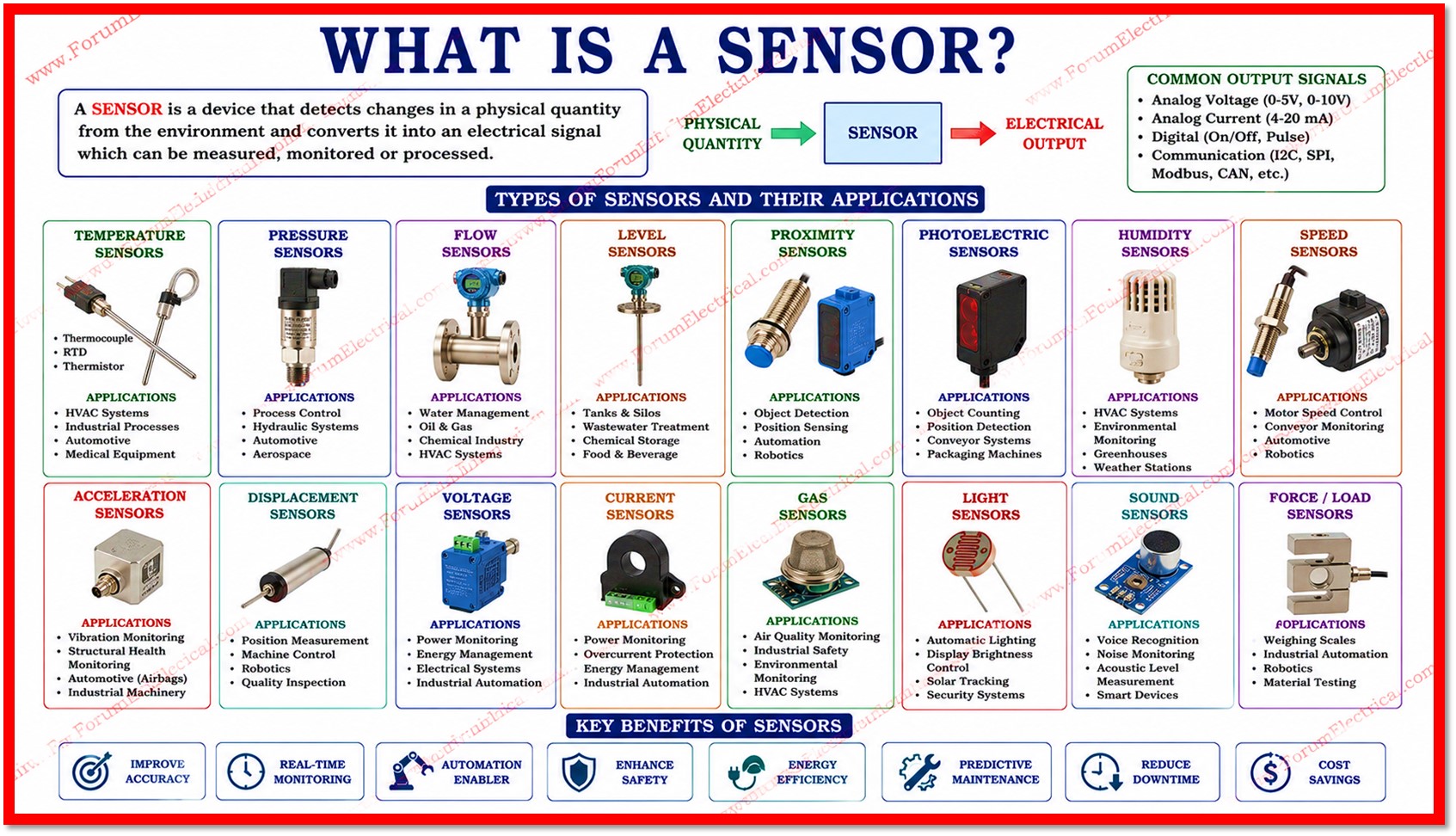
In today’s rapidly evolving industrial landscape sensors have become the most important one of every automated system.
- What is a Sensor?
- Why Sensors are important?
- Types of Sensors
- 1). Temperature Sensors (RTD, Thermocouple)
- 2). Current and Voltage Sensors
- 3). Proximity Sensors
- 4). Pressure and Flow Sensors
- 5). Level Sensors
- 6). Humidity Sensors
- 7). Vibration Sensors
- 8). Speed Sensors
- 9). Gas Sensors
- Applications in Power Systems and Automation
- What is the main purpose of a Sensor?
- Do sensors use AC or DC?
- Conclusion
From massive power generation plants to compact home appliances, sensors quietly work behind the scenes, gathering real time data and translating physical phenomena into electrical signals that machines and controllers can understand.
For electrical engineers a solid grasp of sensor technology is not just useful it is essential for designing safe, efficient and reliable systems.
This post explores the sensor and their major types of sensors used across industries & how each one contributes to safer, smarter and more efficient operations.
What is a Sensor?
A sensor is a device that detects and responds to a physical input such as
- Temperature,
- Pressure,
- Light &
- Motion (or) flow
and converts that input into an electrical signal that can be measured, recorded (or) used to trigger an action.
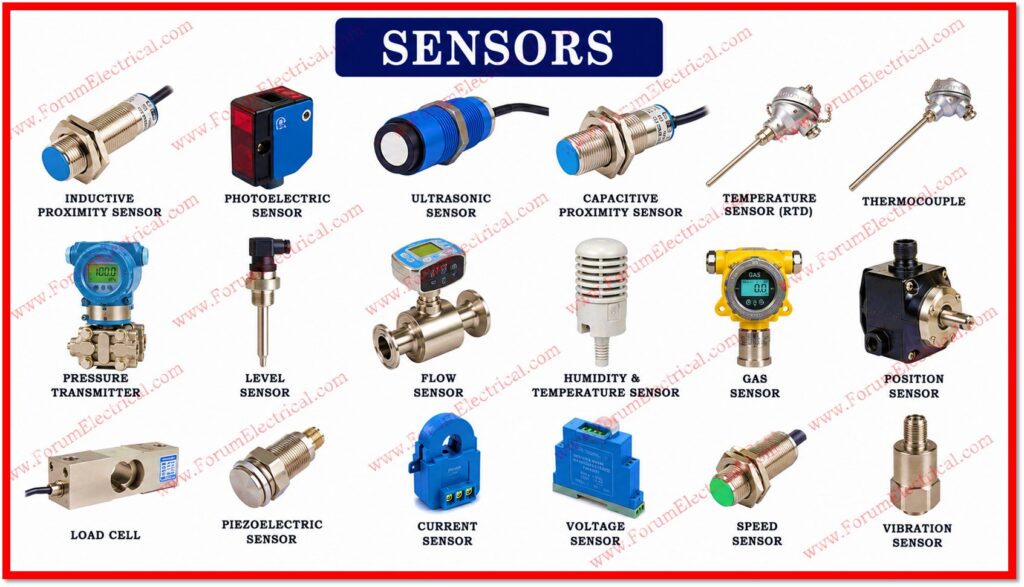
A sensor acts as the interface between the physical world and electrical (or) electronic control systems.
In electrical engineering, sensors are the foundation of
- Automation,
- Protection and
- Monitoring systems.
They feed continuous data to
- Controllers,
- Programmable Logic Controllers (PLCs),
- Supervisory Control and Data Acquisition (SCADA) systems and
protective relays allowing engineers to monitor equipment health that optimize performance and prevent failures before they occur.
Why Sensors are important?
Sensors are fundamental components of modern electrical systems and industrial automation.
They enable
- Real time monitoring,
- Control and
protection of equipment assisting industries enhance safety, efficiency, reliability and predictive maintenance capabilities.
Without accurate sensing even the most advanced control systems would be operating blind, unable to respond to changing conditions or detect early warning signs of failure.
By continuously feeding data into control systems sensors allow industries to shift from reactive maintenance that is fixing problems after they occur to predictive maintenance identifying potential issues before they cause downtime.
This shift alone can save organizations significant costs while improving worker safety & equipment longevity.
Types of Sensors
1). Temperature Sensors (RTD, Thermocouple)
Purpose
Temperature sensors, such as Resistance Temperature Detectors (RTDs) and thermocouples, are used to monitor equipment and process temperatures.
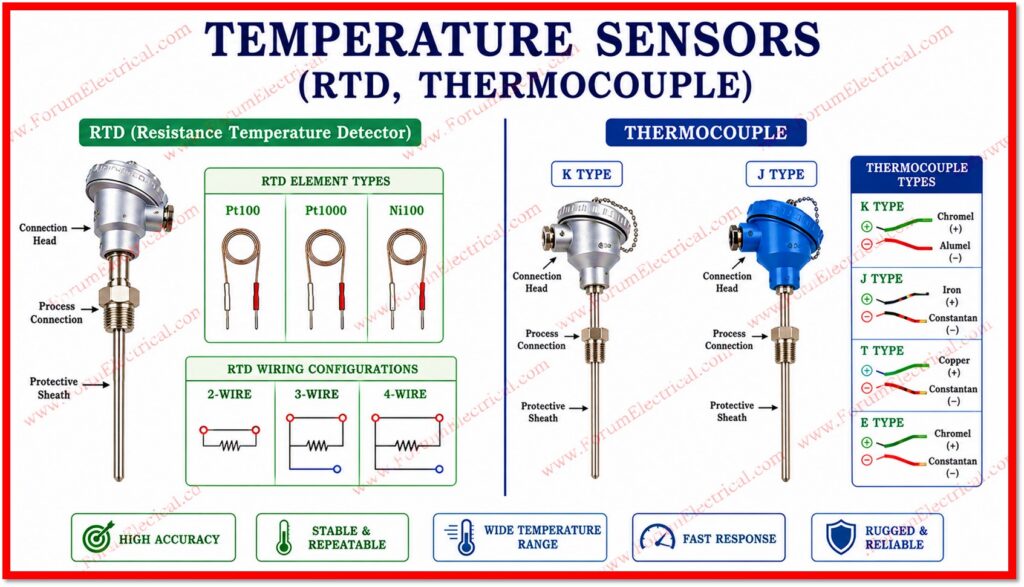
RTDs offer high accuracy and stability making them ideal for accurate applications while thermocouples are valued for their wide temperature range & durability in harsh environments.
Applications
These sensors are important for monitoring
- Transformer windings,
- Motor bearings and
- Process equipment to prevent overheating and thermal damage.
2). Current and Voltage Sensors
Purpose
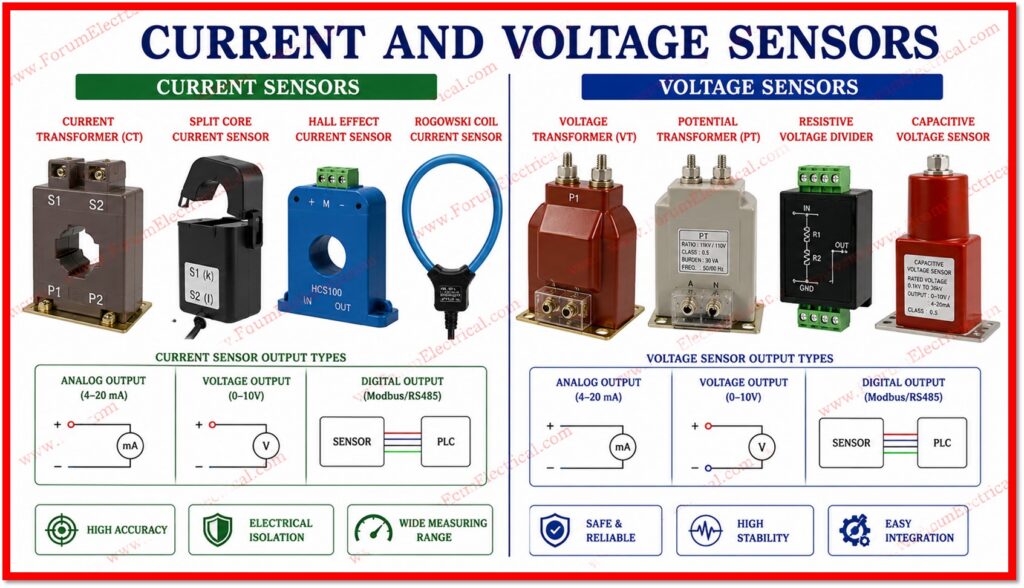
Current and voltage sensors measure the electrical parameters for protection, monitoring and energy management.
Devices such as
- Current transformers (CTs),
- Potential transformers (PTs) and
- Hall-effect sensors
allow engineers to track load conditions, detect faults and ensure that circuit breakers and protective relays respond correctly during abnormal conditions.
Applications
These sensors are indispensable in power distribution panels & energy metering systems.
3). Proximity Sensors
Purpose
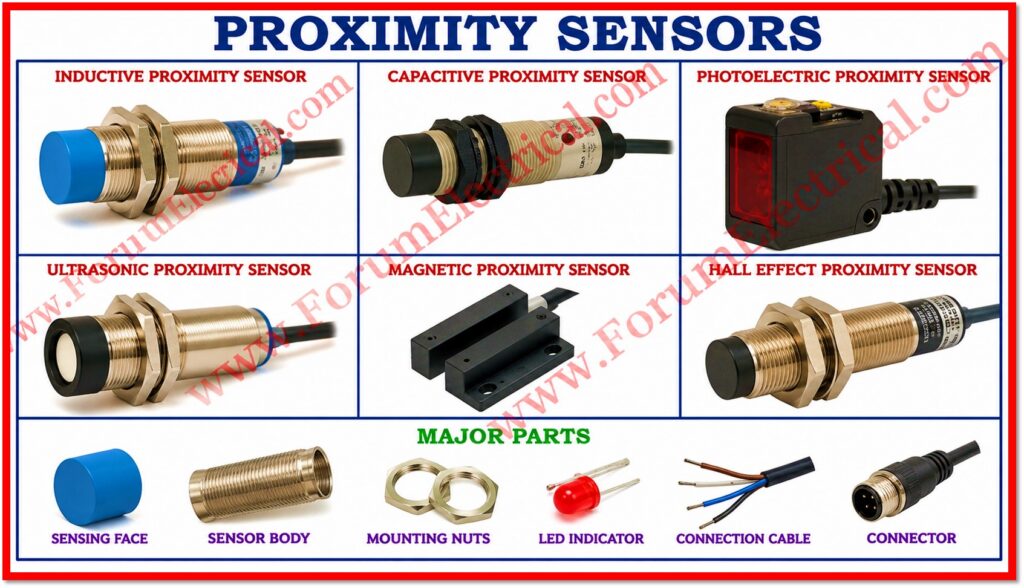
Proximity sensors detect the presence (or) position of objects without physical contact.
Applications
Using technologies like
- Inductive,
- Capacitive (or) ultrasonic sensing these devices
are widely used on conveyor systems, robotic arms, and assembly lines to detect object presence, count components (or) trigger safety interlocks all without the wear and tear associated with mechanical contact switches.
4). Pressure and Flow Sensors
Purpose
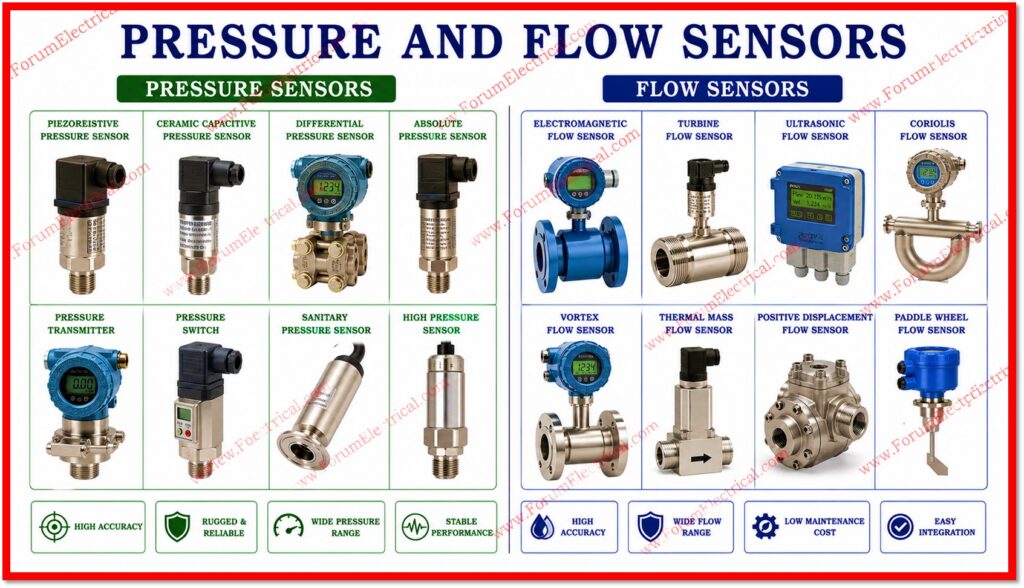
Pressure and flow sensors monitor fluid and gas systems to ensure an optimal performance.
Applications
They are essential in
- Hydraulic systems,
- Boilers, pipelines and
- Cooling systems
where maintaining accurate pressure and flow rates directly impacts safety and efficiency.
These sensors help prevent equipment damage caused by overpressure, cavitation (or) insufficient flow.
5). Level Sensors
Purpose
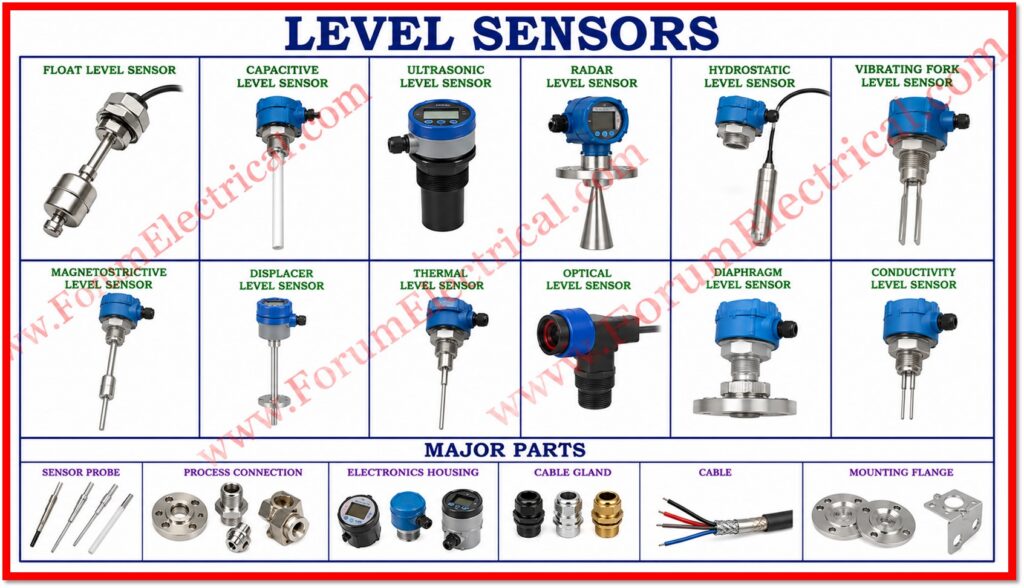
Level sensors measure liquid (or) material levels in
- Tanks,
- Reservoirs and
- Process equipment.
Applications
Using float, ultrasonic (or) capacitive technologies these sensors prevent overflows, dry-running of pumps and interruptions in production caused by inaccurate inventory tracking of raw materials (or) finished products.
6). Humidity Sensors
Purpose
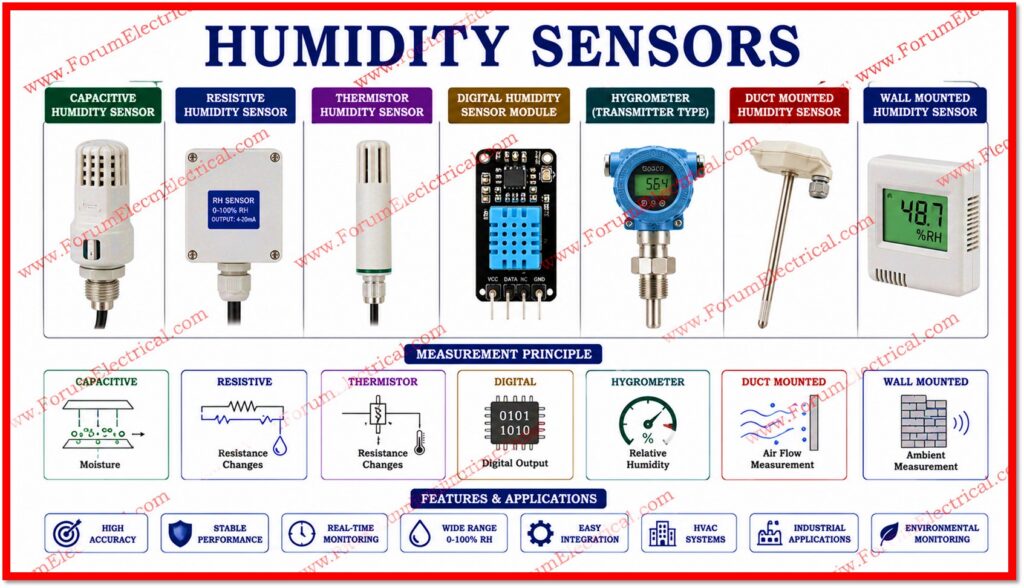
Humidity sensors monitor environmental conditions in industrial and commercial applications.
Applications
7). Vibration Sensors
Purpose
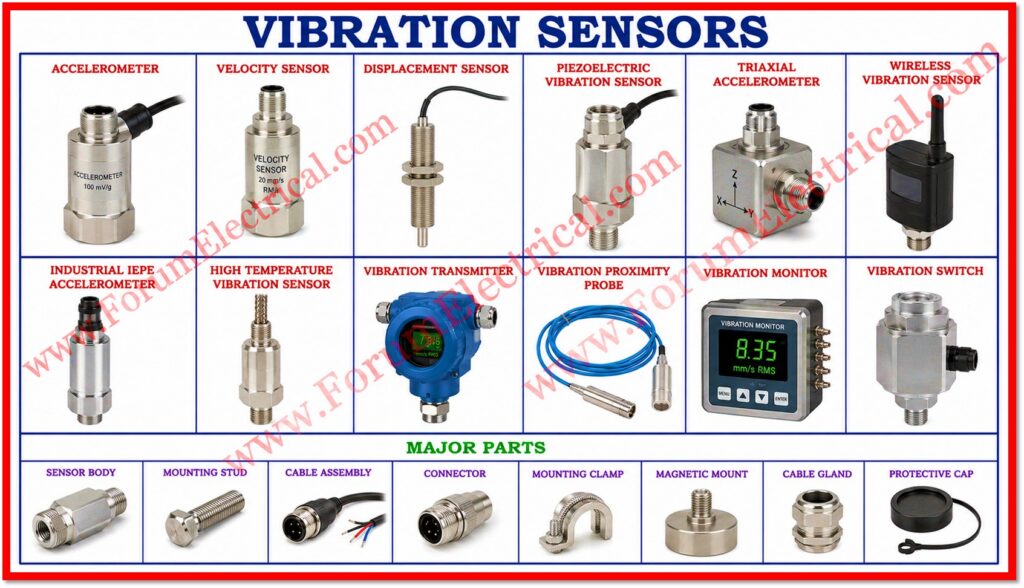
Vibration sensors detect abnormal machine vibrations for condition monitoring and predictive maintenance.
Applications
By continuously analyzing vibration patterns in motors, pumps and rotating machinery these sensors can identify early signs of bearing wear, misalignment (or) imbalance allowing maintenance teams to intervene prior to a minor issue becoming a costly failure.
8). Speed Sensors
Purpose
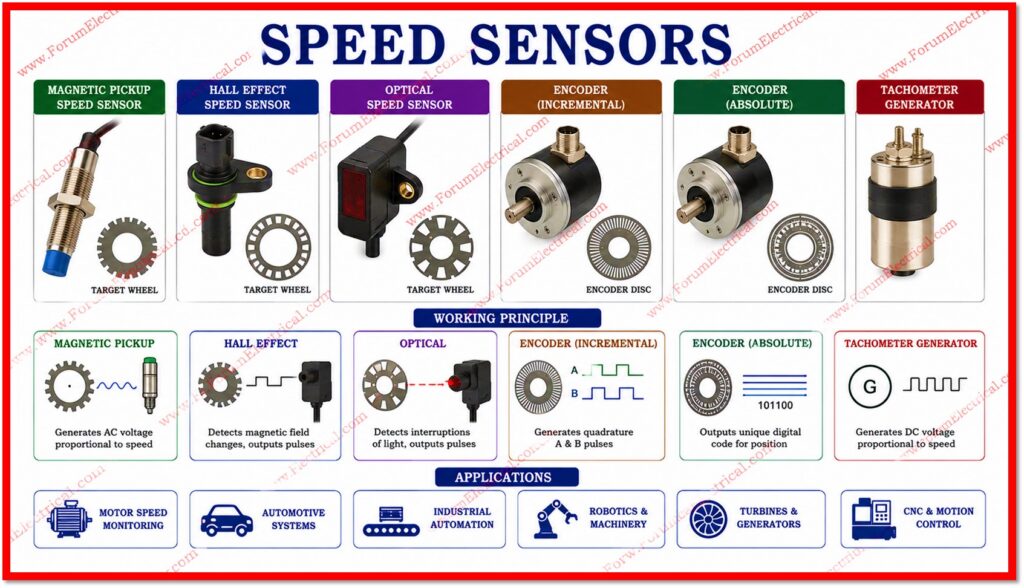
Speed sensors measure rotational (or) linear speed in motors, conveyors and machinery.
Applications
- Encoders,
- Tachometers and
- Hall-effect speed sensors
provide precise feedback used in motor control loops ensuring accurate synchronization, smooth operation and protection against overspeed conditions in industrial drives and automation systems.
9). Gas Sensors
Purpose
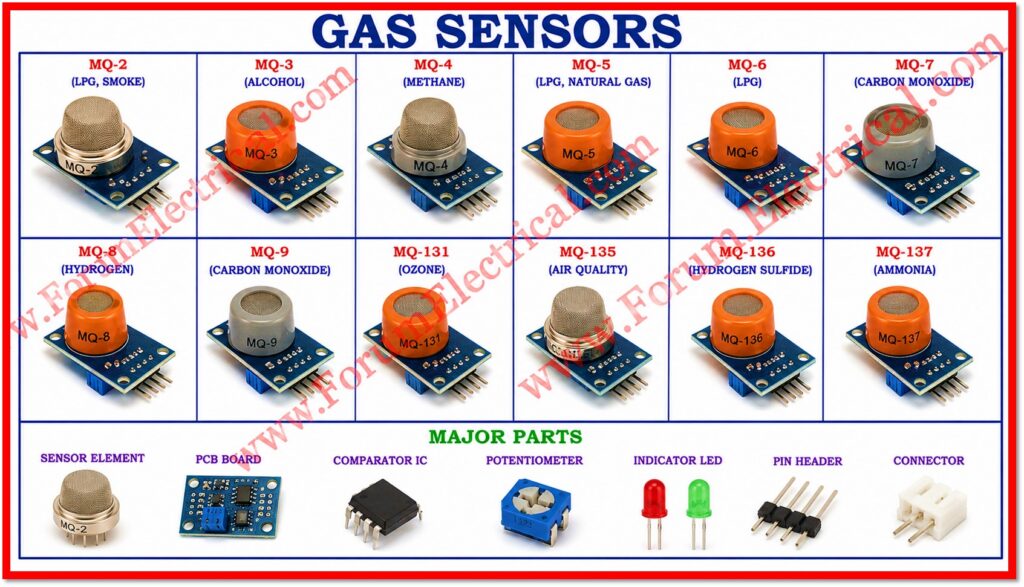
Gas sensors detect hazardous (or) combustible gases to enhance workplace safety.
Applications
Deployed in
- Substations,
- Chemical plants and
- Confined spaces
these sensors provide early warnings of gas leaks helping prevent explosions, fires and health hazards to personnel working in potentially dangerous environments.
Applications in Power Systems and Automation
These sensors assists as important function in
- Power systems,
- Transformers,
- Motors,
- Control panels,
- PLCs and
- Industrial automation processes.
In power systems current and voltage sensors work alongside protective relays to isolate faults within milliseconds preventing cascading failures across the grid.
In transformers,
- Temperature and
- Gas sensors
continuously monitor insulation health helping utilities avoid catastrophic failures and extend asset life.
In motors and drives,
- Speed and
- Vibration sensors
provide the feedback needed for accurate control and early fault detection while in control panels and PLCs, a combination of proximity, level and pressure sensors enables seamless automation of manufacturing and process industries.
What is the main purpose of a Sensor?
The primary function of a sensor is to detect and convert changes in physical or environmental factors (such as temperature, pressure, light or motion) into measurable signals.
This interpretation connects the physical & electronic worlds allowing devices, computers & systems to observe, evaluate and automate their surroundings.
Do sensors use AC or DC?
Although fluxgate sensors can measure both DC and AC currents they are more commonly utilized for DC measurements.
Current measurements can be made using a variety of magneto resistance effects.
Conclusion
Sensors are the most important of modern electrical engineering providing the essential data that keeps industrial systems safe, efficient and reliable.
From temperature and pressure to vibration and gas detection each sensor type serves a unique purpose in protecting equipment & enabling smarter automation.
As industries continue to embrace digital transformation the function of sensors will only increase making them an indispensable part of every electrical engineers toolkit.

