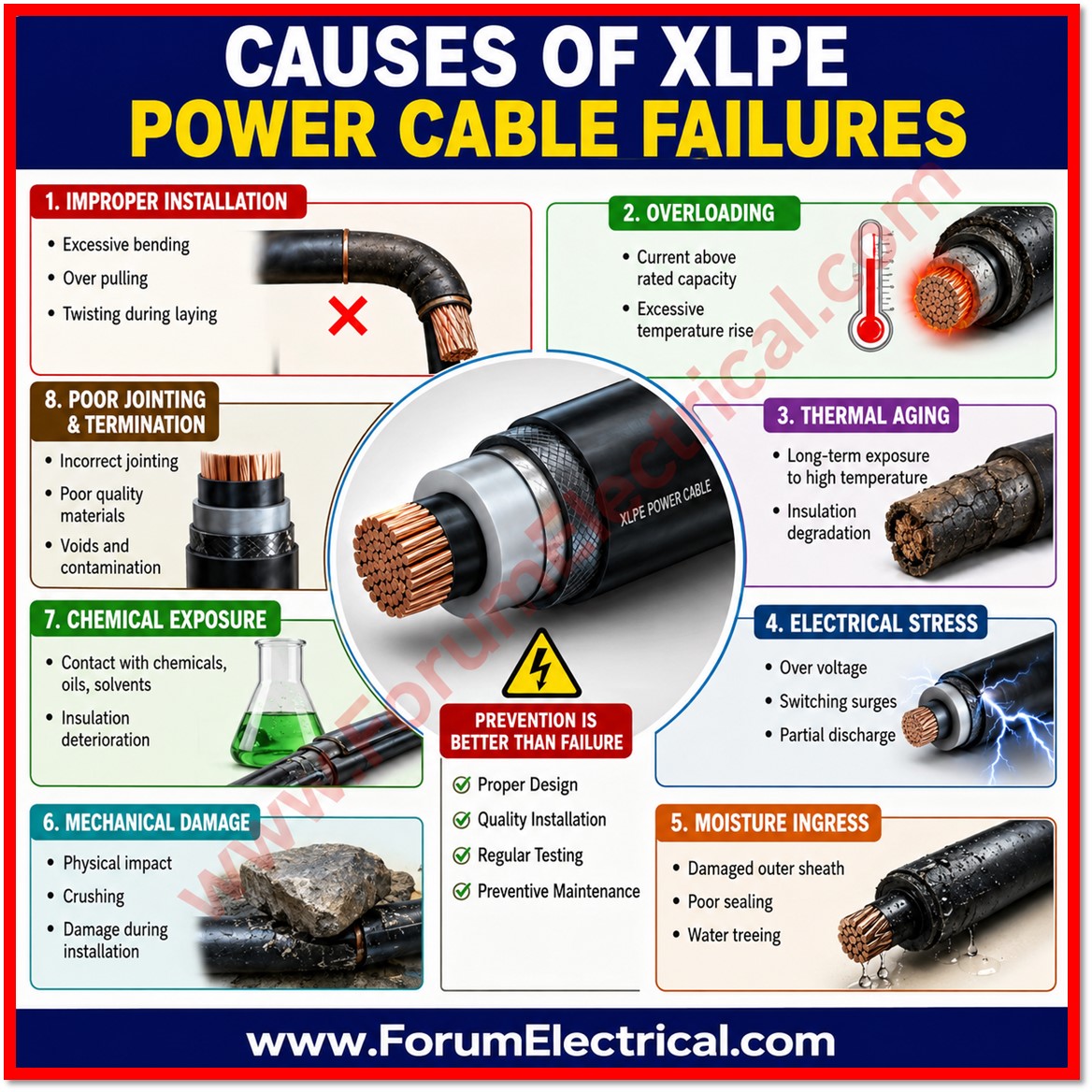
Cross-linked polyethylene (XLPE) insulated power cables are the backbone of modern electrical distribution and transmission networks valued for their excellent dielectric strength, thermal endurance, and mechanical robustness compared to older paper-insulated (or) PVC cables.
Understanding these root causes is essential for utilities, contractors, and asset managers to design, install, and maintain cable systems that achieve their intended service life which typically ranges from 25 to 40 years.
This post presents a detailed technical review of the primary causes of XLPE cable failure, the field symptoms associated with each, and the preventive measures recommended to mitigate them.
Electrical Failures
Electrical stress is one of the most frequent and damaging causes of insulation breakdown in XLPE cables.
Partial discharges (PD) occurring within voids, cavities, or contaminant inclusions in the insulation generate localized ionization events that progressively erode the surrounding polymer.
Over time, this erosion develops into electrical treeing that is branching, tree-like channels that propagate through the insulation wall under the influence of the applied electric field. If left undetected, these trees eventually bridge the conductor and the earthed screen, resulting in complete dielectric breakdown. Overvoltages, whether from switching transients, lightning strikes, or system faults, can accelerate this process by imposing stresses well beyond the cable’s design rating.
In the field, electrical failures typically manifest as visible burn marks, punctured insulation (or) carbonized conduction paths, most commonly found within joints and terminations where field grading is most critical.
Preventive maintenance includes routine partial discharge (PD) testing, use of correctly rated and installed terminations and proper stress-grading materials to control the electric field distribution at cable accessories.
Thermal Failures
Thermal failures arise when a cable operates above its rated temperature for sustained periods either due to excessive load current (or) inadequate heat dissipation from the surrounding environment.
XLPE insulation is rated for continuous operation at 90°C conductor temperature, and repeated (or) prolonged excursions beyond this limit accelerate thermal aging, oxidation, and a gradual loss of mechanical and dielectric strength.
Poor cable spacing in ducts or trenches, overloaded circuits, and inadequate derating for grouped installations are common contributing factors. Field evidence of thermal failure includes discoloration (or) visible melting of the insulation, softened or deformed cable jackets and burnt (or) carbonized semi-conducting screens at the conductor and insulation interfaces.
To prevent thermal failures, cables should be correctly sized for the expected load, installed with appropriate spacing and derating factors, and periodically monitored using infrared thermography to detect abnormal hot spots before they progress to failure.
Mechanical Damage
Mechanical damage is frequently introduced during cable handling, transportation, installation (or) backfilling operations, rather than during normal service. Excessive pulling tension, bending the cable tighter than its specified minimum bending radius, or subjecting it to impact from sharp objects, heavy machinery or improperly compacted backfill material can crush the insulation or create micro-cracks in the outer sheath.
These defects cannot cause immediate failure but instead create pathways for moisture ingress, setting the stage for long-term degradation such as water treeing.
Preventive measures include careful handling procedures during transport and laying, strict adherence to the manufacturer’s minimum bending radius requirements, and the use of mechanical protection such as sand bedding, protective tiles, or warning tapes above the cable route to reduce the risk of future third-party damage.
Moisture Ingress and Water Treeing
Water treeing is a slow, insidious degradation mechanism unique to polymeric cable insulation.
It occurs when moisture penetrates through a damaged outer sheath, a compromised termination (or) a poorly sealed joint and comes into contact with the XLPE insulation under electrical stress.
Over years of service, this combination of moisture and electric field gives rise to microscopic, branch-like channels known as water trees, which progressively reduce the local dielectric strength of the insulation. Although water trees grow slowly and may not cause immediate failure, they significantly lower the breakdown voltage margin and can eventually convert into fast-growing electrical trees, leading to sudden failure.
Effective defenses against water treeing include the use of longitudinally and radially moisture-sealed cable designs, correctly installed joint kits with adequate sealing and regular sheath integrity testing to detect breaches before significant moisture ingress occurs.
Chemical and Environmental Degradation
XLPE cables installed in harsh industrial, coastal (or) chemically aggressive environments face accelerated degradation of their outer sheath due to exposure to ultraviolet (UV) radiation, ozone, industrial oils, solvents, and acidic (or) alkaline soil conditions.
UV exposure causes photo-oxidative embrittlement of unprotected jacket materials while chemical attack can soften, swell (or) crack the sheath that is compromising its role as a barrier against moisture and mechanical damage.
In coastal areas, salt-laden atmospheres can also accelerate corrosion of metallic armor and screens.
The recommended mitigation is the selection of UV-stabilized and chemical-resistant sheath compounds appropriate to the specific installation environment along with periodic visual inspection of exposed cable runs to identify early signs of surface degradation.
Joint and Termination Failures
Any of these defects can create localized regions of enhanced electrical stress, initiating partial discharge activity that progressively erodes the insulation until breakdown occurs.
Because joints and terminations are engineered to manage the electric field transition at the cut end of the cable, even minor assembly errors can have an outsized impact on long-term reliability.
Prevention relies on the use of trained and certified jointers, strict adherence to manufacturer-specified installation procedures, maintenance of a clean and controlled working environment during assembly and mandatory post-installation testing to confirm the integrity of the completed joint or termination.
Summary of Failure Modes
The table below summarizes the principal failure modes discussed in this review together with their primary causes and characteristic field indications.
| Failure Mode | Primary Cause | Field Indication |
| Electrical | Partial discharge, treeing, overvoltage. | Burn marks, punctured insulation, carbonized paths. |
| Thermal | Overcurrent, poor heat dissipation. | Discolored/melted insulation, burnt semi-con screens. |
| Mechanical | Improper handling, tight bends, impact. | Crushed insulation, cracks, moisture ingress points. |
| Water Treeing | Moisture ingress via damaged sheath/terminations. | Branch-like microscopic channels in XLPE. |
| Chemical/Environmental | UV, ozone, oil, acid exposure. | Sheath deterioration, embrittlement, cracking. |
| Joint/Termination | Poor workmanship, contamination, air gaps. | Localized PD, misaligned stress cones, breakdown. |
Preventive Measures and Best Practices
A comprehensive maintenance and quality-assurance program is the most effective safeguard against premature XLPE cable failure.
The following practices, drawn from industry experience, are recommended as a baseline for utilities and industrial cable owners:
- Use trained and certified personnel for all jointing and termination work.
- Ensure correct cable sizing & suitable installation conditions including proper derating for grouped or duct-bank installations.
- Conduct periodic Very Low Frequency (VLF) withstand, Tan Delta & Partial Discharge (PD) testing to assess insulation condition.
- Maintain sheath integrity and effective moisture barriers via regular sheath fault testing.
- Monitor thermal loading utilizing infrared thermographic scans to detect hot spots at joints, terminations & along cable routes.
- Follow manufacturer installation instructions meticulously including bending radius, pulling tension & accessory assembly procedures.
Conclusion
XLPE power cable failures rarely result from a single isolated cause; rather, they typically emerge from a combination of electrical stress, thermal loading, mechanical damage, moisture ingress, environmental exposure and workmanship quality at joints and terminations.
A proactive method that combines correct design and material selection, disciplined installation practices, and a structured diagnostic testing regime including PD, Tan Delta, VLF and thermal monitoring which significantly extends cable service life and reduces the risk of unplanned outages.
By addressing each failure mechanism systematically, utilities and industrial operators can achieve the full design life expected from modern XLPE cable systems while minimizing the operational and safety risks associated with unexpected.

