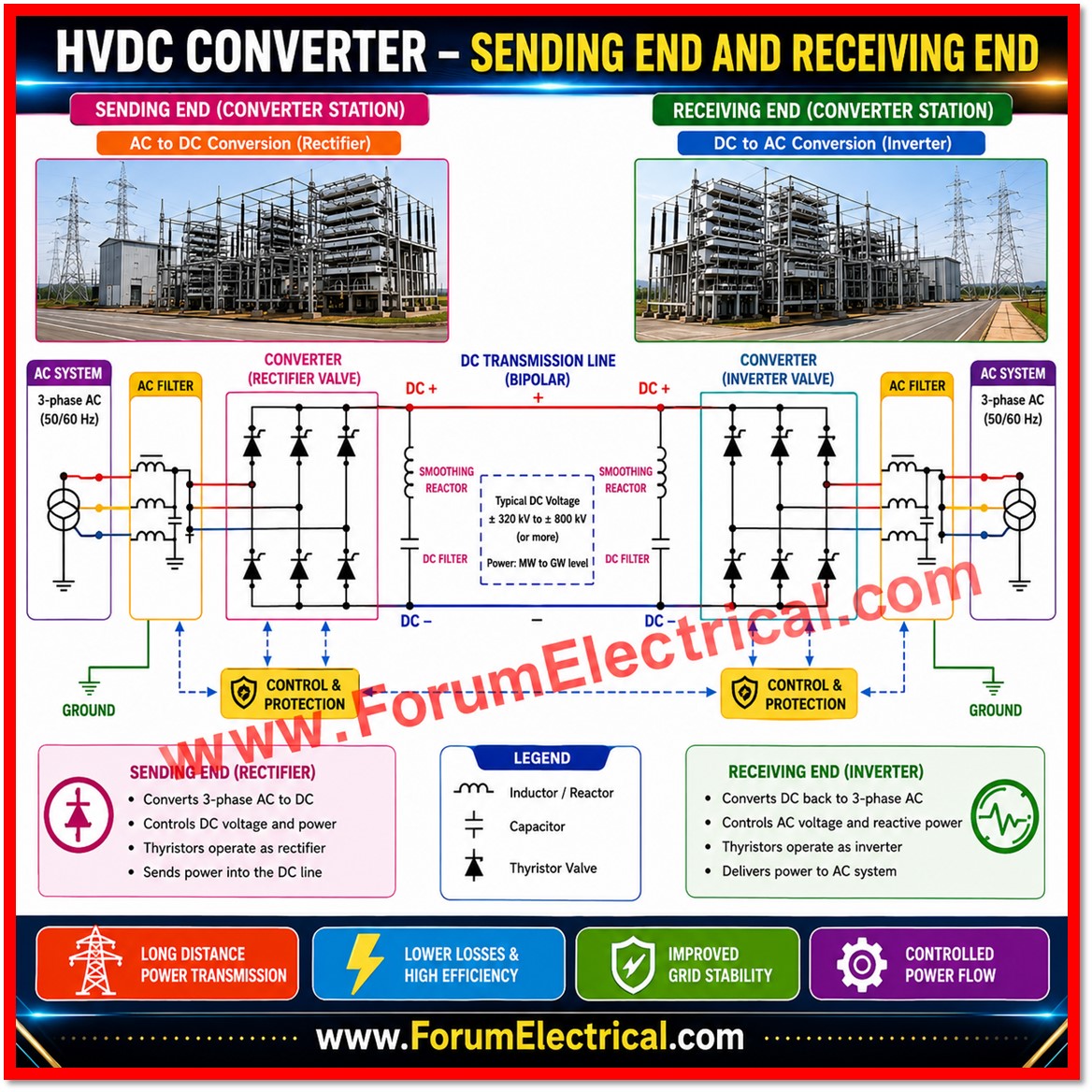
As an increasing electricity demand continues and renewable energy adoption accelerates, High Voltage Direct Current (HVDC) technology has developed as one of the most efficient methods for transmitting bulk power over long distances.
The primary importance of every HVDC transmission scheme depends on the converter station being a sophisticated power electronic facility which is responsible for converting electrical power across alternating current (AC) and direct current (DC).
This post provides a detailed technical overview of HVDC converter stations, their components, operating principles and the technologies that make modern long distance transmission possible.
What is an HVDC Converter?
An HVDC converter is a power electronic system that performs bidirectional conversion between AC and DC power.
Every HVDC transmission link requires 2 converter stations, one at each end of the line working together to move power efficiently across vast distances (or) undersea crossings.
Sending End (Rectifier)
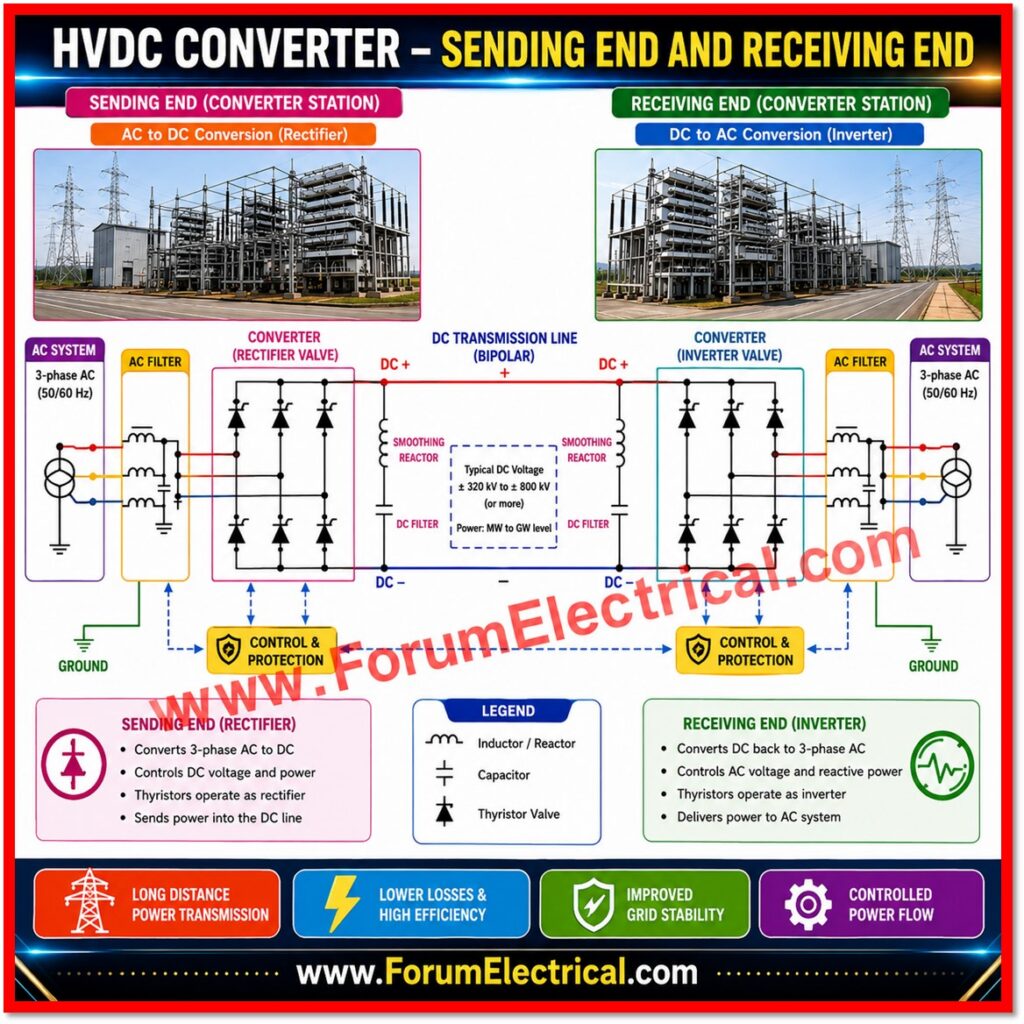
The sending end (rectifier) converts AC power from the source grid into DC for an efficient long distance transmission.
Receiving End (Inverter)
The receiving end (inverter) converts the transmitted DC power back into AC for distribution through the local grid.
Because power can flow in either direction depending on system requirements, each converter station is typically designed to operate as either a rectifier (or) an inverter giving HVDC schemes exceptional operational flexibility.
Components of a Converter Station
A converter station is a complex assembly of electrical and electronic equipment, each performing a specific role in ensuring safe, efficient and stable conversion of power.
Converter Transformer
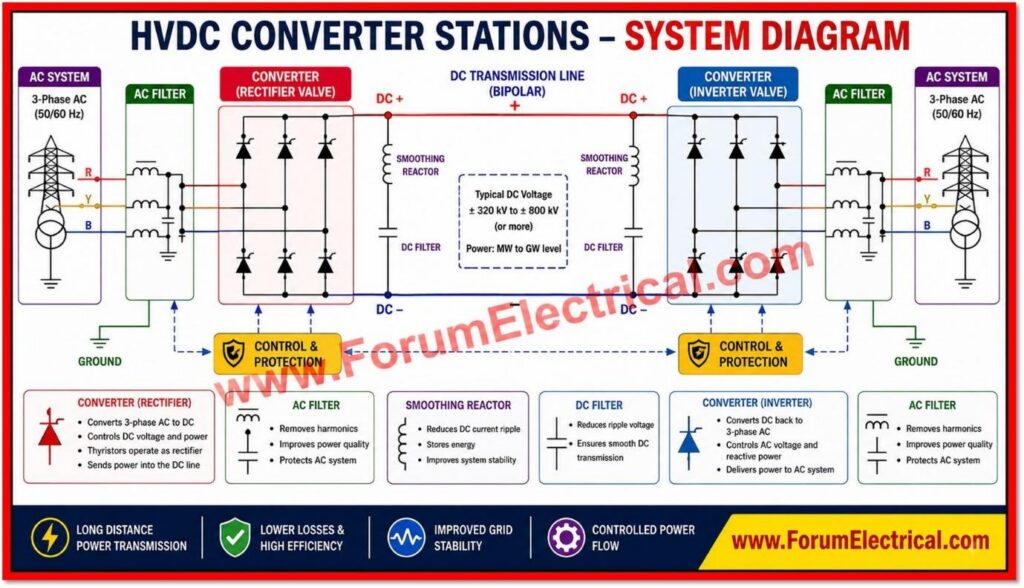
The converter transformer matches voltage levels between the AC grid and the converter provides electrical isolation and reduces harmonics through phase shifting.
Converter Valves
Converter valves are the heart of the converter built using Thyristors in Line Commutated Converter (LCC) systems or IGBTs in Voltage Source Converter (VSC) systems for controlled AC/DC conversion.
AC Filters
AC filters reduce harmonic distortion, improve power quality and supply reactive power support particularly important in LCC systems.
DC Filters
DC filters minimize DC side harmonics and prevent interference with nearby communication systems.
Smoothing Reactor
Smoothing reactor reduces current ripple on the DC side and limits fault current and improves overall system stability.
Reactive Power Compensation
Reactive power compensation employs capacitor banks, Static VAR Compensators (SVCs), STATCOMs (or) synchronous condensers to support voltage and supply reactive power.
Control and Protection System
The control and protection system continuously monitors voltage, current, frequency and power flow and triggers protective action during fault conditions to ensure safe and reliable operation.
How does an HVDC Converter Station Works?
Sending-End Converter (Rectifier)
- Receives 3 phase AC power from the connected grid.
- The converter transformer adjusts the voltage to the level needed by the valves.
- AC filters remove unwanted harmonics generated during the process of conversion.
- Converter valves convert the AC waveform into high voltage DC.
- A smoothing reactor stabilizes the DC current and limits ripple.
- DC power is then transmitted over overhead lines, underground cables (or) submarine cables with significantly lower transmission losses than AC.
Receiving-End Converter (Inverter)
- Receives the high voltage DC power delivered from the sending end.
- A smoothing reactor stabilizes the incoming DC current.
- Converter valves convert the DC back into AC synchronized with the receiving grid.
- AC filters used to improve the power quality of the output waveform.
- The converter transformer matches the required voltage to that of the local distribution grid.
- Clean & synchronized AC power is finally delivered to consumers.
HVDC Technologies: LCC vs. VSC
2 primary principal converter technologies are used in modern HVDC schemes each suited to different transmission requirements.
The table below summarizes their key characteristics.
| Feature | LCC-HVDC | VSC-HVDC |
|---|---|---|
| Switching device | Thyristors | IGBTs |
| Grid requirement | Requires a strong AC network. | Operates with weak grids. |
| Power/reactive control | Coupled and needs external reactive support. | Independent active and reactive power control. |
| Converter losses | Lower converter losses. | Relatively higher switching losses. |
| Typical application | Very high power and long distance bulk transmission. | Offshore wind and renewable energy integration. |
LCC-HVDC (Line Commutated Converter) systems depend on thyristor valves and are the traditional choice for very high-power, point-to-point bulk transmission over long distances.
They need a strong AC network to commute the valves and provide relatively low converter losses that make them ideal for large scale interconnections such as continental bulk power corridors.
VSC-HVDC (Voltage Source Converter) systems based on IGBT technology, represent the more modern methods.
They can operate with weak (or) even passive AC grids providing an independent control of active and reactive power and are especially well suited to offshore wind farm integration and multi-terminal DC grids where flexibility and compact converter station footprints are essential.
Why HVDC?
HVDC transmission provides a range of technical and economic advantages over conventional AC transmission particularly for long distance and specialized applications:
- Lower transmission losses over long distances.
- Higher power transfer capability per conductor.
- Precise, fast control of power flow direction & magnitude.
- Improved grid stability & damping of the power oscillations.
- Ability to interconnect asynchronous grids operating at different frequencies.
- Ideal for long-distance overhead, underground and submarine transmission.
- Strong support for large scale renewable energy integration including offshore wind.
Conclusion
Converter stations are the primary stations of every HVDC transmission system enabling the seamless, efficient and controllable exchange of power between AC and DC networks.
As power systems worldwide evolve to accommodate higher renewable energy penetration, longer transmission corridors and interconnected asynchronous grids, the function of HVDC converter stations whether based on mature LCC technology or the increasingly popular VSC technology will only continue to improve as per their importance.

