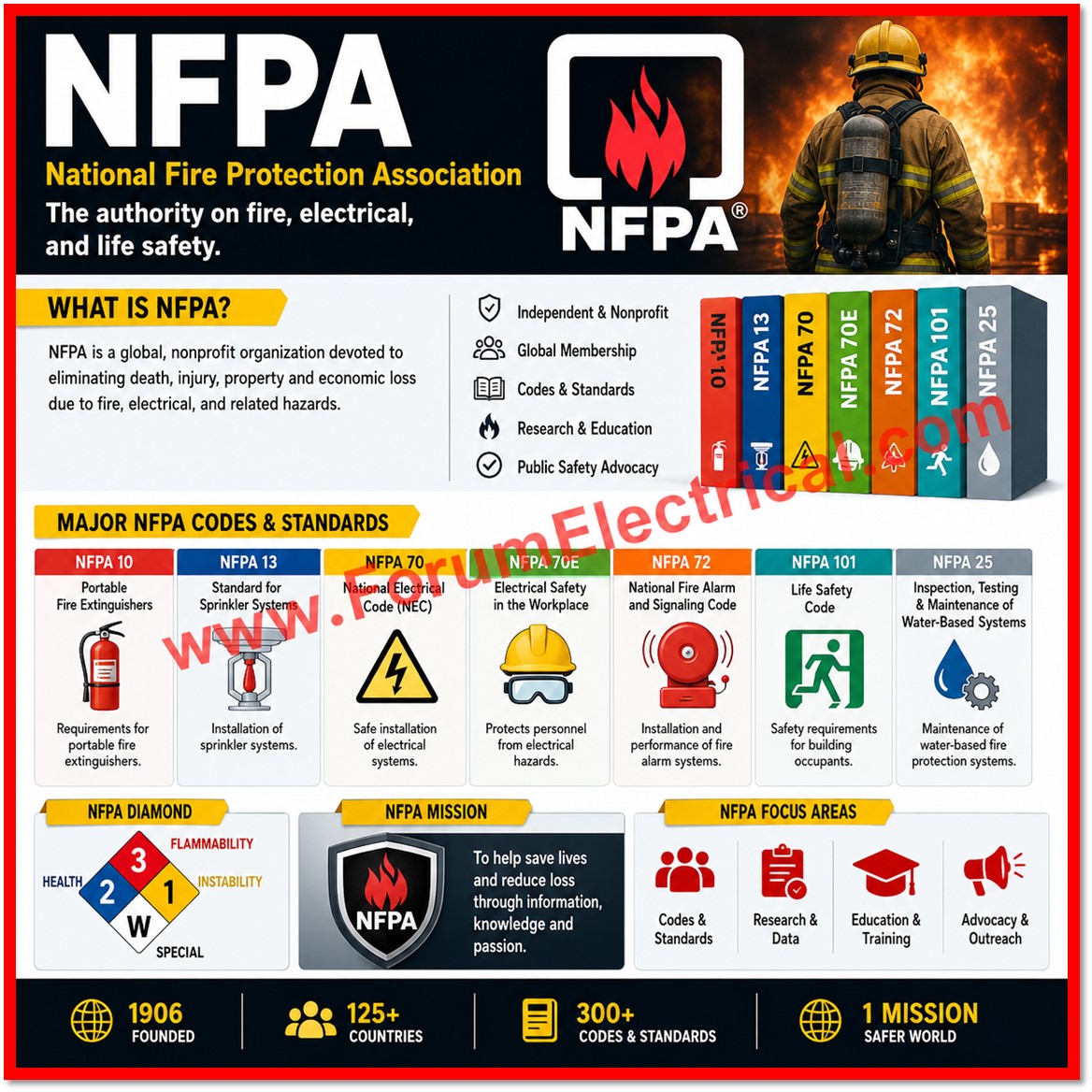
National Fire Protection Association (NFPA)
The National Fire Protection Association (NFPA) is an internationally recognized nonprofit organization established in 1896.
Over more than a century of operation, NFPA has grown into one of the most widely referenced sources of fire, electrical and life-safety guidance in the world.
NFPA develops and maintains more than 300 codes and standards, produced through a consensus-based process involving engineers, manufacturers, insurers, regulators and end users.
These post are adopted, in whole or in part, by regulatory authorities across North America and are referenced extensively by industries worldwide, including in the Middle East, Asia and Europe particularly for power generation, oil and gas, and renewable energy facilities.
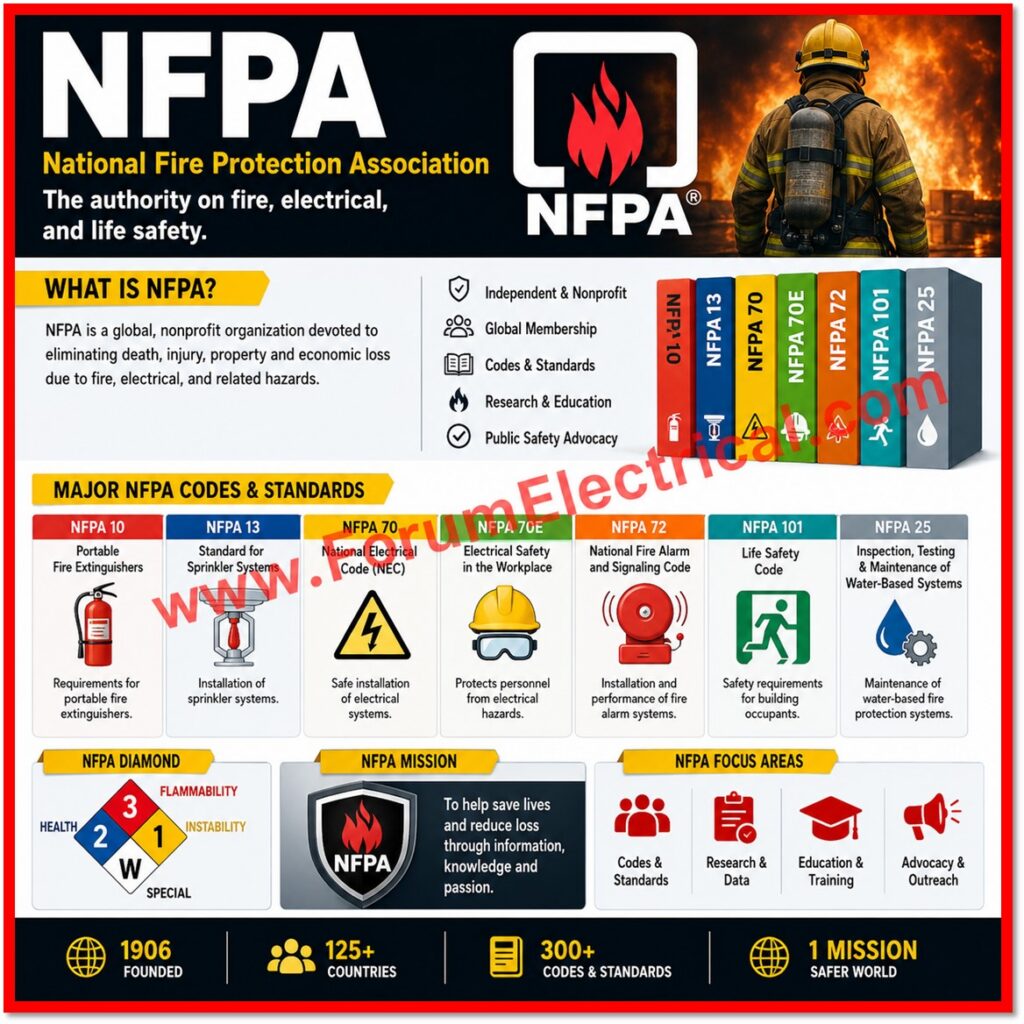
Objectives of NFPA
- Improve fire and electrical safety across residential, commercial and industrial facilities.
- Develop internationally accepted safety codes and standards through open consensus.
- Promote fire prevention through education, training and public outreach.
Important NFPA Standards
While NFPA maintains 100 of codes, a core set of standards is most relevant to electrical engineering, fire protection design and industrial plant safety.
These are summarized below:
| Standard | Title | Primary Scope |
|---|---|---|
| NFPA 70 | National Electrical Code (NEC) | Wiring, grounding, and safe installation of electrical systems |
| NFPA 70E | Electrical Safety in the Workplace. | Arc flash protection, PPE and safe work practices. |
| NFPA 72 | National Fire Alarm and Signaling Code. | Design, installation, and testing of fire alarm systems. |
| NFPA 13 | Installation of Sprinkler Systems. | Requirements for automatic fire sprinkler design. |
| NFPA 10 | Portable Fire Extinguishers. | Selection, placement and maintenance of extinguishers. |
| NFPA 25 | ITM of Water Based Fire Protection Systems. | Inspection, testing and maintenance schedules. |
| NFPA 101 | Life Safety Code. | Egress, occupancy and life safety requirements. |
| NFPA 850 | Fire Protection for Electric Generating Plants. | Guidance for power plants and HVDC converter stations. |
Among these, NFPA 70 (NEC) and NFPA 70E are foundational for electrical engineers, governing safe design, installation and workplace practices while NFPA 850 is specifically designed to power generation facilities including large scale substations and converter stations.
Importance of NFPA in Electrical Engineering
Electrical hazards, including shock, arc flash and fire ignition from faulty wiring (or) overloaded circuits represent some of the most serious risks in industrial and commercial facilities.
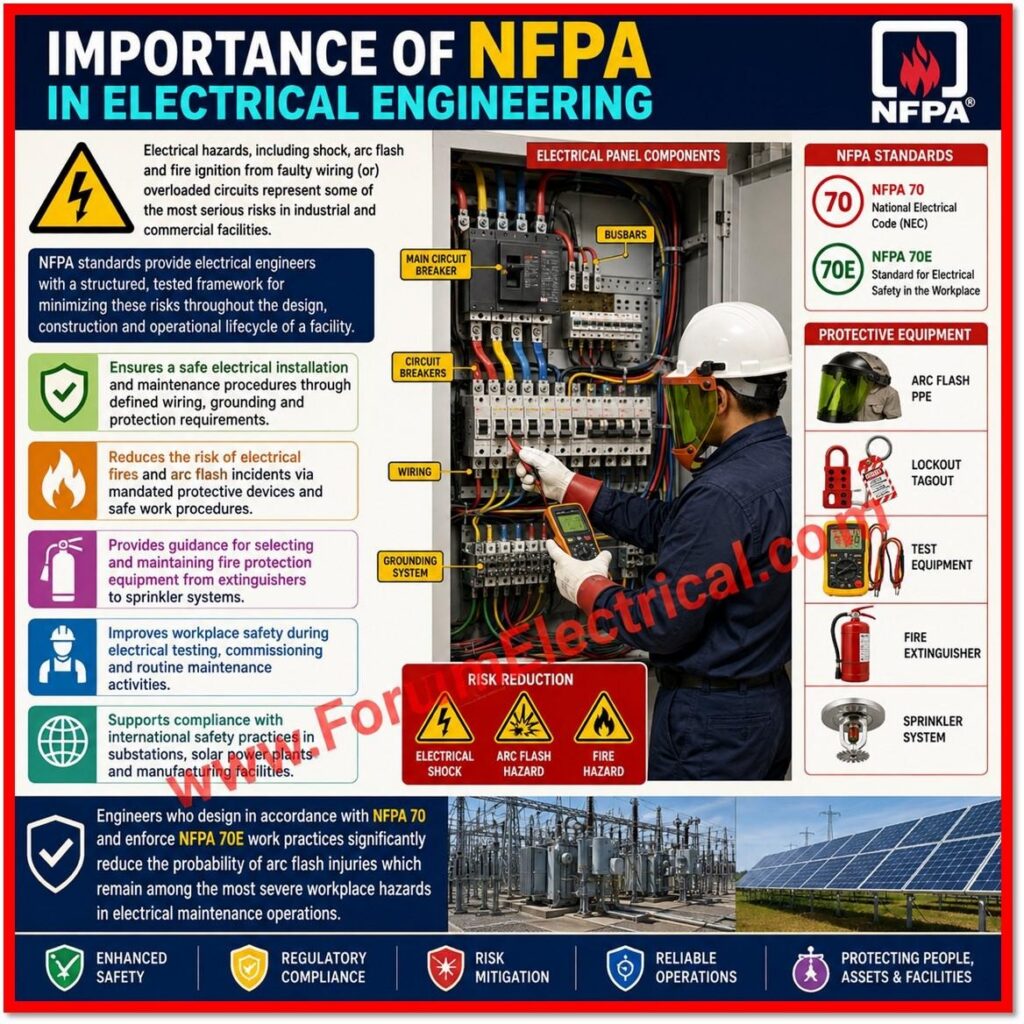
NFPA standards provide electrical engineers with a structured, tested framework for minimizing these risks throughout the design, construction and operational lifecycle of a facility.
- Ensures a safe electrical installation and maintenance procedures through defined wiring, grounding and protection requirements.
- Reduces the risk of electrical fires and arc flash incidents via the mandated protective devices and safe work procedures.
- Provides the guidance for selecting and maintaining fire protection equipment from fire extinguishers to sprinkler systems.
- Improves the workplace safety during electrical testing, commissioning and routine maintenance activities.
- Supports compliance with international safety practices in substations, solar power plants and manufacturing facilities.
Engineers who design in accordance with NFPA 70 and enforce NFPA 70E work practices significantly reduce the probability of arc flash injuries which remain among the most severe workplace hazards in electrical maintenance operations.
NFPA in Solar Power Plants
The rapid global expansion of photovoltaic (PV) installations has introduced new fire safety considerations distinct from conventional electrical systems, including high DC voltages, rooftop arrays and large scale ground mounted plants.
NFPA standards particularly NFPA 70 (Article 690 for PV systems) and NFPA 855 for energy storage are widely applied to address these unique risks.
Key focus areas for solar power plant fire safety include:
- Proper cable routing and protection to prevent insulation damage and DC arc faults.
- Safe installation of inverters and transformers including clearances and thermal management.
- Fire detection and suppression systems suited to outdoor and rooftop PV environments.
- Emergency shutdown (rapid shutdown) procedures that de-energize arrays during emergencies.
Because PV arrays can remain energized whenever exposed to sunlight even after the main disconnect is opened and NFPA based rapid shutdown requirements are essential to protecting emergency responders and maintenance personnel alike.
Advantages of NFPA Standards
Adopting NFPA standards delivers measurable operational and safety advantages across a facility lifecycle extending well beyond regulatory compliance.
- Improved personnel safety through standardized hazard identification and mitigation.
- Reduced fire and electrical accident risks which is lowering the probability of costly incidents.
- Enhanced equipment reliability from consistent inspection, testing and maintenance practices.
- Better regulatory compliance that is easing insurance approval and legal audit procedures.
- Lower maintenance costs and downtime from proactive and standards based maintenance.
- Increased confidence in overall plant safety among operators and regulators.
Conclusion
NFPA standards are considered to be global best practices for fire and electrical safety.
They provides electrical engineers and safety professionals with a consistent, tested framework for designing, installing and maintaining systems that protect both people and assets.
By following NFPA requirements ranging from NFPA 70 for electrical installations to NFPA 850 for power generation facilities and emerging guidance for solar and battery storage systems, industries can create safer workplaces and protect valuable assets and ensure the reliable, long term operation of electrical systems throughout their lifecycle.

