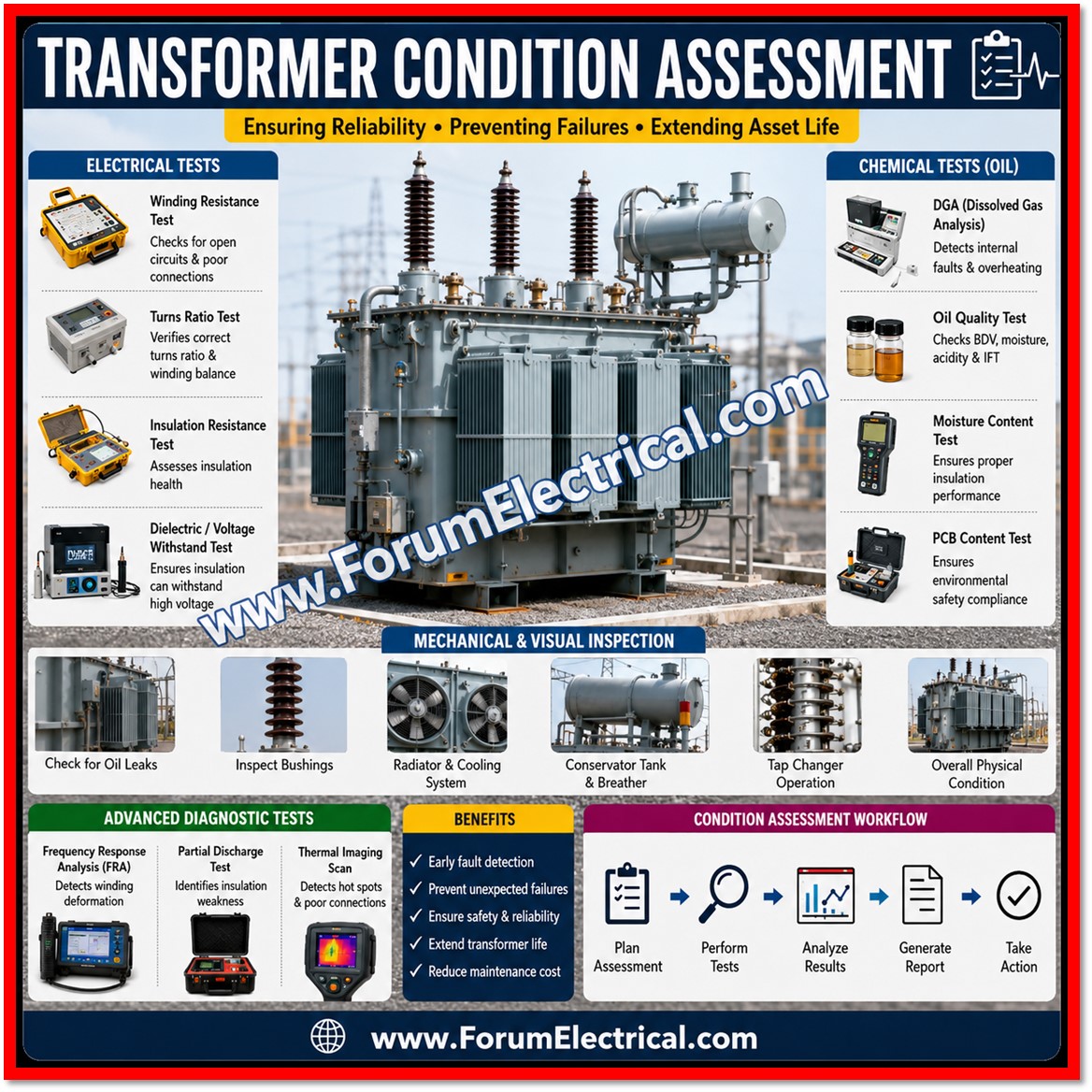
A power transformer is one of the most critical and capital-intensive assets in an electrical network.
Since, unplanned failure can lead to prolonged outages, safety hazards and significant financial loss, utilities and industries rely on a structured condition assessment methodology rather than judging health from a single test.
- Reviewing the Transformer History
- Transformer Oil Tests
- Dissolved Gas Analysis (DGA)
- Breakdown Voltage (BDV)
- Moisture in Oil
- Acidity (Neutralization Number)
- Dielectric Dissipation Factor (Tan Delta)
- Furan Analysis
- Electrical Tests
- Visual Inspection
- Thermal Inspection
- Paper Insulation Assessment
- Evaluating Test
- Summary: Interpreting Overall Transformer Health
- Signs the Transformer is Healthy
- Signs the Transformer may require Attention
- Conclusion
A comprehensive assessment combines historical review, laboratory oil testing, electrical diagnostics, visual and thermal inspection and insulation life evaluation to build a complete condition of the transformers actual condition.
Reviewing the Transformer History
Before any test is performed, the transformers service history provides essential details for interpreting results.
A transformer that has experienced repeated overloading (or) via faults is far more likely to show mechanical winding displacement even if its oil currently looks acceptable.
Key historical records to review include:
- Loading history: Frequency and severity of overloading events, including duration above nameplate rating.
- Faults and short circuits: Records of through faults, external faults and system disturbances the transformer has withstood.
- Oil leakage history: Past leaks at gaskets, valves, radiators (or) the tank and repairs carried out.
- Previous test reports: trends from earlier DGA, electrical, and oil quality tests.
- Maintenance records: Oil filtration, gasket replacement, OLTC servicing and breather maintenance.
- Temperature records: Top oil and winding temperature trends over time, including hot-spot indications.
- Number of operations: Especially OLTC tap-change count which governs contact wear and maintenance intervals.
Transformer Oil Tests
Oil sampled from the transformer acts as a diagnostic fluid because it is in direct contact with the windings, core and paper insulation.
Laboratory oil testing is considered the single most important assessment category since it can reveal incipient internal faults long before they become visible externally.
Dissolved Gas Analysis (DGA)
DGA measures gases such as hydrogen, methane, ethane, ethylene, acetylene, carbon monoxide, and carbon dioxide dissolved in the oil.
A healthy transformer shows low concentrations of combustible gases with no abnormal generation trend.
Rising acetylene or ethylene levels typically point to arcing or severe thermal faults.
Breakdown Voltage (BDV)
BDV indicates the oil’s ability to withstand electrical stress without breaking down. Values are typically expected to exceed 60 kV though acceptable limits vary by standard and equipment class.
Low BDV usually signals moisture (or) particulate contamination.
Moisture in Oil
Moisture accelerates paper insulation ageing and lowers dielectric strength.
A healthy transformer maintains very low moisture content and rising trends warrant investigation into seal integrity or breather condition.
Acidity (Neutralization Number)
Acidity reflects oil oxidation and ageing.
Low acid numbers indicate the oil has not significantly degraded; rising acidity suggests the oil is oxidizing and may soon require reconditioning or replacement.
Dielectric Dissipation Factor (Tan Delta)
Tan Delta measures dielectric losses in the oil. Low values indicate good insulating quality, while increasing values point to contamination, ageing byproducts (or) insulation deterioration.
Furan Analysis
Furan compounds are generated as cellulose paper insulation degrades.
Because paper insulation life largely determines the remaining life of the entire transformer, furan analysis is considered especially essential low furan content indicates the solid insulation remains in good condition whereas elevated values suggest significant, often irreversible, paper ageing.
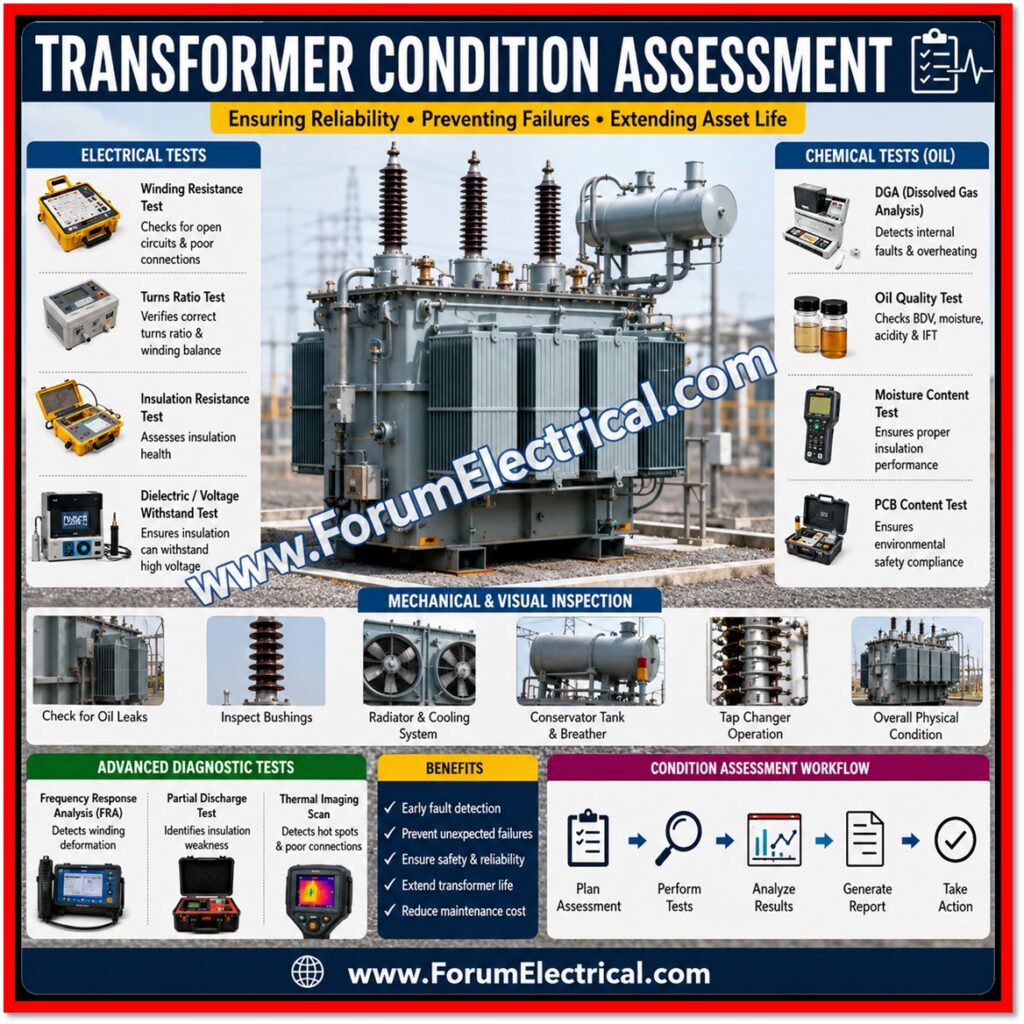
Electrical Tests
Electrical diagnostic tests assess the condition of windings, insulation and the magnetic circuit directly.
Recommended tests include:
- Insulation Resistance (IR): Verifies the integrity of insulation between windings and to earth.
- Polarization Index (PI): The ratio of 10-minute to 1-minute IR readings, indicating insulation dryness and cleanliness.
- Winding Resistance: Detects loose connections, broken strands, or high-resistance joints.
- Transformer Turns Ratio (TTR): Confirms correct turns ratio and detects shorted turns.
- Magnetic Balance Test: Checks the magnetic circuit and core condition.
- Vector Group Verification: Confirms correct phase relationship and winding connections.
- Excitation Current Test: Detects core faults and shorted turns via no-load current comparison across phases.
- Sweep Frequency Response Analysis (SFRA): Detects winding deformation, displacement, or looseness caused by mechanical stress or through-faults.
- Capacitance and Tan Delta Test: Evaluates insulation condition of windings and bushings.
- Leakage Reactance Test (if required): Supplements SFRA in confirming winding geometry integrity.
Visual Inspection
A thorough physical inspection often reveals early warning signs that laboratory tests may not immediately capture.
Inspectors must check:
- Oil leaks at gaskets, valves, radiators and welded joints.
- Rust and corrosion on the tank, radiators and support structure.
- Conservator condition, including the diaphragm (or) air cell and oil level indicator.
- Breather silica gel color – blue/pink indicates dry, while a pale (or) white color indicates moisture saturation.
- Bushings – checking for cracks, tracking marks, or surface contamination.
- Cooling radiators – checking for blockages, leaks or fan/pump malfunction.
- On-Load Tap Changer (OLTC) condition – mechanism, oil compartment and contact wear.
- Gaskets – for hardening, cracking (or) oil seepage.
- Pressure Relief Device (PRD) – for proper sealing and operability.
- Buchholz relay – for correct oil level, gas accumulation and alarm history.
- Earthing connections – for tightness, corrosion and continuity.
Thermal Inspection
Using a thermal camera, technicians check for:
- Hot bushings, indicating internal defects (or) poor contact.
- Hot cable joints and terminations, indicating loose (or) corroded connections.
- Uneven radiator temperatures, indicating blocked oil flow (or) trapped air/sludge.
- Loose connections at bus bars, terminals and clamps.
- OLTC overheating which may indicate contact wear (or) coking.
Paper Insulation Assessment
The cellulose paper wrapped around the windings provides the primary solid insulation system, and its mechanical strength that is measured indirectly through the Degree of Polymerization (DP) (or) furan content which is largely determines the remaining useful life of the transformer.
Unlike oil, paper insulation cannot be reconditioned once it has degraded significantly, since ageing is irreversible.
Furan trending over successive tests, together with DGA and moisture data, gives the most reliable estimate of the insulation’s remaining life and helps utilities plan for refurbishment, rewinding (or) replacement well in advance of failure.
Evaluating Test
A single test result has limited value in isolation.
Assessment requires comparing current results against:
- Factory Acceptance Test (FAT) reports which is the original baseline values from the manufacturer.
- Commissioning reports is the as installed baseline before energization.
- Previous maintenance results is the periodic historical data used to identify developing trends.
Trend analysis is especially important for SFRA, Tan Delta, DGA gas concentrations and winding resistance since a gradual change over time is often more significant than any single absolute value.
Summary: Interpreting Overall Transformer Health
Bringing together history, oil tests, electrical tests and inspections allows a clear determination of whether a transformer is healthy (or) requires attention.
Signs the Transformer is Healthy
| Indicator |
| DGA results normal with no abnormal gassing trend. |
| Furan values low that is indicating healthy paper insulation. |
| Insulation Resistance and Polarization Index satisfactory. |
| Tan Delta within acceptable limits. |
| SFRA signature unchanged from baseline. |
| Transformer Turns Ratio within tolerance. |
| No partial discharge activity detected. |
| No abnormal heating found during thermography. |
| No abnormal noise or vibration during operation. |
| Clean oil with good Breakdown Voltage. |
| No significant oil leaks observed. |
Signs the Transformer may require Attention
| Warning Sign |
| Rapid rise in hydrogen, acetylene, methane (or) ethylene in DGA. |
| High furan values, indicating advanced paper insulation ageing. |
| Low Insulation Resistance readings. |
| High Tan Delta values. |
| Poor Breakdown Voltage results. |
| High moisture content in oil. |
| Hot spots detected during thermographic survey. |
| SFRA changes indicating winding movement (or) deformation. |
| Frequent Buchholz relay alarms. |
| Increasing partial discharge activity. |
Conclusion
A complete transformer condition assessment involves historical data, laboratory oil analysis, electrical diagnostics, visual along with thermal inspection and paper insulation life evaluation.
Since Dissolved Gas Analysis (DGA) & Furan Analysis disclose internal faults & insulation aging that cannot be seen, they are the most important indications.
The transformer is healthy and ready for service when all metrics trend within acceptable limits & no abnormal indicators are detected. Any deviation, especially rapid gas generation, low insulation resistance, weak Tan Delta (or) SFRA deviation should prompt a more extensive inquiry, increased monitoring frequency (or) planned maintenance to prevent unforeseen failure.

