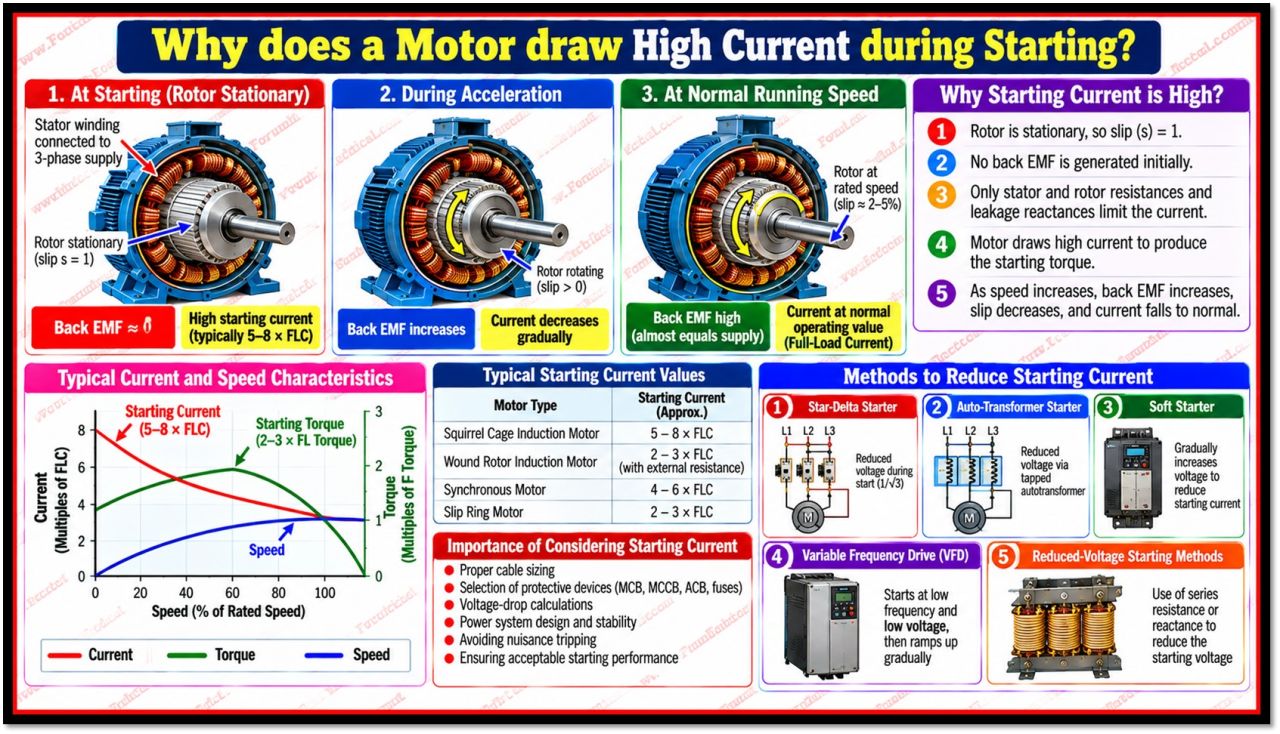
When an electric motor is switched on, it draws a current far larger than the current it draws at rated load and rated speed.
For a typical three-phase squirrel-cage induction motor (3-phase squirrel-cage induction motor) connected directly to the supply, this starting current is commonly 5 to 8 times the full-load current.
For a DC motor started without any protection, it can be 10 to 20 times larger or more. This surge is not a fault.
It is a natural consequence of the motor electromagnetic behaviour at standstill, and understanding it is essential for correct selection of cables, protection devices and starting methods.
Fundamental Cause: Absence of Back EMF
A running motor behaves as a generator as well as a motor.
As the rotor turns, the conductors cut magnetic flux and a voltage is induced that opposes the supply voltage. This is called the back electromotive force (back EMF).
It is the primary factor that limits the running current.
At standstill the rotor speed is 0, so no back EMF exists and the only opposition to current is the small winding impedance.
For a DC motor, this is expressed directly:
Ia = (V − Eb) / Ra
At the instant of starting,
Eb = 0,
so
Ia = V / Ra.
Because armature resistance Ra is very small, often a few hundredths of an ohm (Ω) in large machines, the current is extremely high.
As the motor accelerates, Eb rises in proportion to speed and the current falls to its normal value.
Induction Motor Starting Condition
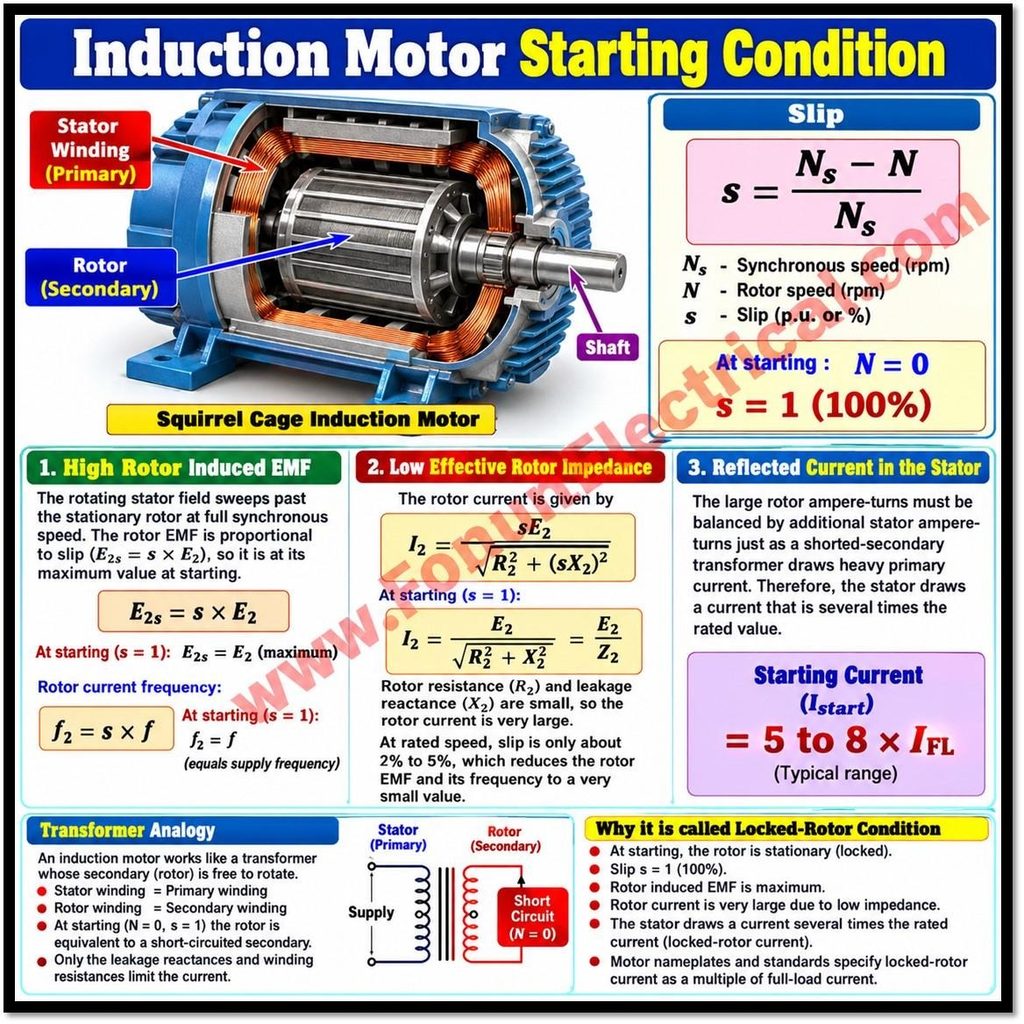
An induction motor works like a transformer whose secondary (the rotor) is free to rotate.
The stator winding is the primary.
Current drawn from the supply depends on the current demanded by the rotor which is reflected into the stator through transformer action.
The key quantity is slip which js defined as:
s = (Ns – N) / Ns
where
Ns – Synchronous speed
N – Rotor speed.
At the moment of starting, N = 0, so slip s = 1 (100 percent).
This has three important effects.
- High rotor induced EMF: The rotating stator field sweeps past the stationary rotor at full synchronous speed. The rotor EMF is proportional to slip (E2s = s x E2), so it is at its maximum value, and its frequency equals the supply frequency (f2 = s x f).
- Low effective rotor impedance: The rotor current is given by I2 = sE2 / √(R2² + (sX2)²). At s = 1 this becomes E2 / Z2, where Z2 is the standstill rotor impedance. Rotor resistance and leakage reactance are both small, so the rotor current is very large. At rated speed, slip is only about 2% to 5% which reduces the rotor EMF and its frequency to a very small value.
- Reflected current in the stator: The large rotor ampere-turns should be balanced by additional stator ampere-turns just as a shorted-secondary transformer draws heavy primary current. The stator therefore draws a current that is several times the rated value.
In effect, a stationary induction motor is a transformer with its secondary short-circuited.
Only the leakage reactances and winding resistances limit the current.
This is why the starting condition is also called the locked-rotor condition and it is the reason motor nameplates and standards specify locked-rotor current as a multiple of full-load current.
Motor Starting Current Methods
The table below summarises approximate values.
Exact values depend on motor design, rating and standard, so manufacturer data should always be consulted.
| Starting Method | Typical Starting Current | Remark |
| Induction motor, direct-on-line | About 5 to 8 times full-load current. | Locked-rotor condition. |
| Star-delta starter | About one-third (1/3rd) of the DOL value. | Reduced starting torque as well. |
| Autotransformer starter | Approximately (tap ratio) squared of the DOL value. | Line current falls with the square of the tap. |
| Soft starter / VFD | Adjustable, roughly 1 to 4 times full-load current. | Controlled voltage (or) frequency ramp. |
| DC motor, direct start | 10 to 20 times full-load current (FLC) (or) more | Limited only by armature resistance. |
Why High Current, Low Torque?
A common misconception is that high current generates high torque.
In an induction motor at standstill, the rotor circuit is highly inductive relative to its resistance, so the rotor power factor is low (typically 0.1 to 0.3 lagging).
Torque depends on the in-phase component of rotor current and on the air-gap flux, so starting torque is only about 1 to 2 times full-load torque even though current is 5 to 8 times higher.
As the motor speeds up, rotor frequency falls, reactance sX2 decreases, power factor improves & the current falls steadily until the motor settles at its operating point.
Effects of High Starting Current
- Voltage dip: The heavy current causes a drop across the supply impedance which can disturb lights, sensitive electronics & other motors.
- Thermal stress: Heating is proportional to I²R. Repeated (or) prolonged starts, (or) high-inertia loads, can overheat windings & degrade insulation.
- Mechanical stress: Electromagnetic forces are proportional to the square of current and can stress end-windings, shafts and couplings.
- Protection issues: Incorrectly set overload relays (or) fuses may trip during normal starting.
Methods to Reduce Starting Current
- Star-delta starting: Windings are connected in star at start reducing phase voltage to 1/√3 and line current to one-third of the direct-on-line (DOL) value. Torque is reduced by the same factor.
- Autotransformer starting: Reduced voltage is applied through taps. Motor current is proportional to the voltage ratio and line current is proportional to the square of the ratio.
- Rotor resistance starting: In slip-ring motors, external rotor resistance lowers starting current & simultaneously it improves starting torque and power factor.
- Soft starters and variable frequency drives: Thyristor voltage ramping (or) frequency control limits current to near rated values and provides smooth acceleration.
- Starting resistance in DC motors: A series resistance is added at start & cut out in steps as back EMF builds.
Conclusion
A motor draws high current during starting because the rotor is stationary, so no back EMF exists in a DC motor & slip equals unity in an induction motor.
The result is a high rotor EMF, low impedance and a heavy reflected stator current similar to a transformer with a shorted secondary.
The current declines as speed increases.
Proper starting methods, correctly sized conductors & appropriately set protection allow motors to start reliably without damaging equipment (or) disturbing the supply.

