1). What is the difference between AC and DC?
The difference between AC and DC are
| AC (Alternating Current) | DC (Direct Current) |
| AC (Alternating Current) periodically changes its magnitude and direction. | DC (Direct Current) flows in one direction; its magnitude may be constant or may vary. |
2). What is Ohm’s Law?
Ohm’s Law states that current through a conductor is directly proportional to the voltage across it, provided temperature and other physical conditions remain constant.
Formula: V = I × R
Where V = voltage (V),
I = current (A) and
R = resistance (Ω).
3). What is the difference between kW and kVA?
Difference between kW and kVA are kW (kilowatt) is active power, while kVA (kilovolt-ampere) is apparent power.
Formula: kW = kVA × power factor
4). What is electrical power?
Electrical power is the rate at which electrical energy is transferred or converted.
Single-phase real power: P = V × I × PF
Balanced three-phase real power: P = √3 × VL × IL × PF.
5). What is the difference between a conductor and an insulator?
A conductor allows electric current to flow easily; examples include copper and aluminium.
An insulator strongly resists current flow; examples include rubber, PVC, and porcelain.
6). What is a Transformer?
A transformer is a static electrical device that transfers electrical energy between circuits through electromagnetic induction. Transformer usually changes voltage and current levels without changing frequency.
7). What is the difference between a step-up and a step-down transformer?
A step-up transformer increases voltage and reduces current for a given power (neglecting losses).
A step-down transformer decreases voltage and increases current.
8). What is the working principle of an Induction Motor?
An induction motor works on electromagnetic induction.
The stator produces a rotating magnetic field, which induces current in the rotor and develops electromagnetic torque.
9). What is the difference between a single-phase and a three-phase motor?
A single-phase motor operates from a single-phase AC supply and generally needs a starting arrangement.
A three-phase induction motor produces a rotating magnetic field naturally when supplied by a balanced three-phase source.
10). What is the function of a capacitor in a single-phase induction motor?
A capacitor creates a phase shift between the currents in the main and auxiliary windings to develop starting torque.
In some motor designs, a capacitor also remains connected during running to improve performance.
11). What is the function of a starter in an induction motor?
A motor starter controls starting and stopping and may provide overload and short-circuit protection depending on its design and the protective devices used.
12). What is LOTO in electrical maintenance?
LOTO – Lockout/Tagout
LOTO is a controlled isolation procedure used to avoid unexpected energization (or) release of stored energy while maintenance is being carried out.
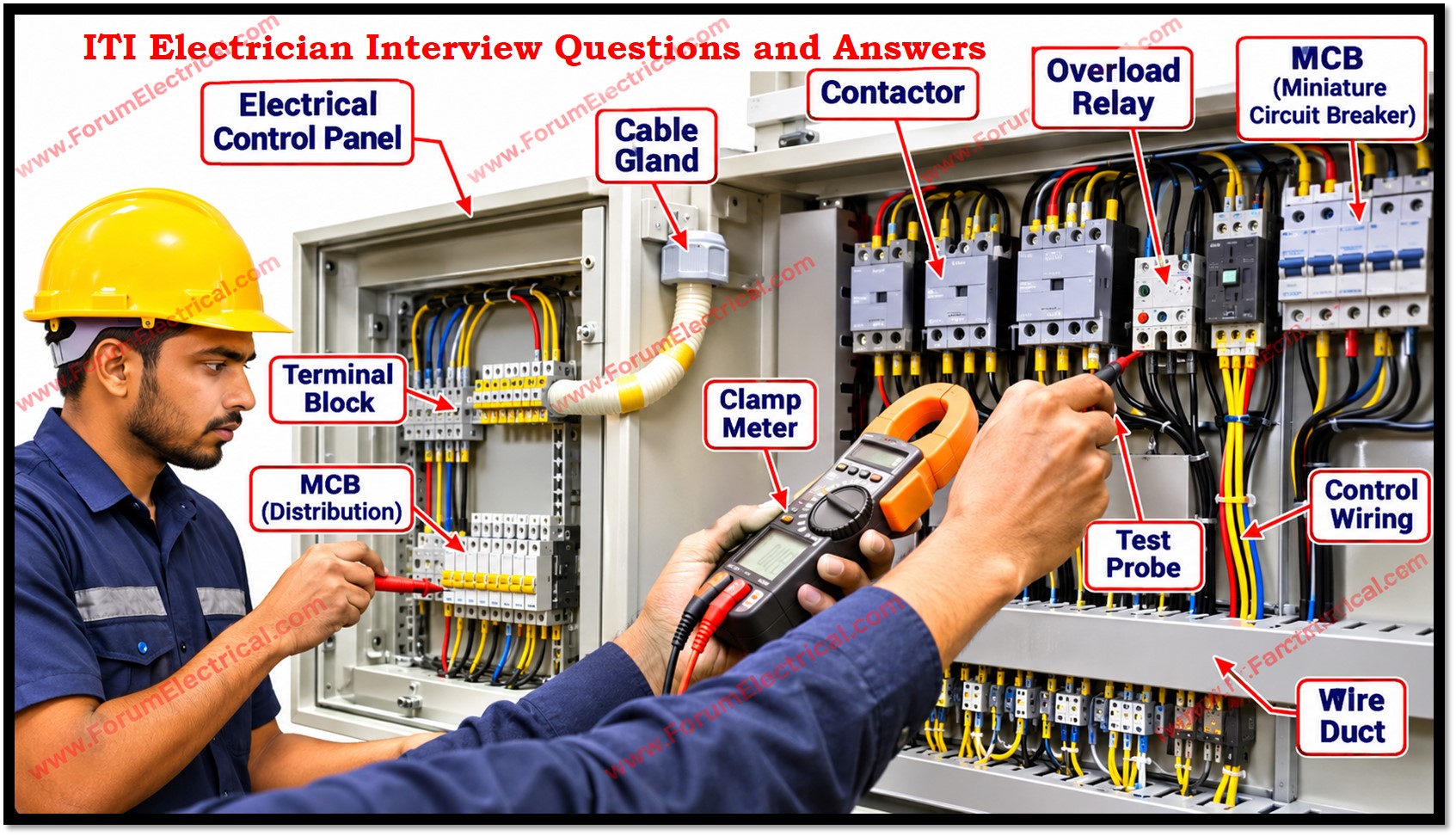
13). What is the function of an MCB?
An MCB (Miniature Circuit Breaker) automatically disconnects a circuit during overload or short-circuit conditions within its specified ratings.
14). What safety precautions should an electrician follow before electrical maintenance?
Identify all energy sources, isolate the equipment, apply LOTO, verify absence of voltage with an appropriately rated and proven tester, discharge stored energy where applicable, use suitable PPE and insulated tools and follow the approved safe-work procedure.
15). What is the function of an ELCB (or) RCCB?
An RCCB detects residual current caused by current imbalance between live conductors and trips to reduce electric-shock and fire risks.
An RCCB alone does not provide overload (or) short-circuit protection; an appropriate overcurrent protective device is also required.
16). What is Earthing? Why is it important?
Earthing is the connection of an installation’s designated parts to the earth through an earthing system.
Protective earthing helps provide a fault-current path so protective devices can disconnect the supply and helps reduce electric-shock risk.
17). Why is a conventional three-phase induction motor not self-starting on a single-phase supply?
A conventional three-phase induction motor supplied from a single-phase source does not develop the normal rotating magnetic field produced by a balanced three-phase supply.
It therefore does not develop reliable starting torque without a suitable conversion or starting arrangement.
18). What is the function of a fuse?
A fuse protects a circuit by melting its fuse element when current exceeds its specified operating characteristics, thereby interrupting the circuit.
19). What is a short circuit?
A short circuit is an unintended low-impedance connection between points at different electrical potentials. It can cause a very high fault current.
20). What is an overload condition?
An overload occurs when equipment or a circuit carries current above its rated value under operating conditions.
It does not necessarily involve a short circuit.
21). What is a megger?
A megger or insulation resistance tester, applies a specified DC test voltage to measure insulation resistance in cables, motors, transformers and other equipment.
The result is commonly expressed in megaohms (MΩ).
22). What is a multimeter?
A digital multimeter is used to measure electrical quantities such as AC/DC voltage, resistance, and continuity.
Some models also measure
- Current,
- Frequency,
- Capacitance and
- Diode characteristics.
23). What is a clamp meter?
A clamp meter measures current by sensing the magnetic field around a conductor, usually without opening the circuit.
Many models also measure voltage and other electrical parameters.
24). What is the function of a continuity tester?
A continuity tester checks whether an electrical path is complete by indicating a sufficiently low-resistance connection between two points.
25). What are the common causes of motor overheating?
Common causes of motor overheating include
- Overloading,
- Single phasing,
- Voltage unbalance,
- Incorrect voltage,
- Poor ventilation,
- Blocked cooling passages,
- Bearing problems,
- Frequent starts and
- Winding-insulation deterioration.

