
Industrial arc furnace (EAF) transformers are among the most challenged electrical components in heavy industries like steelmaking.
- Switch-Off Phenomenon in No-Load Transformers
- Characteristics of Switching Overvoltage
- High Amplitude
- Steep Fronts
- Oscillatory Nature
- Repetitive Occurrence
- Resistor Function
- Practical Applications in Arc Furnace Transformers
- Design Considerations for RC Filters
- Advantages of RC Filters
- Industry Practices and Standards
- Conclusion
They have to manage with drastically changing load conditions, frequent switching operations and extreme thermal and electrical stressors.
One of the most difficult challenges in their operation is when the transformer is turned off at no load.
During this switching procedure, high-frequency transient overvoltages are generated that can have a negative impact on
- Transformer insulation,
- Damage circuit breaker contacts and
- Cause unanticipated system failures.
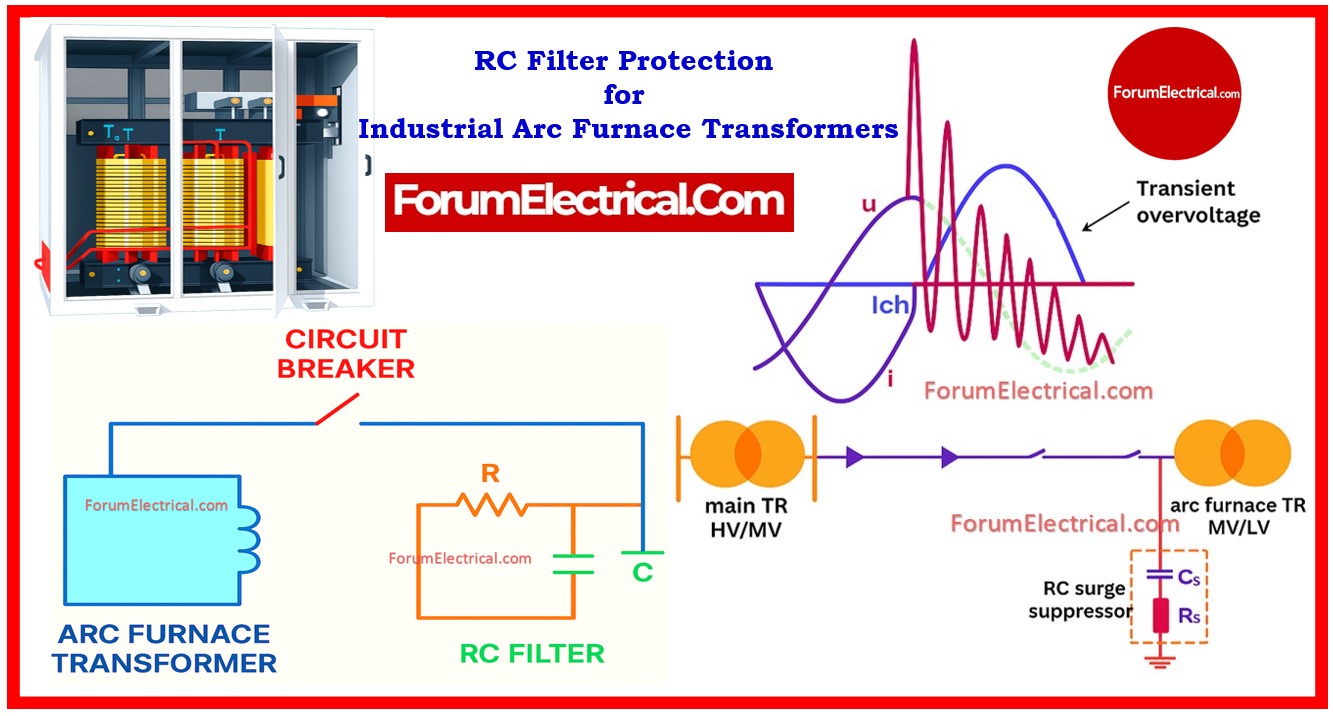
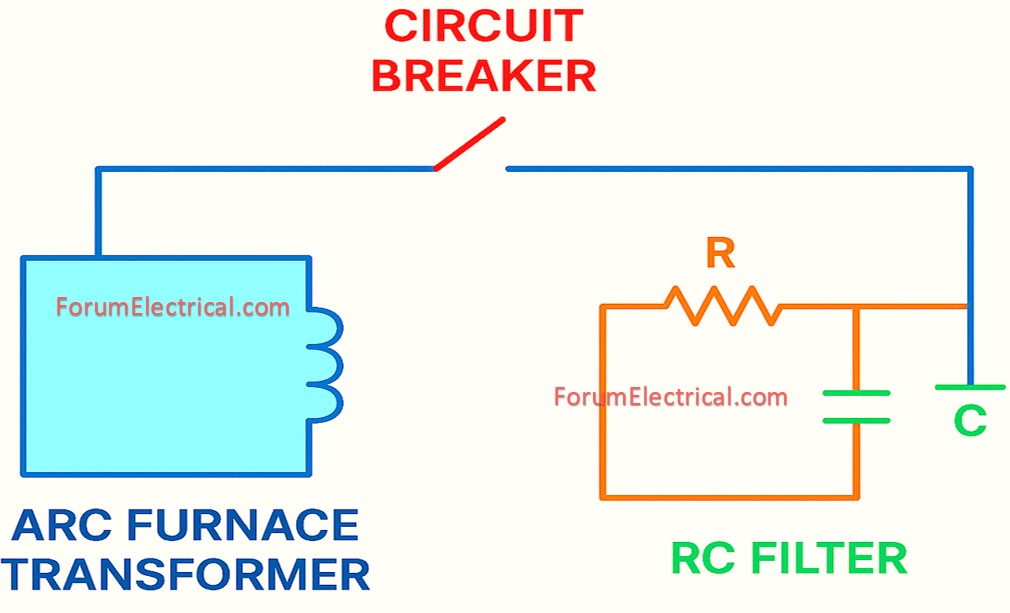
To counteract these effects, an RC filter circuit, often known as an RC snubber, is utilized.
This post goes into detail on the switching-off phenomenon, overvoltage causes and the importance of the RC filter in safeguarding arc furnace transformers.
Switch-Off Phenomenon in No-Load Transformers
When a transformer is turned off in no-load mode, the magnetizing current that flows via the windings is very modest but highly inductive.
This current is responsible for sustaining the transformer’s magnetic flux.
When the breakers open:
> The magnetizing inductance strives to keep the current flowing.
> Since the circuit is being disrupted, this energy is forced into system’s stray capacitances.
> The combination of heavy inductance and minimal capacitance generates a high-frequency oscillatory circuit with steep voltage transients.
In vacuum circuit breakers, a new problem occurs:
> When the current falls beneath the chopping current level, the arc in the breaker becomes unstable and abruptly burns out.
> This quick interruption causes a steep rate of change in the current (di/dt) which resulting in large overvoltages at the transformer terminals.
Characteristics of Switching Overvoltage
Switching overvoltages in the arc furnace transformers have a unique features:
High Amplitude
Because of the transformer’s enormous inductance and the conductors low capacitance that resultant voltages can be many times the rated system voltage.
Steep Fronts
Transient voltages increases in microseconds, pushing transformer insulation past its design limitations.
Oscillatory Nature
The combination of inductance & capacitance produces a damped oscillation that may occur numerous times before the energy is expended.
Repetitive Occurrence
Because arc furnaces switch often, these transients occur multiple times, resulting in cumulative insulation aging.
If unmanaged these overvoltages can cause:
> Insulation in the transformer windings has broken down.
> Premature failure of the vacuum circuit breakers.
> Disruptions occur in additional sensitive electrical devices linked to the network.
Resistor Function
The resistor that are coupled in series with the capacitor provides 3 fundamental functions:
Limits the Charging Current: Without a resistor the capacitor would charge instantly resulting in large inrush currents that could destroy the capacitor.
Controls Damping: The resistor drains energy ensuring that the oscillations are appropriately dampened.
Protects System Components: By limiting the rate of energy transfer the resistor promotes circuit stability & keeps the capacitor from getting overheating.
The RC network decreases the amplitude of overvoltage and also slows its progression thereby protecting the transformer & associated equipment.
Practical Applications in Arc Furnace Transformers
Arc furnace transformers are subjected to more severe conditions than standard power transformers because:
> Frequent switch operations,
> Arc strikes produce high short-circuit currents &
> Rapid load fluctuations.
In such cases, RC filters are necessary for ensuring consistent performance.
Filters are typically fitted at the transformer’s high-voltage terminals or across breaker contacts.
The construction of the RC network should consider the following:
> Transformer ratings and magnetizing current,
> System voltage (e.g: 33 kV, 66 kV or 132 kV),
> Switch frequency and breaker type (vacuum, SF6 or oil) &
> Expected surge levels.
In certain cases, multiple RC filters are linked in parallel to accommodate greater energies.
Design Considerations for RC Filters
Designing an RC filter needs an extensive analysis of component values.
Capacitance Value
Should be sufficiently large to absorb transitory energy.
Typical range can be between 0.01 µF to several µF, based on voltage level.

Resistance Value
Chosen to reduce charging current and dampen oscillations.
Should be high enough to minimize resonance while remaining low enough to allow for effective dampening.
Thermal Rating
Both the capacitor and the resistor must tolerate many surges without overheating.
Location of Installation
RC filters are frequently installed within the breaker cubicle (or) directly linked to the transformer bushing.
Advantages of RC Filters
The utilization of RC filters in the arc furnace transformers provides various operational advantages:
> Reduces the transient overvoltages during no load switching.
> Protects the insulation & windings from the dielectric stress.
> Reduces the arcing stress & contact erosion in the (VCB) vacuum circuit breakers.
> Reduces the unwanted tripping & also equipment damage.
> Lowers maintenance expenses and unscheduled outages.
Industry Practices and Standards
Several international standards & industrial practices propose using RC filters, such as:
> IEC 60076 (Power transformers),
> IEEE C57 rules on transformer protection,
> Manufacturer’s suggestions for arc furnace installation.
Utilities as well as companies with voltages of 66 kV or more frequently use RC snubbers, particularly when vacuum circuit breakers are employed to switch huge inductive loads.
Conclusion
Switching transients under no-load operations endanger the safe and reliable functioning of the arc furnace transformers.
The sudden termination of the magnetizing current in a (VCB) vacuum breakers causes high-frequency overvoltages which can harm both the transformer and the switching electronics.
The usage of RC filters (snubber circuits) offers an effective option. RC filters limit overvoltage amplitude and steepness by absorbing transient energy via the capacitor & managing surge currents via the resistor.
This not only extends transformer and breaker life additionally ensures overall system reliability.
In industrial cases in which arc furnaces require frequent and rigorous switching operations and RC filters are no longer optional and also they are a must-have protective measure to preserve important electrical assets and ensure uninterrupted output.