 working diagram with correct wiring, applications and protection logic. Learn how phase sequence, under-voltage, over-voltage and phase loss protection safeguard three-phase motors in industrial electrical systems.)
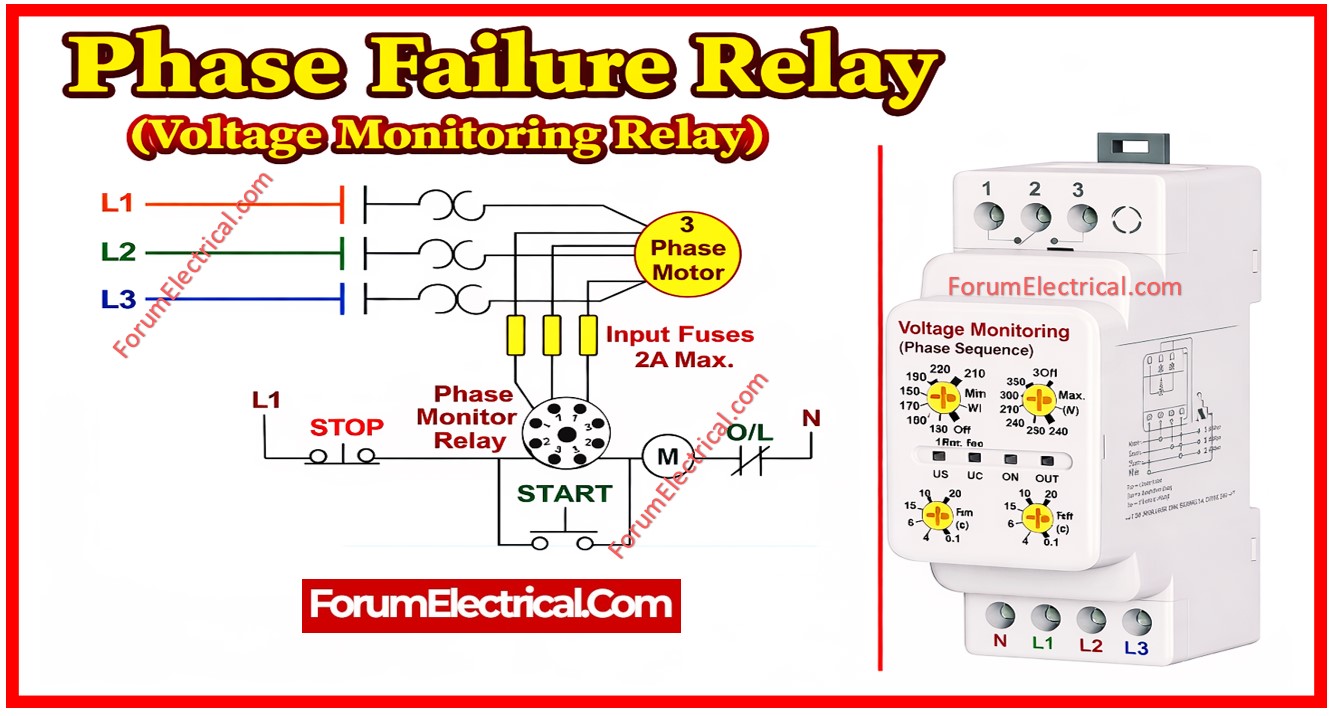
Three-phase motors are essential components of industrial electrical systems, powering pumps, compressors, cranes, elevators, HVAC systems and heavy machinery.
Even slight abnormalities like voltage imbalance, phase loss (or) wrong phase sequence can result in severe overheating, insulation failure (or) catastrophic motor burnout in seconds.
Engineers use a Phase Failure Relay, which is additionally known as a Voltage Monitoring Relay (or) a Phase Sequence Relay to avoid costly breakdowns.
This small but powerful equipment continuously monitors the state of the three-phase supply & guarantees that motors work only according to safe electrical conditions.
What is a Phase Failure?
A phase failure (or) phase loss happens when the voltage in one (or) more of electrical phases reaches (or) approaches zero.
If not identified quickly this imbalance in three-phase systems can lead to equipment malfunction, lower efficiency (or) entire motor failure.
What is a Phase Failure Relay?
A Phase Failure Relay is a protective monitoring device used to monitor three-phase power systems. It identifies important electrical irregularities such
- Phase loss,
- Improper phase sequence,
- Under voltage,
- Overvoltage and
- Phase imbalance.
When the supply deviates from the predefined safe limits the relay promptly trips and disconnects the load typically via a contactor to avoid motor damage and unsafe operation.
Essential Electrical Parameters of Phase Failure Relay
A voltage monitoring relay continually assesses the reliability of the incoming three-phase supply.
It detects phase loss which is when one phase is completely lacking results in single-phasing in motors.
It also checks the phase sequence to ensure proper rotation (L1-L2-L3) and prevents the motor from rotating in reverse.
It also monitors under voltage and overvoltage conditions which might result in excessive current draw (or) insulation stress.
Most industrial relays have adjustable ON-delay and OFF-delay timers which enable engineers to mitigate transient disturbances & avoid nuisance tripping.
Working Principle of Phase Failure Relay
During normal operation, when all 3 phases are present voltage levels are within the specified parameters and the phase sequence is accurate and the relay activates its output contacts.

This permits the contactor to close & the motor to run safely. If an unexpected condition occurs such as a
- Phase failure,
- Voltage falling below the minimum threshold,
- Voltage exceeding the maximum limit &
- Phase sequence reversal
the relay de-energizes immediately.
This action opens the contactor and cuts off the motor supply preventing overheating, reverse rotation and electrical damage.
Importance of Phase Failure Relay
From an engineering standpoint the phase failure relay is an essential precaution against single-phasing condition that may increase motor current by up to six fold resulting in severe thermal degradation.
By assuring proper voltage and phase conditions the relay lowers downtime, maintenance costs & equipment failure.
It also improves staff safety by minimizing unpredictable motor control and is frequently required by industrial electrical regulations & best practices for motor protection.
How to select right Phase Failure Relay?
A 3-wire relay monitors phase-to-phase voltage (usually 400 V – 415 V) whereas a 4-wire relay monitors phase-to-neutral voltage (230 V – 240 V).
Single (or) double-pole changeover outputs are usual. To add more contacts utilize auxiliary (or) slave relays.
Determine the monitoring functions that are required. Phase loss is standard however options such as under/overvoltage and phase sequence differ per type.
Application of Phase Failure Relay
Phase failure relays are commonly employed in industries wherein three-phase motors & equipment are important.
They protect motors found in pumps, compressors, conveyors, cranes, elevators, hoists and HVAC systems.
These relays protect lifting equipment & elevators against dangerous reverse rotation caused by an incorrect phase sequence.
They are also used in industrial automation panels, motor control centers (MCCs), generator synchronization and changeover panels and other installations that require consistent phase stability.
Summary
A Phase Failure Relay may be modest in size but its importance in protecting 3-phase motors is significant.
It operates as a silent guardian by continuously monitoring voltage levels, phase presence and phase sequence disconnecting equipment before it is damaged.
Installing a voltage monitoring relay is a simple but highly efficient investment for panel technicians, maintenance engineers and plant operators that saves costs on motor repairs enhances system reliability and assures safe industrial operation.