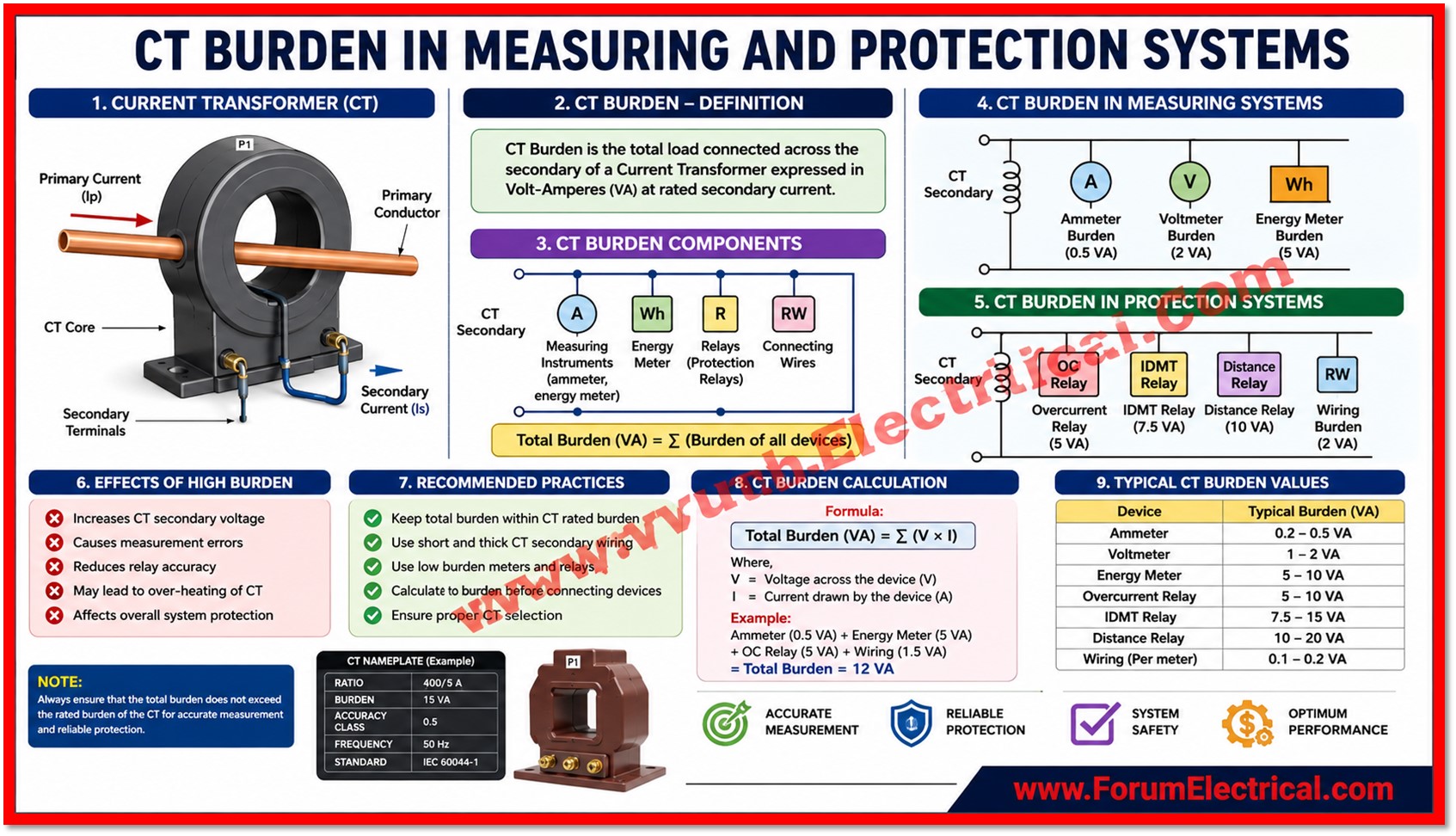
Current transformers (CTs) serve a dual purpose in electrical power systems that extends far beyond simple measurement.
They are fundamental to both the revenue accuracy and protection system reliability.
A minor miscalculation in CT burden can cascade into significant operational consequences from billing errors to the equipment damage and safety incidents.
What is the CT Burden?
CT burden represents the total electrical load connected to a current transformer’s secondary winding measured in volt-amperes (VA). This burden includes:
• Relay coil impedance,
• Energy meter input impedance,
• Secondary cable resistance &
• Connection and terminal resistances.
The CT must deliver the required secondary current to this burden without reaching magnetic saturation.
Saturation occurs when the CTs iron core can no longer increase the magnetic flux causing the secondary current to deviate from the ideal transformer connections and introducing measurement errors.
CT burden is the overall resistance of a current transformers secondary load (or) more specifically, the highest load that may be delivered to a CTs secondary.
The maximum load of a CT varies according to its turns ratio, expected CT output and sensor current rating.
The CT load is often represented in one of 2 ways:
• The overall impedance of the circuit in Ohms (Ω)
• The total VA (volt-amperes) & PF (power factor) at a given current/voltage and frequency
Three elements contribute to the overall impedance of a CT:
• The total resistance in the CTs secondary winding.
• The resistance between the CT’s lead wires
• The resistance of the meter, relay (or) other device connected to CT.
Why is CT Burden Important?
If the load is too large, the CT might not result in an accurate current measurement resulting in inaccurate APFC functioning.
If the load is too low, the CT performs effectively, yet, a huge CT may be unnecessary costly.
How to select the right CT based on Burden?
• Check the APFC controller’s burden rating (typically in VA).
• Make sure that CT burden rating is greater yet near to the overall circuit load.
• If wire lengths are lengthy use 1A secondary CT to reduce losses.
CT Burden in Metering Applications
Metering class CTs are engineered to deliver the high accuracy across the normal operating current range.
Their performance directly impacts billing accuracy and revenue protection.
When Burden is within Rated Specifications
Metering CTs maintain accuracy within their classified limits (typically Class 0.2 or 0.5) ensuring that the energy consumption is correctly measured and recorded.
This prevents the revenue loss and maintains audit integrity.
When Burden exceeds Rated Specifications
The CT saturates prematurely causing the secondary current to fall below the true transformed value.
The meter records the less energy consumption than actually occurred resulting in systematic under billing.
For utilities and large consumers even small cumulative errors translate into a significant financial impact over months (or) years.
The accuracy required for the revenue metering means that burden verification is not optional but it is essential to the economic operation of the power system.
CT Burden in Protection Applications
Protection CTs operate differently from the metering CTs.
While metering CTs must be accurate during normal load conditions, protection CTs are designed to remain accurate during fault conditions when currents can be many times higher in their rated values.
Saturation Problem in Protection CT
If CT burden is excessive, the magnetizing voltage required to drive secondary current increases.
During a high current fault the CT saturates before the relay receives the full fault current signal.
This causes the protection relay to see a significantly lower current than the actual fault magnitude which leading to:
• Delayed relay trip times,
• Complete failure to trip in severe cases and
• Equipment damage that the protection was intended to prevent.
A high magnitude fault current does not ensure an adequate protection if the CT itself becomes saturated and cannot accurately generate that current signal.
Risk Factor
• Multiple Devices on a Single CT.
• Modern substations often connect multiple devices to a single CT secondary:
> Protection relays,
> Energy meters,
> Revenue grade transducers,
> SCADA / RTU interfaces &
> Power quality monitoring devices.
Each device adds to the total CT burden.
Without rigorous burden accounting during the design phase the cumulative load can easily exceed the CTs capability.
The results in:
• Loss of metering accuracy,
• Compromised protection relay performance &
• Unpredictable function across multiple systems.
A particularly dangerous practice is combining metering and protection circuits on the same CT core without any verified burden calculations.
Calculator: CT Burden Resistor Calculator
Different accuracy classes and fault current requirements make this procedure inherently risky.
Open Secondary Hazard in CT
When a CT secondary is disconnected:
• Secondary voltage can rise to a several kilovolts (kV),
• Severe shock hazard to personnel,
• Insulation damage to the CT windings,
• Risk of fire &
• Permanent CT failure.
This hazard remains even during seemingly routine maintenance activities.
The fundamental principle to avoid this hazard is that a CT secondary must always be either connected to a burden (or) intentionally shorted and never left open while the primary is energized.
To ensure both measurement accuracy and protection reliability the following practices must be standard.
Design Phase
Calculate CT burden periodically including secondary cable resistance and all connected devices.
Do not estimate (or) assume standard values without verification.
Safety Margin
Apply a 20–30% reserve margin to the CTs VA rating.
This accommodates variations in the equipment impedance and provides headroom for the future additions.
Separate Cores
Use a dedicated CT cores for the metering and protection circuits whenever possible.
This eliminates a risk of one function by compromising the other.
Cable Selection
For long secondary runs specify 1 A CTs rather than 5 A.
The lower secondary current proportionally reduces cable burden and improves overall accuracy.
Maintain detailed burden calculations and circuit diagrams for every CT installation.
Safety
Implement correct procedures prohibiting the opening of CT secondaries without any proper grounding and supervision.
Train personnel on the safety hazards and require verification before any secondary disconnection.
How to reduce CT Burden?
• Metering coils and
• Leads Resistance
is the load (or) stress on the metering CT.
Selection of the right CT ratio that must be CT secondary ratings range from 1A to 5A.
If the relay is close to the CT and the lead resistance is low a 5A CT & relay rating is desirable since the overall load of the CT will be reduced.
Conclusion
CT burden is not an accurate calculation to be performed once and forgotten.
It directly determines whether your metering systems accurately record energy, if your protection systems can respond to faults and if your equipment and personnel remain safe during abnormal conditions.

