

What is an Autotransformer Starter?
An autotransformer starter is a type of motor starter that reduces the starting current required for an induction motor.
- What is an Autotransformer Starter?
- Working Principle of Autotransformer Starter
- Function of Autotransformer Starter
- What is an Autotransformer used for?
- Advantages of Autotransformer Starter
- Disadvantages of Autotransformer Starter
- Applications of Autotransformer Starter
- Importance of Autotransformer Starters
- What is the purpose of Autotransformer Starter?
- Conclusion
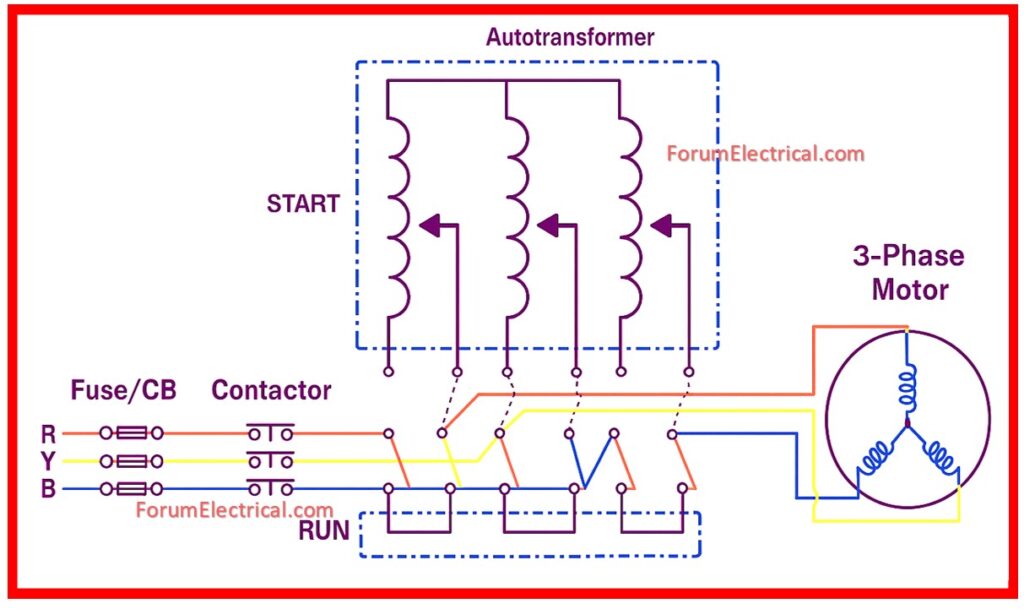
It utilizes an autotransformer with several tapping points (primarily 50%, 65% & 80% of VL – line voltage) to supply a lower voltage to the motor during startup.
Once the motor has accelerated and reached a specific speed the autotransformer disconnects & the motor is directly linked to the full line voltage.
This starter is extensively utilized in medium & large-size induction motors to reduce high inrush current during startup.
Contactors and motor starters (including AC motor starters and autotransformer starters) are representations of low-voltage switchgear along with control equipment defined under IEC 60947-4-1.
Working Principle of Autotransformer Starter
The principle of an autotransformer starter depends on voltage reduction via transformer tapping.
When a motor is started, it typically consumes 6 to 8 times its full-load current that can result in voltage drops and mechanical stress.
The autotransformer decreases the voltage provided to the motor upon startup.
Because the torque produced by an induction motor is proportional to the square of the applied voltage, lowering the voltage decreases both the starting current and the starting torque.
Once the motor gains speed, the autotransformer is bypassed & the motor operates at full voltage.
Function of Autotransformer Starter
The primary function of an autotransformer starter is to control the starting current of an induction motor without significantly lowering the starting torque.
It delivers smooth acceleration to the motor while reducing mechanical stress on both the motor & the linked equipment.
It is suitable for motors that require a high starting torque because the adjustable tapping points allow for greater flexibility in determining the proper voltage reduction.
What is an Autotransformer used for?
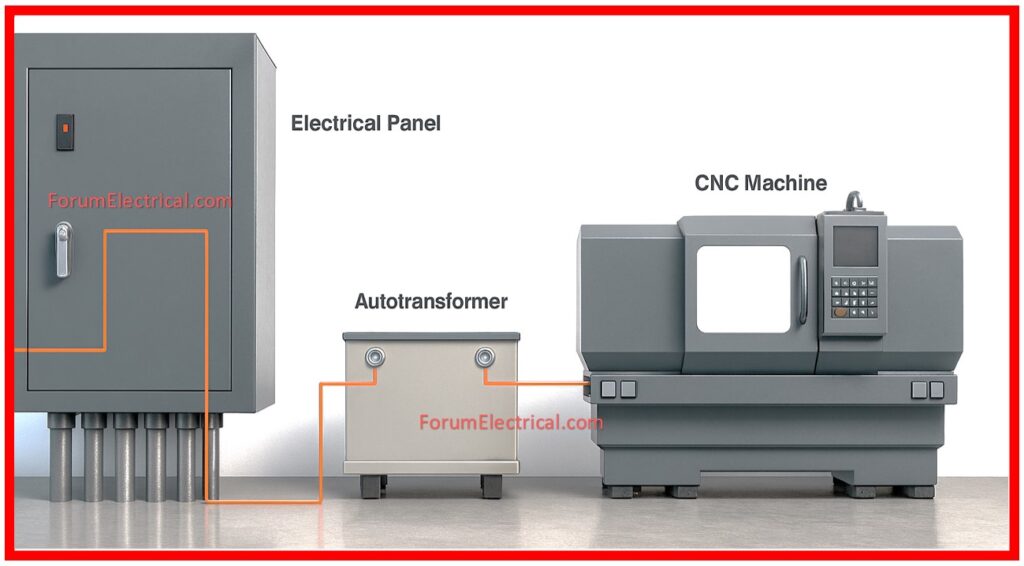
Autotransformers are beneficial for adjusting the voltage on commercial and industrial devices.
They provide an efficient, low-cost method of supplying the correct voltage to motors & compressors,
- CNC Machines,
- Lathes and
- Other Industrial Equipment
that requires a step up or down from the building’s service voltage.
Advantages of Autotransformer Starter
- Significantly reduces the inrush current which protects the motor and reduces stress on the electrical system.
- When compared to other reduced-voltage starters such as star-delta, it has a higher starting torque at the same current level.
- Voltage tapping options (such as 50%, 65%, and 80%) can be adjusted to meet application needs.
- Provides the smoother acceleration while reducing mechanical stress on the electric drive system.
- Primarily utilized in large-capacity motors if direct-on-line (DOL) starting is not possible.
Disadvantages of Autotransformer Starter
- More expensive or costly than simple starting methods such as DOL (or) star-delta starters.
- Because of the autotransformer it needs a larger setup and also therefore less compact.
- Switching between decreased and the full voltage requires more sophisticated control circuits.
- Transformers & associated switching devices may require regular examination and repair.
- Not suitable for frequent starts. Frequent motor starting may cause mechanical & electrical components to wear out more quickly.
Applications of Autotransformer Starter
- It is an effective device for lowering the voltages in an induction motor starter.
- Perfect design to be utilized as a booster at the end of lengthy transmission lines, allowing compensation for significant losses incurred.
- Applicable to particular fluorescent bulb fittings.
- Some electrical devices, particularly those in testing labs depend on autotransformers to execute their functions effectively.
- They are used to increase the circuit’s incoming voltages.
- They are also employed as boosters in AC feeders to allow the system to obtain the needed level of voltage.
- Slip ring & squirrel cage induction electric motor activation
- Used in interconnect systems to get the requisite threshold voltages.
Importance of Autotransformer Starters
- Direct-On-Line motor starts consume too large currents and voltages making them unsuitable for starting squirrel gauge motors resulting in an increased use of autotransformer starters for starting induction electric motors.
- An autotransformer contains many voltage tapings with voltages varying from 50% to 80%, resulting in a variable amount of output voltage provided to the motor.
- The starting circuit includes three switches labeled 1, 2 & 3 that govern whether the motor operates at limited or full volts.
- The benefits of an autotransformer starter include limiting inrush currents, modifying starting voltage, reducing excitation currents, significantly improved voltage regulation & many more.
- The downsides include a low power factor, increased cost and space constraints due to its bigger size.
- The autotransformer is widely used for lighting some fluorescent lights, slip-ring & squirrel cage induction motor starting, circuit voltage boosters, AC feeders, transmission line boosters & a wide range of other applications.
What is the purpose of Autotransformer Starter?
The autotransformer starter has emerged as the most popular device for decreasing starting current inrush in induction motors; it gives maximum starting torque while using the least amount of line current.
IEC 60076/IS 2026 must be adhered to the autotransformer component whereas IEC 60947-4-1/IS 13947-4-1 & IEC 61439/IS 8623 must be adhered to the motor starter & control panel components respectively.
Conclusion
One of the most dependable methods for starting large induction motors is to use an autotransformer starter.
This starter involves applying a lower voltage via the transformer taps, which results in a lower starting current & a higher torque.
Its higher cost, larger size and greater complexity are the primary disadvantages, despite having the advantage that it provides greater flexibility and a more streamlined operation.