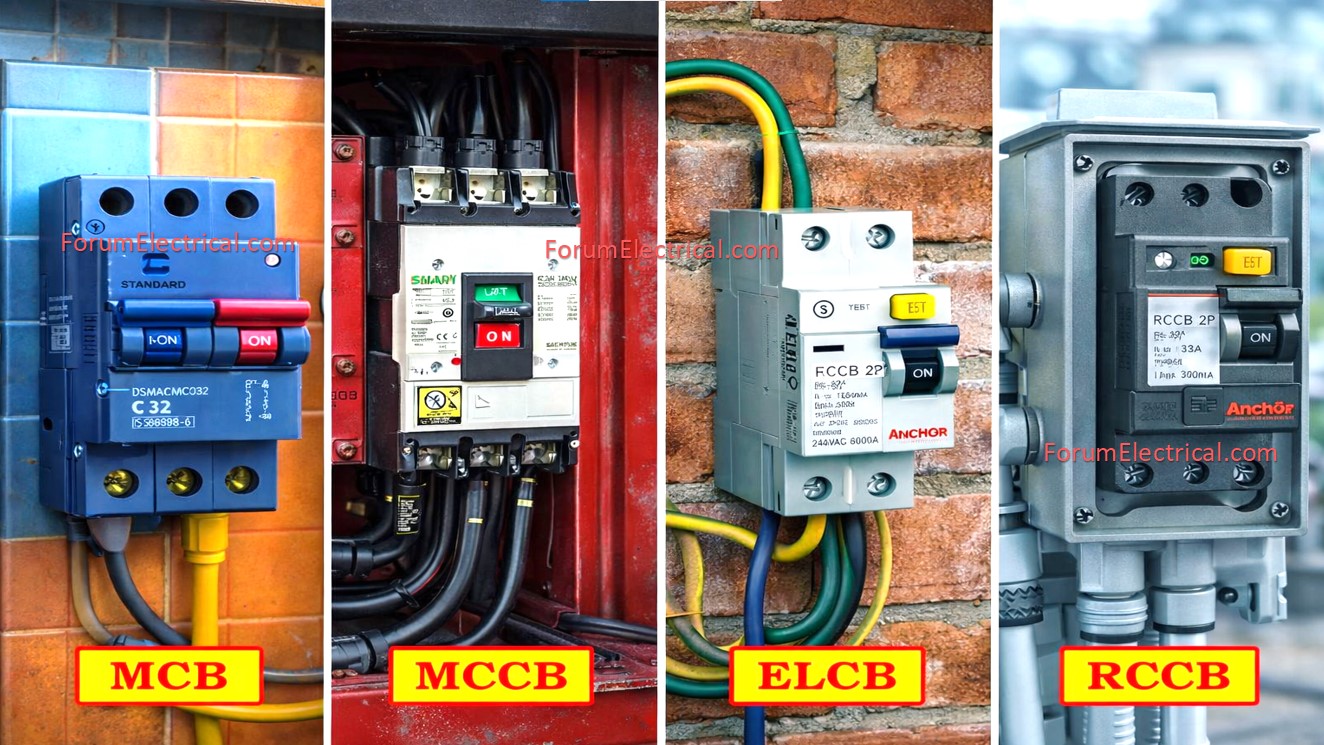
Circuit breakers are essential for electrical safety and system reliability yet correct selection is usually difficult.
- Essential Parameters of Breaker Selection
- Determine Load Requirements
- Selecting the Appropriate Breaker Type
- 1). Thermal-Magnetic Breakers
- 2). Electronic Trip Breakers
- 3). Molded Case Circuit Breakers (MCCB)
- 4). Miniature Circuit Breakers (MCB)
- 5). GFCI and AFCI Breakers
- Calculate Amperage Rating
- Step-1: Calculate Full Load Current (FLC)
- Step-2: Apply Continuity Factors
- Step-3: Select Standard Size
- Step-4: Verify Wire Gauge Compatibility
- Short Circuit Coordination
- Practical Application
- Common Mistakes to Avoid
- Standards
- Conclusion
A circuit breaker automatically interrupts excess current to prevent equipment damage, fire and electrocution.
Unlike fuses it can be reset after tripping.
Proper breaker selection ensures safe operation, protects assets and supports dependable electrical system performance.
Essential Parameters of Breaker Selection
Every breaker selection depends primarily on three important specifications:
1). Voltage Rating
Voltage rating must match your circuit operating voltage.
Common ratings include 120V, 240V, 440V and 480V.
240V breaker on a 480V circuit creates severe safety hazards.
Always verify the voltage before selection.
2). Current Rating
Current Rating (amps) indicates the maximum electrical current that the breaker can safely carries without any nuisance tripping.
This ranges from 15A in residential circuits to thousands of amperes in industrial applications.
The breaker must accommodate your full load current (FLC) under normal operation with appropriate safety margins for the continuous loads (typically 125% of load).
3). Interrupting Rating (Breaking Capacity)
Interrupting rating (breaking capacity) represents the maximum fault current the breaker can safely interrupt without destructive arcing (or) explosion and expressed in kiloamperes (kA).
This specification is often overlooked but absolutely essential.
Your system short circuit current must never exceed the breakers interrupting rating.
Calculate available fault current using system impedance data to ensure the adequate breaker rating.
Determine Load Requirements
Proper selection require certain requirements.
Calculate Continuous vs. Non-Continuous Loads
The National Electrical Code (NEC) defines continuous loads as those running three (or) more hours.
These require breaker ratings of at least 125% of load current.
A 100A continuous motor load requires a minimum 125A breaker.
Non-continuous loads can use breakers at 100% of the load.
Load Type
Resistive loads (heaters, lighting) have stable current draw while inductive loads (motors, transformers) have high inrush currents at startup which often 5-10 times the running current.
Electronic loads with harmonics require special consideration.
Motor circuits in particular demand careful analysis of startup transients.
Selecting the Appropriate Breaker Type
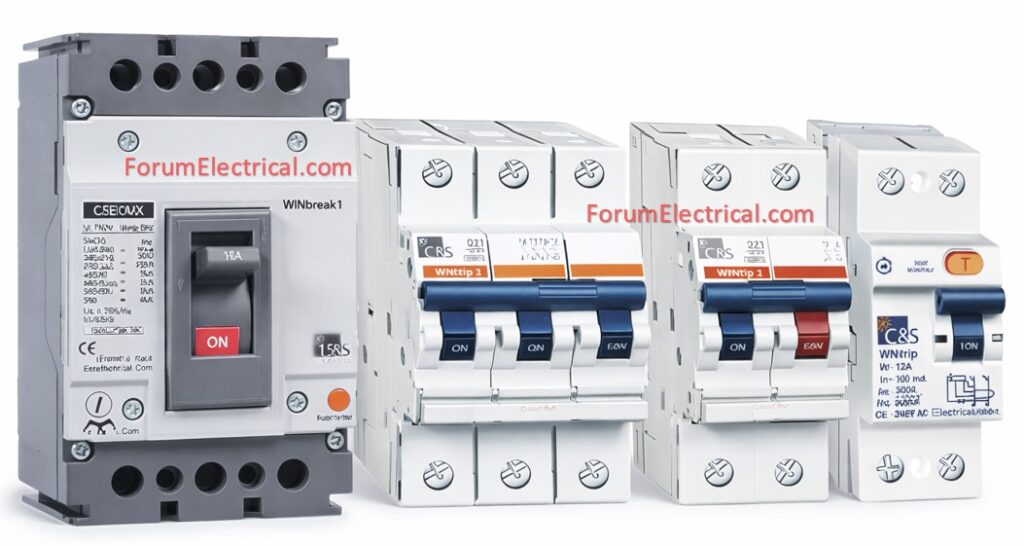
Different breaker types serve different purposes:
1). Thermal-Magnetic Breakers
2). Electronic Trip Breakers
3). Molded Case Circuit Breakers (MCCB)
4). Miniature Circuit Breakers (MCB)
5). GFCI and AFCI Breakers
1). Thermal-Magnetic Breakers
Thermal-magnetic breakers are the primary of electrical distribution.
They use bimetallic strips for overload protection and electromagnets for short-circuit protection.
Cost-effective and reliable.
They are affordable for most general purpose applications with steady loads.
2). Electronic Trip Breakers
Electronic trip breakers feature microprocessor based logic providing
- Superior selectivity,
- Adjustable curves and
- Communication capabilities.
They are primarily in the complex systems requiring an accurate coordination and also remote monitoring via higher costs require justification in important applications.
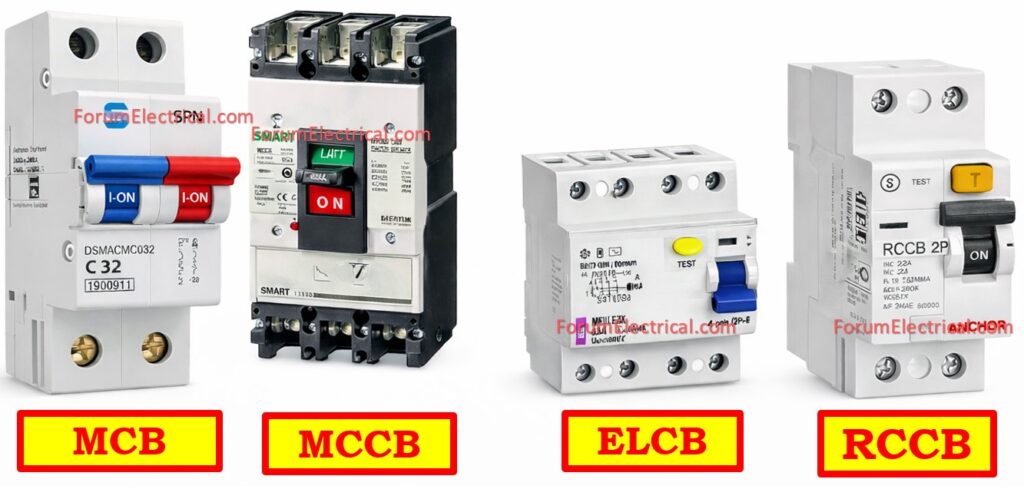
3). Molded Case Circuit Breakers (MCCB)
Molded Case Circuit Breakers (MCCB) can able handle larger currents (16A to 6300A) and are standard in industrial & commercial applications.
They provide adjustable settings with quick breaking capacity and specified protection features.
4). Miniature Circuit Breakers (MCB)
Miniature Circuit Breakers (MCB) are the most compact breakers for lower amperage (typically to 125A) standard in residential and light commercial distribution panels.
They are economical and space efficient.
5). GFCI and AFCI Breakers
GFCI and AFCI Breakers provide specialized protection.
GFCI breakers detect ground faults and trip in milliseconds (ms) protecting against electrocution in wet areas.
AFCI breakers detect the arcing faults that cause fire.
Calculate Amperage Rating
Proper amperage (amps) selection requires the systematic calculation.
Step-1: Calculate Full Load Current (FLC)
For motors: Use the nameplate ratings (or) NEC tables.
For other loads: Sum all the connected equipment specifications.
Example: A 5-ton air conditioner (AC) might draw 25A as specified in nameplate.
Step-2: Apply Continuity Factors
For continuous loads use to multiply FLC (Full Load Current) by 1.25.
A 25A continuous load requires atleast 31.25A breaker (round to 40A standard size).
Step-3: Select Standard Size
Standard amperage (amps) ratings increase in an order (15A, 20A, 25A, 30A, 40A, 50A, 60A, 80A, 100A, 125A, 150A etc.).
Step-4: Verify Wire Gauge Compatibility
The breaker rating should not exceed the wires ampacity.
A 30A breaker needs a minimum 10 AWG copper wire.
Mismatched breaker and wire sizing causes fires.
Short Circuit Coordination
One of the most unspecified aspects of breaker selection is coordination with available fault current.
Calculate available short-circuit current at the installation point using system impedance and source information typically expressed in kA.
Modern software simplifies this calculation though manual methods remain valid.
Select Breakers with Adequate Interrupting Rating
The breaker’s interrupting rating (kAIC) must exceed available short-circuit current.
- Most utility-supplied residential systems have 15-30 kA and
- Industrial systems can exceed 100 kA.
Practical Application
- Residential Application,
- Light Commercial,
- Industrial Facility and
- Motor Circuit
Common Mistakes to Avoid
Oversizing Breakers creates serious fire risks. A 50A breaker for a 20A circuit to avoid nuisance tripping is dangerous.
Ignoring interrupting rating assumes all breakers work interchangeably which is false. A 10 kA breaker in a 20 kA system is unsafe.
Mismatching wire gauge causes fires. Always verify wire ampacity before installation.
Improper coordination in multi-level systems results in complete outages from localized faults instead of selective shutdowns.
Standards
The breaker itself must meet required standards like
1). UL 489 (MCBs),
2). UL 1066 (MCCBs)
3). UL 1077 (Supplementary Protectors).
Always verify the appropriate certifications before installation.
Conclusion
The right breaker protects the electrical systems and saves lives by understanding voltage, current & interrupting ratings, verifying code compliance & maintaining safety margins.
Steady condition in normal operation but important during faults.
Proper breaker selection is a long-term investment in safety, reliability and dependable electrical performance.

