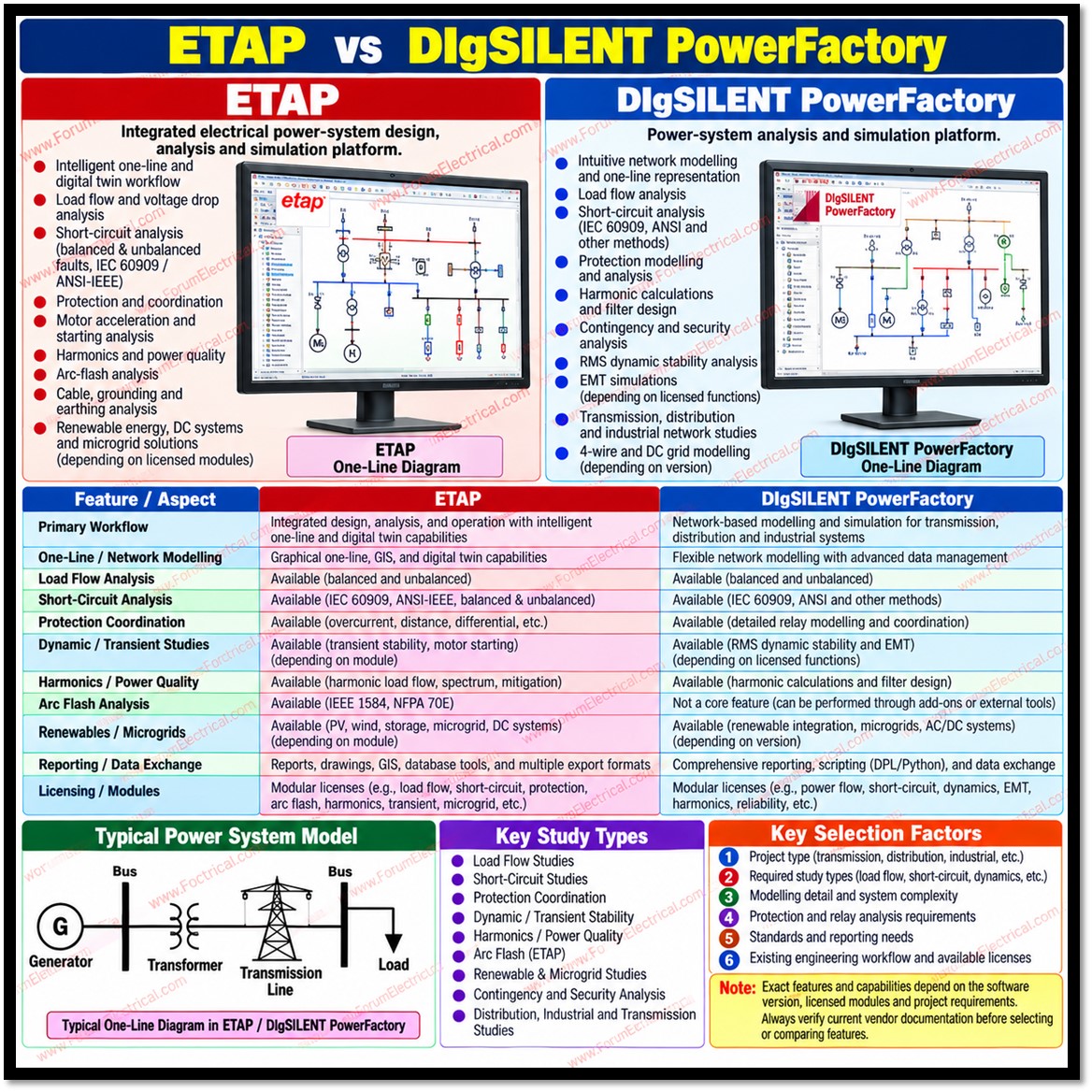
Choosing the right power system analysis software strongly influences how efficiently electrical networks are designed, analysed and operated.
Two of the most widely adopted platforms are ETAP and DIgSILENT PowerFactory.
Both perform
- Load flow,
- Short-circuit and
- Stability studies
yet they were developed with different user communities.
ETAP is best suited to industrial and commercial power systems such as manufacturing plants, refineries, offshore platforms and data centres.
DIgSILENT PowerFactory is designed for utility scale grids and advanced system studies including national transmission networks and large distribution systems.
This post compares their scope, strengths and limitations and explains when each tool is the better choice.
ETAP
ETAP – Electrical Transient Analyzer Program
ETAP (Electrical Transient Analyzer Program) provides an integrated environment in which a single database supports
- Single Line Diagrams (SLD),
- Cable and equipment libraries and
- Wide range of analysis modules.
- Intuitive interface: Drag-and-drop one-line diagram construction and clear result overlays make the software easy to adopt even for engineers new to power system studies.
- Protection coordination: Time-current characteristic (TCC) plots, a large library of relay, fuse and breaker devices and sequence-of-operation tools support selective and reliable protection schemes.
- Arc flash analysis: Incident energy and arc flash boundary calculations follow IEEE 1584 and NFPA 70E with automated label generation for safety compliance.
- Real-time capability: Through its operation oriented modules, ETAP can connect to SCADA and monitoring systems allowing the same model to be utilized for online monitoring and operator training.
- Practical engineering focus: Motor starting, harmonic analysis, cable sizing, grounding and DC system studies are all handled within one consistent workflow.
DIgSILENT PowerFactory
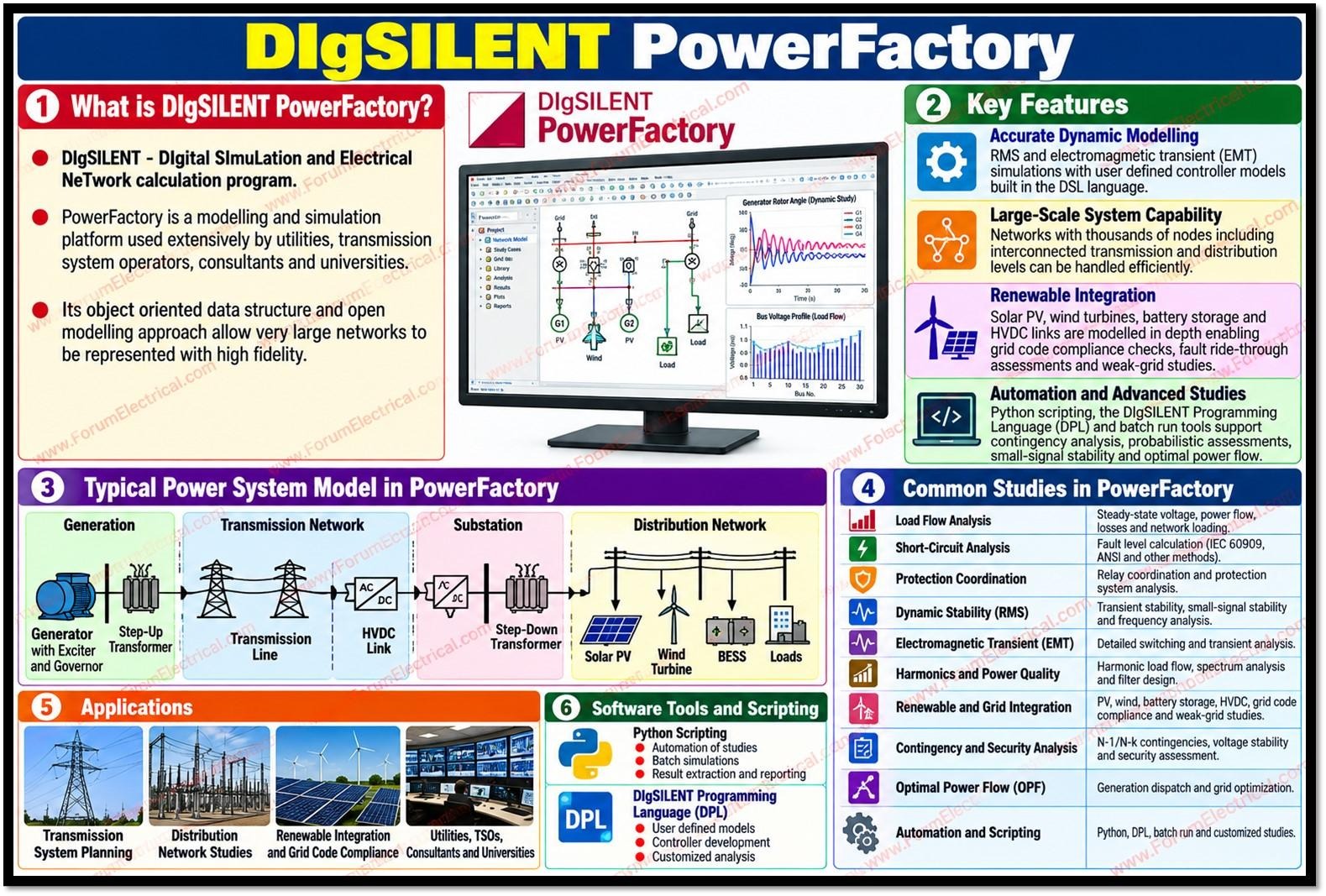
DIgSILENT – DIgital SImuLation and Electrical NeTwork calculation program
PowerFactory is a modelling and simulation platform used extensively by utilities, transmission system operators, consultants and universities.
Its object oriented data structure and open modelling approach allow very large networks to be represented with high fidelity.
- Accurate dynamic modelling: RMS and electromagnetic transient (EMT) simulations, together with user defined controller models built in the DSL language provide detailed representation of generators, exciters, governors and power electronics.
- Large-scale system capability: Networks with thousands of nodes including interconnected transmission and distribution levels can be handled efficiently.
- Renewable integration: Solar PV, wind turbines, battery storage and HVDC links are modelled in depth enabling grid code compliance checks, fault ride-through assessments & weak-grid studies.
- Automation and advanced studies: Python scripting, the DIgSILENT Programming Language (DPL) and batch run tools support contingency analysis, probabilistic assessments, small-signal stability and optimal power flow.
When to use Each Tool?
Choose ETAP when working on:
- Industrial plants, oil and gas facilities and data centres.
- Protection coordination and arc flash studies.
- Real-time monitoring and system operation.
- Projects that need fast, user-friendly simulations.
Choose DIgSILENT PowerFactory when working on:
- Transmission and distribution (T&D) network planning.
- Renewable energy integration, including solar & wind.
- Dynamic stability and transient analysis.
- Research work or complex grid simulations.
Difference between ETAP and DIgSILENT PowerFactory
ETAP vs DIgSILENT PowerFactory
| Parameter | ETAP | DIgSILENT PowerFactory |
|---|---|---|
| Primary domain | Industrial and commercial systems. | Utility-scale transmission and distribution. |
| Strongest studies | Protection coordination, arc flash. | Dynamic stability, EMT, grid integration. |
| Interface | Intuitive, one-line driven. | Powerful but complex. |
| Automation | Python scripting, API. | DPL, Python, extensive scripting. |
| Learning curve | Gentle | Steep |
| Operations | Real-time monitoring & SCADA link. | Mainly offline planning and research. |
| Typical users | Plant and consulting engineers. | Utilities, TSOs, researchers. |
Limitations
ETAP has limited depth for advanced transient studies and very large grid models.
It can handle substantial systems but it is not the preferred platform for detailed EMT work (or) continental scale stability analysis.
DIgSILENT PowerFactory has a steeper learning curve & can feel complex for beginners.
Achieving its full potential requires a solid understanding of power system theory and often of scripting and controller modelling as well.
For a routine plant protection study, this depth can be more than the task required.
Practical Selection
Software selection should follow the problem rather than brand preference.
A consulting engineer producing a short-circuit, relay coordination and arc flash report for a petrochemical plant will complete the work faster and with fewer modelling burdens in ETAP.
A grid planner assessing the stability impact of a new 200 MW wind farm on a regional transmission network needs the dynamic modelling accuracy and scalability that PowerFactory are applied.
Many organisations especially larger engineering consultancies keep both tools.
Grid connection studies for an industrial site, for example, may use PowerFactory to evaluate the utility interface and ETAP to design the internal plant network and protection.
Other factors also matter:
- Licensing cost,
- Availability of trained staff,
- Client or utility requirements and
- Ability to exchange models through standard formats.
Standards support is another consideration.
Both tools implement IEC and ANSI/IEEE calculation methods for short-circuit and load flow studies, so results for routine studies are generally comparable when the same data is used.
The real difference depends in what happens beyond those basics:
ETAP wraps the calculations in report templates and safety-focused outputs while PowerFactory exposes the modelling depth required to represent new grid technologies & to validate them against grid code requirements.
Conclusion
There is no one-size-fits-all answer in power system software.
ETAP delivers a practical, industrial and easy-to-use environment with excellent protection and arc flash capabilities.
DIgSILENT PowerFactory delivers an advanced, analytical, grid-focused platform with highly accurate dynamic modelling and strong automation.
Understanding the study objectives, the size of the network and the depth of analysis required will guide engineers to the right tool and knowing both is a real advantage in a modern career in power systems.

