
High voltage (HV) Switchgear is an essential component of modern power systems, particularly in transmission & distribution (T&D) networks.
- High Voltage Switchgear Objectives
- 1). Protection
- 2). Control
- 3). Isolation
- 4). Monitoring and Measurement
- Components of High Voltage Switchgear
- 1). Circuit Breakers
- 2). Disconnectors/Isolators
- 3). Current Transformer
- 4). Voltage Transformer
- 5). Protective Relays
- 6). Busbars
- 7). Earthing Switches
- High Voltage Switchgear Types
- 1). Air Insulated (AIS) Switchgear
- 2). Gas Insulated Switchgear (GIS)
- Conclusion
It refers to a collection of electrical equipment designed to manage and regulate high voltages ranging from 36 kV to 765 kV (or) higher in ultra-high-voltage systems.
The fundamental purposes of HV switchgear are to protect, control, isolate and monitor the electrical grid.
Without switchgear, an unexpected fault such as a short circuit, overload (or) insulation failure might lead to blackouts, equipment damage (or) even fires.
High Voltage Switchgear Objectives
1). Protection
HV switchgear detects abnormal conditions which include
- Short circuits,
- Overcurrents
- Insulation breakdowns
and isolates the problematic part to prevent a complete system failure.
This assures the safety of the equipment, staff, and network.
2). Control
It enables operators to connect and disconnect
- Transmission lines,
- Transformers and
- Feeders
as needed ensuring proper load control during routine operations and emergencies.
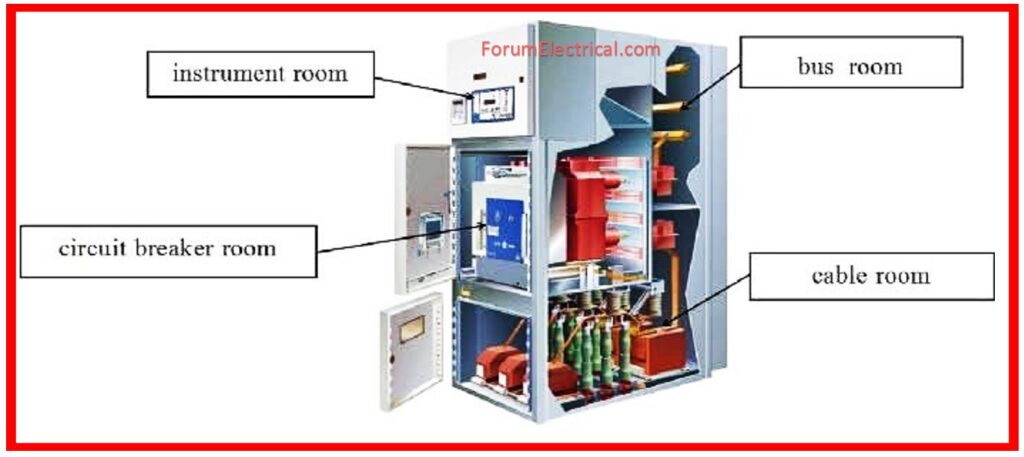
3). Isolation
Faulty or energized components are isolated from the entire system utilizing disconnectors/isolators to ensure that no hazardous current passes through the working zone.
4). Monitoring and Measurement
Modern HV switchgear includes
- Current Transformers (CTs),
- Voltage Transformers (VTs) &
- Smart sensors
that send real-time data to SCADA systems for better monitoring, fault detection and preventative maintenance.
Components of High Voltage Switchgear
1). Circuit Breakers
Circuit breakers are the primary safety devices in HV switchgear. They interrupt electrical power flow during faults and resume normal functioning.
Types include:
Oil Circuit Breaker (OCB): An oil circuit breaker (OCB) uses insulating oil to quench the arc.
SF₆ Circuit Breaker: The SF₆ circuit breaker uses sulfur hexafluoride gas for high-voltage insulation & arc extinction.
Vacuum Circuit Breaker (VCB): Utilize a vacuum to quench arcs and is ideal for medium and high voltages.
Air Blast Circuit Breaker (ABC): A type of circuit breaker that uses high-pressure air to quench arcs in older systems.
2). Disconnectors/Isolators
These give immediate isolation during maintenance but they cannot interrupt load current.
They are always turned on once the circuit has been disconnected by the breaker.
3). Current Transformer
CTs convert strong currents into safe levels for metering & protection.
4). Voltage Transformer
VTs reduce high voltages for precise measurement & relay operation.
5). Protective Relays
Relays receive data from CTs & VTs. If a fault is identified, they send a trip order to the circuit breakers isolating the faulty part.
6). Busbars
Copper or aluminum conductors that efficiently transfer current between feeders, transformers & transmission lines.
7). Earthing Switches
Provide a clear passage to the ground during maintenance (or) fault conditions to ensure worker safety.
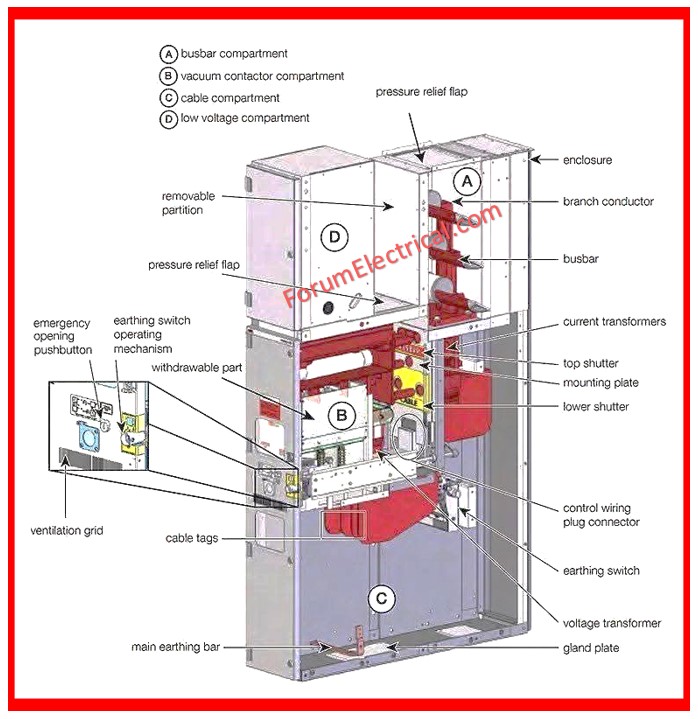
High Voltage Switchgear Types
There are 2 different types of High Voltage (HV) Switchgear:
1). Air Insulated (AIS) Switchgear
2). Gas Insulated Switchgear (GIS)
1). Air Insulated (AIS) Switchgear
Air Insulated (AIS) Switchgear uses air as an insulating medium.
Requires more physical area, making it ideal for rural (or) open installations.
Advantages: Simple design, easy maintenance, and inexpensive original cost.
Applications: Applications include outdoor substations and long-distance transmission systems.
2). Gas Insulated Switchgear (GIS)
Gas Insulated Switchgear (GIS) uses SF₆ gas for insulation.
The compact design enables installation in the congested urban settings where space is limited.
Advantages: High dependability, minimal footprint and low maintenance.
Disadvantages: High cost and environmental risks with SF₆ gas.
Applications: Applications include urban substations, industrial complexes and subterranean substations.
Conclusion
High voltage switchgear is the foundation of electrical transmission & distribution systems, assuring safe, dependable and efficient power delivery.
It protects both equipment and operators by providing vital functions such as protection, control, isolation & monitoring.
Among the 2 primary types, AIS is less expensive and easier to maintain whereas GIS is more compact and reliable in densely populated areas.
As modern power grids evolve, smart HV switchgear with digital monitoring & SCADA integration will become the new standard in power system engineering.

 Switchgear ensures safe power flow with protection, control, isolation & monitoring. Learn AIS vs GIS types, components & functions in detail.)