
The IEEE 80 Earthing Fault Simulator is an industrial grade web-based simulator calculation tool for substation grounding analysis.
IEEE 80 Earthing Fault Simulator
Schwarz’s Equations for Rg
Decrement Factor per IEEE 80 Eq. 79
Touch / Step limits per IEEE 80 Table 1
| Parameter | Actual (V) | Limit (V) | Margin | Status |
|---|
It enables power systems engineers, protection engineers and students to perform rigorous IEEE Std 80-2013 compliant grounding calculations directly in the browser with no software installation required.
The simulator evaluates grounding grid safety by calculating
- Touch and step voltage limits,
- Grid resistance via schwarz’s equations,
- Fault current asymmetry (decrement factor) and
- GPR (Ground Potential Rise).
A clear PASS / FAIL verdict is generated for each condition.
Key Features
- Full IEEE 80-2013 compliance: Schwarz’s equations, GPR, Km, Ks, Ki and Cs correction factors.
- Asymmetrical fault handling via the Decrement Factor (Df) per IEEE 80 Eq. 79.
- Supports both 50 kg (IEEE) & 70 kg (IEC) body weight standards.
- Surface layer correction factor (Cs) for crushed-rock / gravel surfacing.
- Three built-in quick presets: Pole Mount, 66 kV Substation and 400 kV Yard.
- Detailed intermediate result cards: correction factors, grid parameters and voltage limits.
- PASS / FAIL colour coded safety table with margin percentages & progress bars.
- Print ready report output with all inputs and results.
Applicable Standards
- IEEE Std 80-2013: Guide for Safety in AC Substation Grounding.
- IEC 60364-5-54: Earthing Arrangements and Protective Conductors.
- Schwarz’s Combined Equations for grid + rod resistance.
Terms
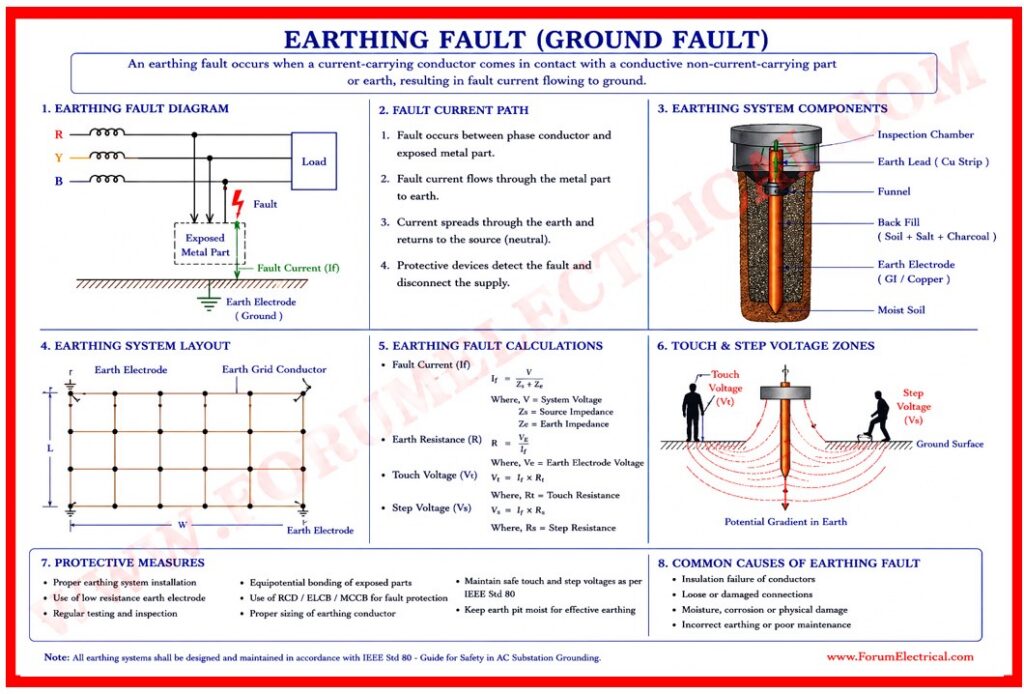
- GPR – Ground Potential Rise: peak voltage of the grounding grid relative to remote earth during fault.
- Rg – Grid Resistance: combined grid and rod resistance computed by Schwarz method.
- Df – Decrement Factor: asymmetry multiplier accounting for DC offset in the fault current.
- Em – Mesh Voltage: maximum touch potential inside a single mesh cell of the grid.
- Es -Step Voltage: potential difference between two feet 1 m apart at grade level.
- Etl – Tolerable Touch Voltage: maximum safe Em per IEEE 80 / IEC for given body weight and fault duration.
- Esl – Tolerable Step Voltage: maximum safe Es per IEEE 80 / IEC.
- Km – Mesh Voltage Correction Factor accounting for grid geometry.
- Ks – Step Voltage Correction Factor accounting for grid geometry.
- Ki – Irregularity Factor: corrects for non-uniform current distribution in the grid.
- Cs – Surface Layer Reduction Factor: accounts for high-resistivity surface material.
- K – Reflection Coefficient: function of native versus surface soil resistivities.
- R11 / R22 / R12 – Schwarz partial resistances for grid alone, rods alone, and mutual coupling.
- LT – Total Conductor Length of the grounding grid.
- Ta – DC Time Constant of the fault circuit (X / (omega x R)).
Input Parameters
All input fields instantly for common substation conditions allowing immediate simulation without manual data entry.
| Preset | Grid Size | Fault Current | Typical Application |
|---|---|---|---|
| Pole Mount | 10 x 10 m | 2000 A | Distribution pole (or) small service substation |
| 66 kV Substation | 40 x 40 m | 10000 A | Medium voltage (MV) transmission substation |
| 400 kV Yard | 120 x 120 m | 25000 A | High voltage (HV) transmission switching yard |
Click a preset button and then click Run Simulation to see results immediately.
Soil & Grid Geometry
The input panel collects all physical parameters describing the soil environment and the geometry of the buried grounding grid:
- Soil resistivity,
- Surface layer properties,
- Grid dimensions,
- Mesh spacing,
- Burial depth and
- Ground rod details.
Fault & System Data
The other side input panel collects the electrical system parameters that define the fault condition:
- Fault current magnitude,
- System X/R ratio,
- Fault Clearing Time,
- Conductor Diameter,
- Frequency And
- Body Weight Standard.
All input parameters and their allowable ranges are listed below:
When a field is left at zero, the simulator substitutes a built-in default value so that presets always produce meaningful output.
| Parameter | Range / Units | Description |
|---|---|---|
| Soil Resistivity (rho) | 1 – 10000 Ohm.m (Ωm) | Native soil resistivity: governs grid resistance & fault current spread |
| Surface Layer (rhos) | 1 – 50000 Ohm.m (Ωm) | Crushed rock/gravel resistivity and reduces hazard via Cs surface reduction factor |
| Layer Thickness (hs) | 0.05 – 1.0 m | Depth of the high resistivity surface protective layer |
| Grid Length (Lx) | 1 – 500 m | Horizontal extent of the buried grounding grid |
| Grid Width (Ly) | 1 – 500 m | Lateral extent of the buried grounding grid |
| Mesh Spacing (d) | 1 – 20 m | Center-to-center distance between parallel grid conductors |
| Grid Depth (h) | 0.1 – 2.0 m | Burial depth of grid conductors below finished grade |
| Rod Length (Lr) | 0.5 – 20 m | Length of each driven ground rod |
| Total Rods (nr) | 0 – 500 | Number of ground rods; set to 0 for grid-only analysis |
| Grid Current (IG) | 1 – 100000 A | Maximum symmetrical fault current flowing into the grounding grid |
| X/R Ratio | 1 – 100 | System reactance-to-resistance ratio and drives DC offset & decrement factor |
| Fault Duration (tf) | 0.01 – 5.0 s | Maximum fault clearing time used for body withstand voltage calculation |
| Conductor Diameter (dc) | 0.001 – 0.05 m | Outer diameter of the bare copper (or) steel grid conductor |
| System Frequency | 50 / 60 Hz | 50 Hz (international standard) (or) 60 Hz (North America) |
| Body Weight Standard | 50 / 70 kg | 50 kg per IEEE 80 or 70 kg per IEC; sets fibrillation-current coefficient |
Action Bar
Run Simulation: It validates inputs and executes all IEEE 80 calculations which renders the full results panel.
Print Report: It triggers a print formatted version of all inputs and results for hard copy (or) PDF export.
Reset: It clears all fields to zero & hides the results panel.
Calculation
Grid Geometry Derivation
From the entered grid dimensions and mesh spacing the simulator derives these primary geometric quantities:
Grid area: A = Lx X Ly
Conductor row counts: nx = round(Lx / d) + 1 and ny = round(Ly / d) + 1
Total conductor length: LT = (nx x Ly) + (ny x Lx)
Geometric factor: n = √(A) / d
Schwarz’s Equations: Grid Resistance
The simulator uses Schwarz’s combined resistance formula (IEEE 80-2013 Section 14.2).
3 partial resistances are calculated and combined:
R11 = (rho / LT) x [ ln(2 x LT / (dc x h)) – 1 + rho x LT / (20 x A) ]
R22 = (rho / 2 x pi x nr x Lr) x [ ln(4 x Lr / dc) – 1 ]
R12 = (rho / LT) x [ ln(2 x LT / √(A)) – 1 + √(A) / (2 √(piA)) ]
Rg = (R11 x R22 – R122) / (R11 + R22 – 2 x R12)
When no rods are present (nr = 0) R22 is treated as infinite & Rg reduces to R11.
Decrement Factor
The Decrement Factor (Df) accounts for the asymmetrical (offset) nature of the fault current waveform. IEEE 80-2013 Eq. 79.
Ta = (X/R) / omega
Df = √[ 1 + (Ta / tf) x (1 – exp(-2 x tf / Ta)) ]
A higher X/R ratio or shorter fault clearing time increases Df which raises the effective fault current and the GPR.
Ground Potential Rise (GPR)
GPR = IG x Df x Rg
GPR is the peak voltage of the grounding grid relative to remote earth during the fault conditions.
It is the primary hazard driving touch and step voltage analysis.
Surface Layer Correction Factor (Cs)
The presence of a high resistivity surface layer (e.g., crushed granite) reduces the body current by increasing the foot-contact resistance.
Cs is approximated per IEEE 80-2013 Eq. 27.
Cs = 1 – [ 0.09 x (1 – rho/rhos) ] / (2 x hs + 0.09)
Mesh and Step Voltage Factors
- Km (mesh voltage factor) and
- Ks (step voltage factor)
are geometric correction factors that scale earth surface potential gradients relative to average current density.
Ki is the irregularity correction factor.
Ki = 0.644 + 0.148 x n
Em = rho x IG x Df x Km x Ki / LT
Es = rho x IG x Df x Ks x Ki / LT
IEEE 80 Tolerable Voltage Limits
- Body weight and
- Fault duration
determine the maximum tolerable touch and step voltages.
Coefficient = 0.116 for 50 kg (IEEE 80); 0.157 for 70 kg (IEC).
Etl = (1000 + 1.5 x Cs x rhos) x coeff / √ (tf)
Esl = (1000 + 6.0 x Cs x rhos) x coeff / √ (tf)
Step-by-Step Calculation
- Select a quick preset (or) enter custom values manually in Sections 1 and 2.
- Verify all inputs are within the stated allowable ranges.
- Select System Frequency (50 Hz / 60 Hz) and Body Weight Standard (50 kg / 70 kg).
- Click Run Simulation.
- A detailed loading indicator appears while calculations execute.
- Review the PASS / FAIL verdict banner and the 3 KPI cards at the top of the results panel.
- Verify the Safety Assessment Table for individual parameter margins.
- Review intermediate result cards for detailed correction factors and partial resistances.
- If the design FAILS, adjust grid dimensions, reduce mesh spacing, add rods (or) increase surface layer thickness and resistivity, then re-run.
- Use Print Report to generate a formatted hard copy (or) PDF report for records.
Outputs
After clicking Run Simulation the results panel presents the following information:
KPI Cards
- Ground Potential Rise (GPR): peak grid voltage in volts (or) kilovolts.
- Grid Resistance (Rg): Schwarz combined resistance in ohms (Ω).
- Decrement Factor (Df): asymmetry multiplier (dimensionless)
Safety Assessment Table
Each voltage parameter is compared against its IEEE 80 / IEC limit with a calculated margin percentage and a PASS / FAIL tag.
A colour-coded progress bar shows proximity to the limit.
| Output | Unit | Significance |
|---|---|---|
| Ground Potential Rise (GPR) | V | Peak voltage of grid relative to remote earth during fault |
| Grid Resistance (Rg) | Ohm | Schwarz combined resistance of horizontal grid and rods |
| Decrement Factor (Df) | — | Asymmetry multiplier for DC offset component of fault current |
| Mesh Touch Voltage (Em) | V | Worst-case touch potential inside a single mesh cell |
| Step Voltage (Es) | V | Potential difference between two feet 1 m apart on the surface |
| Touch Voltage Limit (Etl) | V | Maximum allowable touch potential per IEEE 80 / IEC |
| Step Voltage Limit (Esl) | V | Maximum allowable step potential per IEEE 80 / IEC |
| R11 / R22 / R12 | Ohm (Ω) | Schwarz partial resistances: grid, rods, and mutual coupling |
| Km / Ks / Ki / Cs | — | Geometric and surface-layer correction factors (IEEE 80) |
| PASS / FAIL Verdict | — | Compliance status for both touch and step voltage criteria |
Intermediate Result Cards
Grid Parameters: Area, total conductor length, mesh count, Schwarz partial resistances R11, R22 and R12.
Correction Factors: Reflection coefficient K, surface Cs, irregularity Ki, mesh Km, step Ks and DC time constant Ta.
Potential Calculations: Rg, Df, GPR, Em and Es.
Voltage Limits: body weight, fault duration, Cs x rhos product, Etl and Esl.

