A Current Transformer (CT) is used to step down high primary currents to a standard that is used for measurable secondary current for use in
- Metering instruments and
- Protective relays.
When a CT is used for metering purposes it should remain accurate only within its normal operating range and should not follow the system current into fault conditions. This is where the Safety Factor also known as the Instrument Security Factor (FS or ISF) that becomes an essential design parameter.
It ensures that instrument transformers utilized for metering do not get damaged during through fault conditions and that connected instruments remain protected from dangerously high secondary currents.
Instrument Safety Factor (ISF)
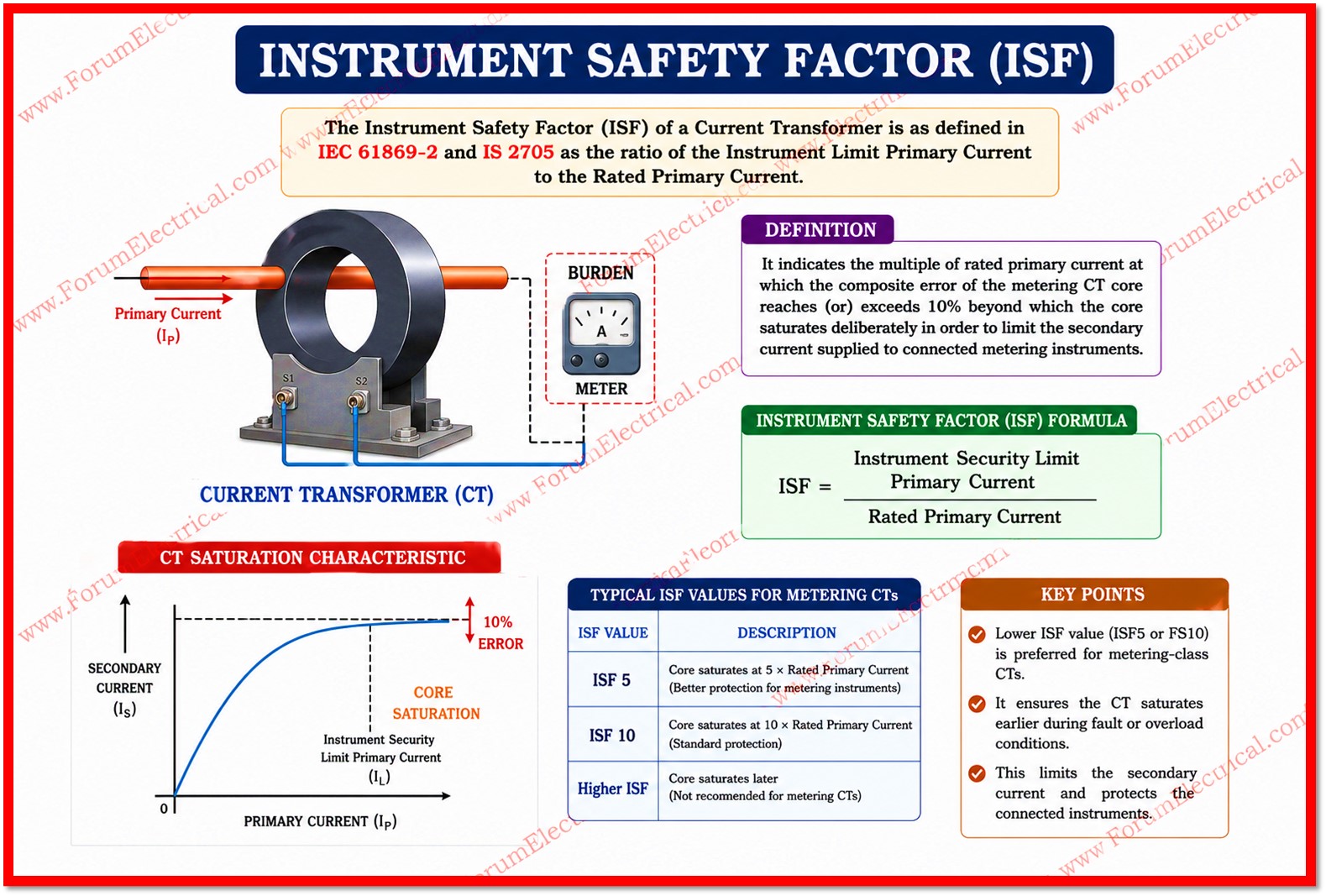
The Instrument Safety Factor of a Current Transformer is as defined in IEC 61869-2 and IS 2705 is the ratio of the Instrument Limit Primary Current to the Rated Primary Current.
It indicates the multiple of rated primary current at which the composite error of the metering CT core reaches (or) exceeds 10% beyond which the core saturates deliberately in order to limit the secondary current supplied to connected metering instruments.
The Safety Factor is expressed as:
ISF = Instrument Security Limit Primary Current / Rated Primary Current
A lower Instrument Safety Factor value (typically ISF5 or FS10) is preferred for metering-class CTs since it means the core saturates earlier & provides better protection to the connected instruments during fault (or) overload conditions.
Standard Values of Instrument Safety Factor
As per IEC 61869-2 and IS 2705, standard Instrument Safety Factor values commonly specified for metering CTs are
| Safety Factor Class | Typical Application |
|---|---|
| ISF5 | General metering circuits requiring higher instrument protection |
| ISF10 | Standard commercial & industrial metering applications |
Why Instrument Safety Factor is Important?
- Protects sensitive metering instruments (ammeters, wattmeters, energy meters) from thermal & mechanical damage during fault currents.
- Ensures the metering core saturates before the connected instruments short time withstand current is exceeded.
- Improves billing accuracy since a low ISF core saturates quickly that is keeping instruments away from distorted, non-linear regions during faults.
- Supports coordination between metering CTs and protection CTs that serve entirely opposite objectives on the same switchgear.
- Reduces the risk of instrument burnout that could otherwise lead to incorrect billing, safety hazards (or) costly instrument replacement.
Difference between Safety Factor (ISF) and Accuracy Limit Factor (ALF)
It is important not to confuse the Safety Factor of a metering CT with the Accuracy Limit Factor (ALF) of a protection CT as the 2 parameters serve opposite design parameters.
| Parameter | Metering CT (ISF) | Protection CT (ALF) |
|---|---|---|
| Purpose | Protect instruments from fault current | Accurately generate fault current for relays |
| Desired behavior | Core saturates early (low ISF) | Core stays linear until high multiples (high ALF) |
| Typical values | ISF5, ISF10 | ALF 10, 15, 20 |
Solved Example
Consider a metering CT rated 400/1 A with an Instrument Safety Factor of FS5.
This means the instrument security limit primary current is 5 x 400 A = 2000 A.
Up to 2000 A of primary current the CT secondary output increases proportionally and drives the connected meter accurately.
Beyond 2000 A (for example, during a short-circuit condition where primary current may reach 8000-10000 A), the core deliberately saturates and the secondary current no longer increases in proportion to the primary fault current.
This saturation behaviour keeps the secondary current within a safe range for the connected instruments even though the primary system may be experiencing a severe fault.
Selection Guidelines for Engineers
- Always select the lowest practical ISF value (ISF preferred over ISF10) for important (or) sensitive metering equipment.
- Verify the instruments rated short time current withstand capability against the CTs Safety Factor (ISF) limit current.
- An oversized burden can push the effective knee point and alter the actual saturation behaviour of the core.
- For revenue metering, coordinate ISF selection with utility (or) regulatory metering standards since accuracy class & FS class are specified together (e.g., 0.5S with FS5).
- Do not confuse ISF with the CT accuracy class and accuracy class (e.g., 0.2, 0.5, 1.0) defines normal load measurement accuracy while ISF defines fault condition instrument protection.
Conclusion
The Instrument Safety Factor (ISF) of a Current Transformer (CT) is a fundamental parameter for any metering CT that is utilized alongside protective and revenue metering instrumentation.
By ensuring that the metering core saturates well before dangerous fault currents can damage connected instruments and the Safety Factor provides a important layer of equipment protection.
An understanding of Safety Factor (FS) together with correct selection of Accuracy Limit Factor for the paired protection CTs allows engineers to design metering and protection schemes that are both accurate under normal conditions and safe under fault conditions.

 of current transformers, its importance, working principle, standard ratings, calculation and function in protecting meters and measuring instruments.)