
What is Tan Delta?
Tan Delta is defined as the tangent of this loss angle and represents the ratio of the resistive (in-phase) current component to the capacitive (quadrature) current component.
A higher Tan Delta value indicates greater dielectric losses and consequently a higher degree of insulation deterioration.
What is Tan Delta Testing?
Tan Delta testing also known as the Dissipation Factor (DF) (or) Loss Angle test is one of the most important diagnostic tools used to assess the condition of insulation in power and distribution transformers.
Insulation systems in transformers are subjected to continuous electrical, thermal and mechanical stresses throughout their operating life.
Over time, moisture ingress, contamination, oxidation and thermal ageing degrade the dielectric properties of the insulation that is increasing the risk of failure.
Tan Delta testing provides a reliable, non-destructive method of quantifying the health of insulation by measuring the dielectric losses that occur when an alternating voltage is applied across the insulation system.
Purpose and Objective
The primary objective of Tan Delta testing is to check the quality and ageing condition of transformer insulation, including bushings, windings and oil.
The test helps in early detection of insulation problems such as
- Moisture absorption,
- Contamination,
- Partial discharge activity and
- Thermal degradation
which long before they manifest as visible faults.
By periodically performing this test and trending the results, maintenance engineers can plan preventive interventions, avoid unplanned outages and extend the operational life of the transformer.
Principle of the Test
In an ideal and lossless insulation system, the current flowing through the insulation would lead the applied voltage by exactly 90 degrees behaving as a pure capacitor.
In practical, all insulation systems exhibit some degree of resistive leakage due to dielectric losses that is causing the current phasor to deviate from the ideal 900 angle by a small angle known as the loss angle denoted by delta (δ).
Test Equipment
- Automatic Tan Delta and capacitance measuring set (e.g., Omicron CPC 100/CP TD1, Doble / equivalent).
- High-voltage test cables and connecting leads.
- Standard reference capacitor for calibration.
- Insulated platform & safety barriers.
- Grounding rods & earthing cables.
- Temperature and humidity measuring instrument.
- Personal protective equipment (PPE).
Safety Precautions
Since the Tan Delta test involves the application of high voltage to the transformer under test strict safety precautions must be followed at every stage. The transformer must be completely isolated from the system, and all associated circuit breakers and isolators must be opened and tagged out. All terminals not under test should be solidly earthed.
A safety measure should be established around the test area with warning signs and only authorized personnel must be permitted inside the boundary during the test.
The test set must be properly earthed and the operator must confirm zero energy state before touching any connections after the test.
Test Procedure
Step-1: Ensure the transformer is de-energized and that is get isolated from the system and properly earthed on all sides.
Step-2: Disconnect all the external connections such as surge arresters, cables & neutral grounding connections from bushings to avoid parallel leakage paths.
Step-3: Clean the bushing surfaces thoroughly (neat and clean) to remove dust, dirt & moisture that may sometime cause surface leakage & erroneous readings.
Step-4: Record the ambient temperature including humidity & the transformer oil temperature as Tan Delta values (measurement) are temperature dependent.
Step-5: Connect the Tan Delta test set to the transformer bushings (or) windings as per the required test mode (GST & GST-Guard or UST).
Step-6: Perform the test in the following standard configurations such as
• HV winding-to-LV winding & ground (CH),
• LV winding-to-HV winding & ground (CL) and
• HV & LV windings to ground (CHL).
Step-7: Apply the test voltage gradually & typically starting from the voltage range of 2 kV & increasing in steps up to 10 kV while monitoring the leakage current & stability of readings.
Step-8: Record the capacitance (in pF) & Tan Delta (in %) values at every test voltage step for each & every configuration.
Step-9: Repeat this test for excitation current measurement & power factor tip up test if needed as per requirement for detailed diagnosis.
Step-10: After completion discharge the winding fully via a discharge rod prior to disconnecting the all the test leads.
Step-11: Restore all connections by removing earthing where appropriate & record the test results for comparison with the previous data and standard limits.
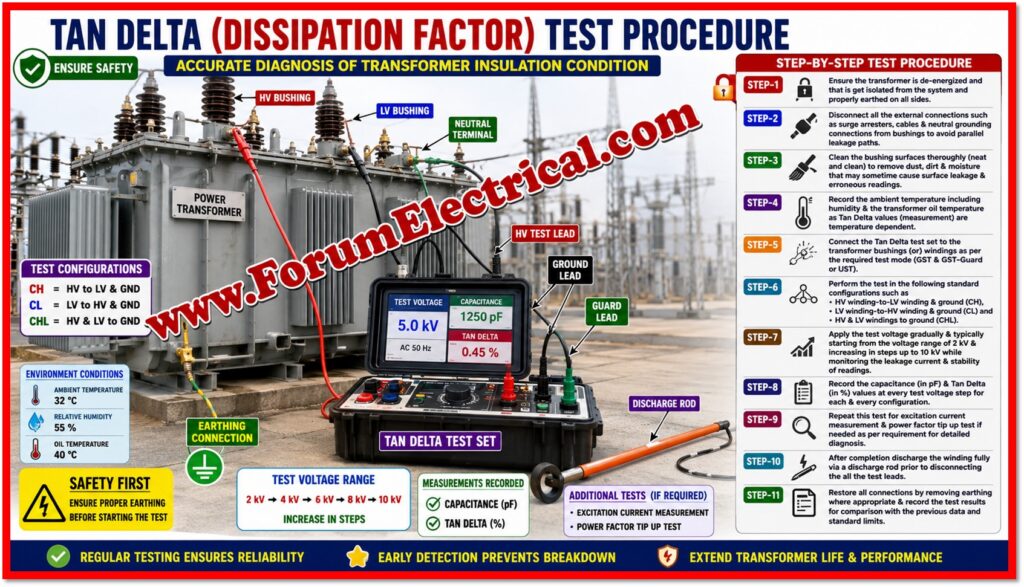
Factors affecting Tan Delta Values
- Temperature of the insulation & surrounding environment at the time of testing.
- Moisture content in the oil and solid insulation (paper/pressboard).
- Surface contamination on bushings and terminal connections.
- Ageing & oxidation of transformer oil.
- Presence of partial discharge or localized insulation defects.
- Test voltage level applied during measurement.
Interpretation of Results
The measured Tan Delta values are corrected to a reference temperature of 20°C using standard correction factors since dielectric losses are highly sensitive to temperature.
The corrected values are then compared against the manufacturers factory test results, previous historical test data and applicable standards such as IEEE C57.12.90 and IEC 60076.
A significant increase in Tan Delta compared to previous baseline readings even if within the general acceptable limit is considered a warning sign of insulation deterioration and warrants further investigation such as oil dissolved gas analysis (DGA) (or) furan testing.
| Transformer Condition | Tan Delta (%) at 20°C | Remarks |
|---|---|---|
| New transformer (as delivered) | < 0.5% | Healthy insulation |
| Good condition in service | 0.5% – 1.0% | Acceptable, monitor trend |
| Moderate deterioration | 1.0% – 2.0% | Investigate, plan maintenance |
| Severe deterioration | > 2.0% | Immediate corrective action |
Conclusion
Tan Delta testing is a important one of a comprehensive transformer condition assessment and predictive maintenance procedure.
It provides a quick, reliable and non-destructive means of evaluating insulation health enabling maintenance teams to detect early signs of deterioration and take corrective action before a catastrophic failure occurs.
Regular periodic testing combined with trend analysis and correlation with other diagnostic tests such as DGA, insulation resistance and power factor testing, ensures optimal reliability, safety and extended service life of power transformers in the electrical network.

