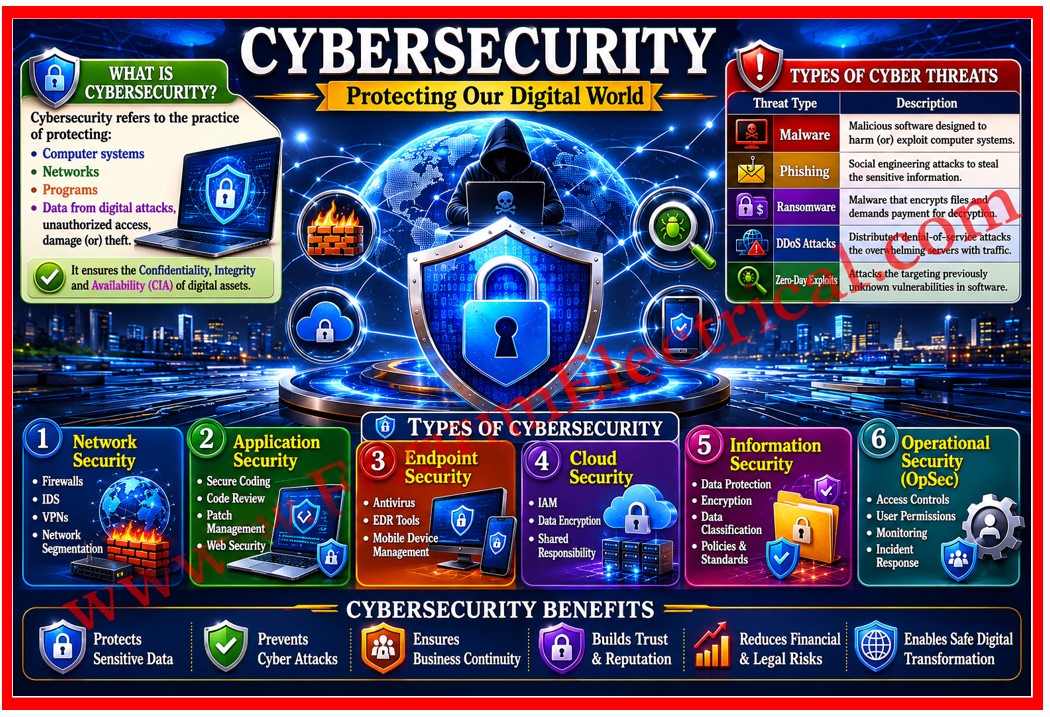
What is Cybersecurity?
Cybersecurity refers to the practice of protecting
- Computer systems,
- Networks,
- Programs and
It encompasses a wide range of technologies, processes and practices designed to protect information and ensure the confidentiality, integrity and availability (CIA) of digital assets.
In an increasingly connected world cybersecurity has become one of the most important disciplines in information technology.
Organizations and individuals are primarily depend on the robust security measures to protect sensitive data and maintain privacy and ensure the continuity of operations.

CIA Triad
The foundation of cybersecurity depends on 3 core principles commonly known as the CIA Triad:
Ensuring that information is accessible only to those authorized to access it. This is attained through encryption, access controls & authentication.
Protecting the accuracy and completeness of information.
Data must not be altered by unauthorized parties.
Hash functions & digital signatures are key tools here.
Ensuring that authorized users may access information and systems whenever required.
This includes protection against denial of service attacks & maintaining disaster recovery plans.
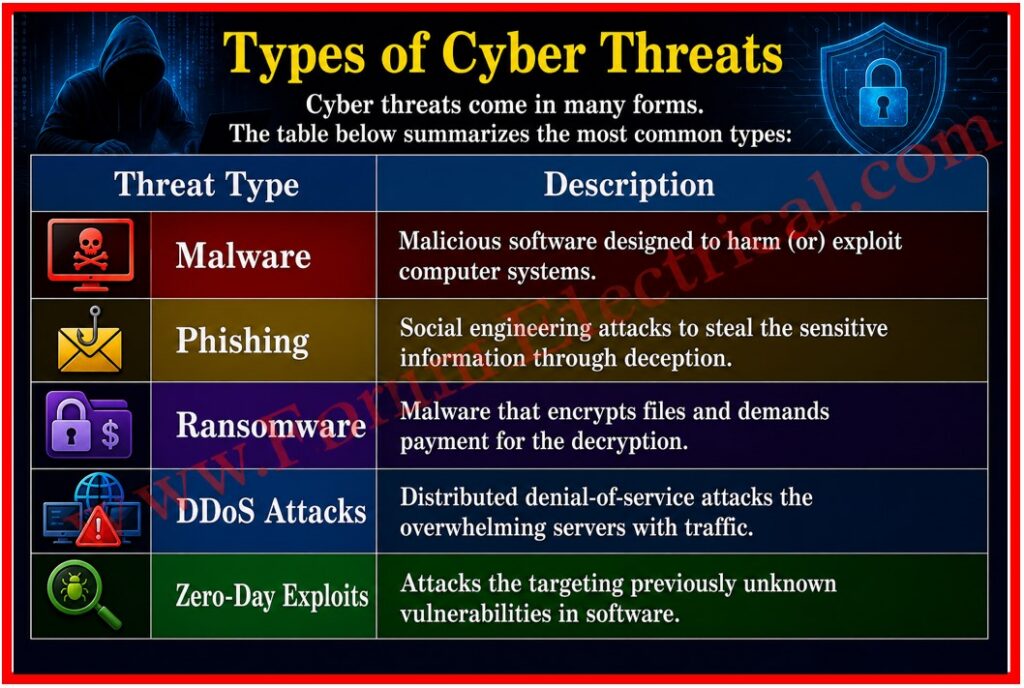
Types of Cyber Threats
Cyber threats come in many forms.
The table below summarizes the most common types:
| Threat Type | Description |
|---|---|
| Malware | Malicious software designed to harm (or) exploit computer systems. |
| Phishing | Social engineering attacks to steal the sensitive information through deception. |
| Ransomware | Malware that encrypts files and demands payment for the decryption. |
| DDoS Attacks | Distributed denial-of-service attacks the overwhelming servers with traffic. |
| Zero-Day Exploits | Attacks the targeting previously unknown vulnerabilities in software. |
Types of Cybersecurity
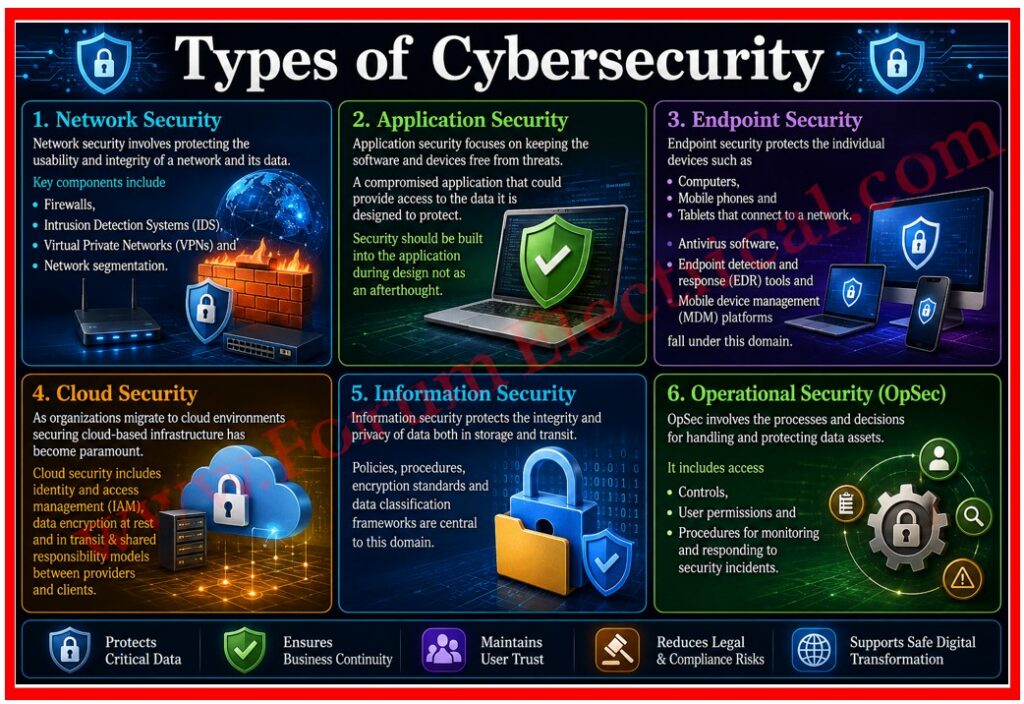
Network Security
Network security involves protecting the usability and integrity of a network and its data.
Key components include
- Firewalls,
- Intrusion Detection Systems (IDS),
- Virtual Private Networks (VPNs) and
- Network segmentation.
Application Security
Application security focuses on keeping the software and devices free from threats.
A compromised application that could provide access to the data it is designed to protect.
Security should be built into the application during design not as an afterthought.
Endpoint Security
Endpoint security protects the individual devices such as
- Computers,
- Mobile phones and
- Tablets that connect to a network.
- Antivirus software,
- Endpoint detection and response (EDR) tools and
- Mobile device management (MDM) platforms
fall under this domain.
Cloud Security
As organizations migrate to cloud environments securing cloud-based infrastructure has become paramount.
Information Security
Information security protects the integrity and privacy of data both in storage and transit.
Policies, procedures, encryption standards and data classification frameworks are central to this domain.
Operational Security (OpSec)
OpSec involves the processes and decisions for handling and protecting data assets.
It includes access
- Controls,
- User permissions and
- Procedures for monitoring and responding to security incidents.
Cybersecurity Best Practices
Implementing the strong cybersecurity measures needs a multi layered method.
The following best practices are widely needed:
Use strong, unique passwords and enable multi-factor authentication (MFA) on all accounts.
Keep all software, operating systems and applications updated with the latest security patches.
Conduct a regular security awareness training for the employees to recognize phishing & social engineering.
Perform the routine backups of essential data & test recovery procedures regularly.
Deploy firewalls, intrusion detection systems & endpoint protection solutions.
Segment networks to limit the spread of attacks and implement the principle of least privilege.
Conduct a regular vulnerability assessments and penetration tests to identify the weaknesses.
Develop and maintain an incident response plan to react swiftly (quickly) to security breaches.
Cybersecurity Career Paths
Cybersecurity gives a diverse range of career opportunities.
Some of the most prominent works include:
Security Analyst: Monitors the systems for threats & investigates security incidents.
Ethical Hacker / Penetration Tester: Simulates the cyberattacks to identify & fix vulnerabilities.
Security Engineer: Designs & implements a secure systems and infrastructure.
Chief Information Security Officer (CISO): Senior executive is primarily responsible for an organizations security strategy.
Forensic Analyst: Investigates the cybercrimes & collects digital evidence.
Security Architect: Designs the overall security framework of an organization or institute.
Future of Cybersecurity
The cybersecurity landscape is constantly evolving.
Emerging trends shaping the future include:
Artificial Intelligence & Machine Learning
AI is being leveraged both to enhance threat detection and unfortunately to craft more sophisticated attacks.
Zero Trust Architecture
Moving away from perimeter based security to a model where no user (or) device is trusted by default regardless of location.
Quantum Computing
While promising for many fields quantum computers could break current encryption standards and necessitating the development of quantum-resistant cryptography.
IoT Security
The explosion of Internet of Things devices creates a new attack surfaces need the dedicated security strategies.
Regulatory Compliance
Increasing global regulations (GDPR, CCPA, etc.) are driving organizations to adopt a stronger data protection measures.
Conclusion
Cybersecurity is no longer an optional investment.
It is an essential necessity for individuals, businesses and governments also.
As digital threats grow in sophistication and frequency maintaining a proactive, layered and well informed security posture is essential to protecting our digital future.
Understanding the fundamentals of cybersecurity is the first and initial step toward building resilient systems and a safer internet for everyone.

