
Calculator
A systematic go through of every calculation the online calculator tool performs from raw nameplate inputs through to all 12 computed results.
Click here for more Electrical Calculators
Each formula is traced to its NEMA MG-1,IEEE112 (or) NEC 2023 source with a fully worked 10 HP,460 V,3 phase example.
Standards
- NEMA MG-1 / IEEE 112
Overview
The NEMA Motor Data Calculator accepts 6 input sections and executes a single pass sequential computation generating 12 results.
Understanding the data flow order is essential:an error in any of the upstream input (especially efficiency,PF or voltage) propagates through every downstream result.
Formula to Calculate
| [1] | Output Power (kW)kW=HP x 0.7457 –shaft mechanical power output |
| [2] | Full Load Speed (RPM)flRPM=syncRPM × (1 − slip) –actual operating speed |
| [3] | Full Load Torque (lb·ft)FLT=(HP x 5252) / flRPM –rated shaft torque |
| [4] | Full-Load Amps (FLA)FLA=(kW x 1000) / (√ (3) x V x PF x eff) –pivot result |
| [5] | Input Power (kW)+Losses (kW)Pin=kW/eff, Losses=Pin –kW |
| [6] | Apparent &Reactive PowerkVA=√(3) x V x FLA/1000, kVAR=√ (kVA²-Pin²) |
| [7] | Starting Current LRCLRC=FLA x startIx (default 6x) |
| [8] | Locked-Rotor Torque LRTLRT=FLT x startPct (default 150%) |
| [9] | Breakdown Torque BDTBDT=FLT x bdPct (default 250%) |
| [10] | Overload Relay Setting (OLC)OLC=FLA x OLmult x SF –NEC 430.32 trip current |
Phase Factor Resolution
The first operation is resolving the phase multiplier.
This single boolean check gates every subsequent current,power and apparent power formula.
Why √(3)?
Three-phase apparent power:S=√ (3) x Vlinex Iline
Rearranging for I:I=S / (√ (3) x Vlinex PF x eta)
Single-phase:S=V x I=>I=S / (V x PF x eta)
Always enter the electric motor nameplate rated voltage not the supply voltage.
Incorrect voltage propagates through FLA,kVA,kVAR,LRC and OLC.
Output Power (kW)
The HP to kW conversion uses the exact NEMA defined mechanical conversion factor.
This is shaft output power that the motor delivers at the coupling. Electrical input power is always higher due to internal losses.
North American motors are rated in HP;IEC motors in kW.
The conversion 1 HP=0.746 kWis used on nameplates.
The calculator uses the more accurately 0.7457 for computational accuracy. For a 10 HP motor:
- Nameplate shows 7.46 kW
- Calculator uses 7.457 kW.
Full-Load Speed (RPM)
Synchronous speed is the speed of the rotating magnetic field determined by supply frequency and pole count.
The rotor always runs slightly slower and this difference is slip and the mechanism by which torque is generated in an induction motor.
Full-Load Speed –NEMA MG-1
Synchronous speed (rotating magnetic field speed):
Ns=(120 x f) / P
Where
f=supply frequency (Hz)
P=number of poles
Selected in the calculator via Synchronous Speed dropdown:
- 3600 RPM=2-pole @ 60 Hz
- 1800 RPM=4-pole @ 60 Hz (most common)
- 1200 RPM=6-pole @ 60 Hz
Full load actual speed:
flRPM=syncRPM x (1 –slip)
Example:1800 RPM sync,3% slip
flRPM=1800 x (1 –0.03)=1800 x 0.97=1746 RPM
| Sync Speed | Poles | Freq | Typical Slip | FL Speed (3% slip) |
|---|---|---|---|---|
| 3600 RPM | 2 | 60 Hz | 1–2% | 3528–3564 RPM |
| 1800 RPM | 4 | 60 Hz | 2–5% | 1710–1764 RPM |
| 1200 RPM | 6 | 60 Hz | 2–5% | 1140–1176 RPM |
| 900 RPM | 8 | 60 Hz | 3–5% | 855–873 RPM |
Full Load Torque (FLT)
The full-load torque formula converts mechanical power and speed into shaft torque using the constant 5252 –a unit conversion factor derived from the definitions of horsepower and rotational mechanics.
Full Load Amps (FLA)
FLA is the central output of the calculator and it is used directly in
- Conductor sizing,
- Overload relay setting and
- Starting current calculations.
It is derived from the electrical power balance:input power equals output divided by efficiency and input power equals the product of voltage,current,PF and phase factor.
Full Load Ampsis based on IEEE 112.
Three Phase Motors
FLA=(kw x 1000) / (√(3) x voltage x pf x eff)
Single Phase Motors
FLA=(kw x 1000) / (voltage x pf x eff)
Why IE3/IE4 motors reduce operating costs?
| Efficiency Level | eta | FLA (10 HP,460 V,3-phase) | Annual kWh (8760h) |
|---|---|---|---|
| Standard (IE1) | 88.0% | 12.50 A | 71,256 kWh |
| Energy Efficient (IE2) | 90.2% | 12.20 A | 71,193 kWh |
| Premium (IE3) | 91.7% | 12.00 A | 71,238 kWh |
| Ultra Premium (IE4) | 93.6% | 11.77 A | 71,218 kWh |
Input Power (kW) &Power Losses
Input power is that the motor draws from the supply.
Losses are the difference that the heat dissipated in
- Stator copper (I²R),
- Rotor copper,
- Core (eddy+hysteresis) and
- Friction/windage.
These losses determine the thermal loading and operating cost.
Apparent Power (kVA) &Reactive Power (kVAR)
kVA is that the supply must deliver and it determines transformer and generator sizing.
kVAR is the reactive component that magnetises the motor but does no useful work and it loads the distribution system and causes voltage drop without contributing to the power meter reading.
The kVAR output confirms that power factor correction (PFC) capacitors must not be installed between a VFD and the motor.
Capacitors on VFD output cause resonance that destroys motor insulation.
PFC capacitors belong on the supply side of the VFD input where the kVA determined from the calculator is used to size the input filter.
Overload Relay Setting (OLC)
The overload relay protects the motor from sustained overloads that would overheat the windings.
NEC Article 430.32(A)(1) requires the relay trip current to not exceed 125% of FLA for motors with a nameplate service factor >=1.15 (or) a temperature rise <=40°C.
- If motor SF >=1.15:OL trip <=FLA x 1.25
- If motor SF <1.15: OL trip <=FLA x 1.15
- If motor temp rise <=40°C:OL trip <=FLA x 1.25
The relay is typically set at~105-115% of this value to account for ambient temperature and class tolerance.
Solved Example
A 10 HP,460 V,3-phase,4-pole,design B induction motor drives a centrifugal pump. Settings:eta=91.7%,PF=0.85,slip=3%,SF=1.15,OL multiplier=1.25,LRC=6×,LRT=150%,BDT=250%.
| Step | Formula | Result | Unit |
|---|---|---|---|
| Phase factor | √(3) | 1.7321 | — |
| Output power | 10 x 0.7457 | 7.457 | kW |
| Full-load speed | 1800 x (1 –0.03) | 1,746 | RPM |
| FLT | (10 x 5252) / 1746 | 30.08 | lb·ft |
| FLA | 7457 / (1.732 x 460 x 0.85 x 0.917) | 12.00 | A |
| Input power | 7.457 / 0.917 | 8.132 | kW |
| Losses | 8.132 − 7.457 | 0.675 | kW |
| kVA | (1.732 x 460 x 12.00) / 1000 | 9.561 | kVA |
| kVAR | √(9.561² –8.132²) | 5.03 | kVAR |
| LRC | 12.00 x 6 | 72.0 | A |
| LRT | 30.08 x 1.50 | 45.1 | lb·ft |
| BDT | 30.08 x 2.50 | 75.2 | lb·ft |
| OLC | 12.00 x 1.25 x 1.15 | 17.25 | A |
How to read a NEMA motor nameplate?
A NEMA motornameplate provides an essential electrical and mechanical details that is required for proper installation,operation and maintenance of a motor.
A NEMA motor nameplate is same as that of how to read a motor nameplate data.
Reading a NEMA motor name plate details correctly is essential for safe operation,efficient performance and long motor life especially in industrial and substation applications.
A NEMA motor nameplate provides key information such as
- Power (HP/kW),
- Voltage,
- Current,
- Speed (RPM),
- Frequency and
- Efficiency
which are essential for proper motor operation.
It also includes details like
- Insulation class,
- Service factor,
- Enclosure type and
- Duty cycle
helping in correct installation,protection setting and safe usage of the motor.
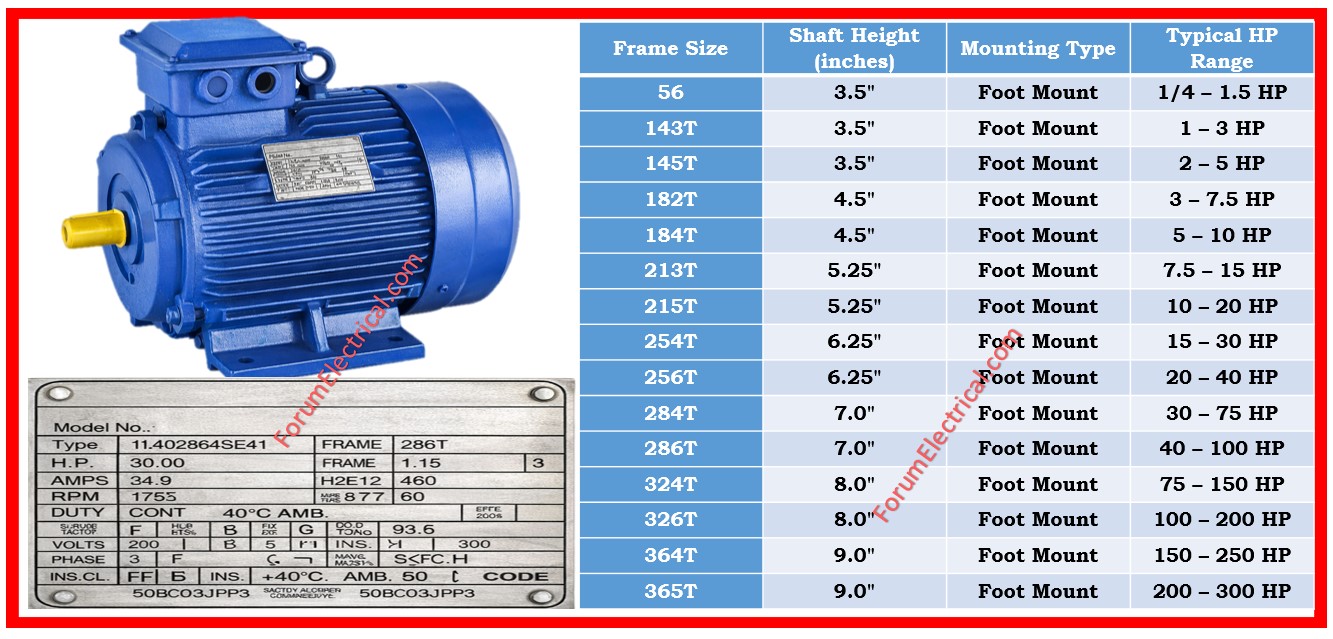
NEMA Motor Frame Size Chart
NEMA frame size using motor frame size chart defines the physical dimensions of a motor including shaft height,mounting hole spacing and shaft diameter ensuring interchangeability.
| Frame Size | Shaft Height (inches) | Mounting Type | Typical HP Range |
|---|---|---|---|
| 56 | 3.5″ | Foot Mount | 1/4 – 1.5 HP |
| 143T | 3.5″ | Foot Mount | 1 – 3 HP |
| 145T | 3.5″ | Foot Mount | 2 – 5 HP |
| 182T | 4.5″ | Foot Mount | 3 – 7.5 HP |
| 184T | 4.5″ | Foot Mount | 5 – 10 HP |
| 213T | 5.25″ | Foot Mount | 7.5 – 15 HP |
| 215T | 5.25″ | Foot Mount | 10 – 20 HP |
| 254T | 6.25″ | Foot Mount | 15 – 30 HP |
| 256T | 6.25″ | Foot Mount | 20 – 40 HP |
| 284T | 7.0″ | Foot Mount | 30 – 75 HP |
| 286T | 7.0″ | Foot Mount | 40 – 100 HP |
| 324T | 8.0″ | Foot Mount | 75 – 150 HP |
| 326T | 8.0″ | Foot Mount | 100 – 200 HP |
| 364T | 9.0″ | Foot Mount | 150 – 250 HP |
| 365T | 9.0″ | Foot Mount | 200 – 300 HP |
NEMA frame sizes standardize motor dimensions making installation,replacement and maintenance easier across different manufacturers.