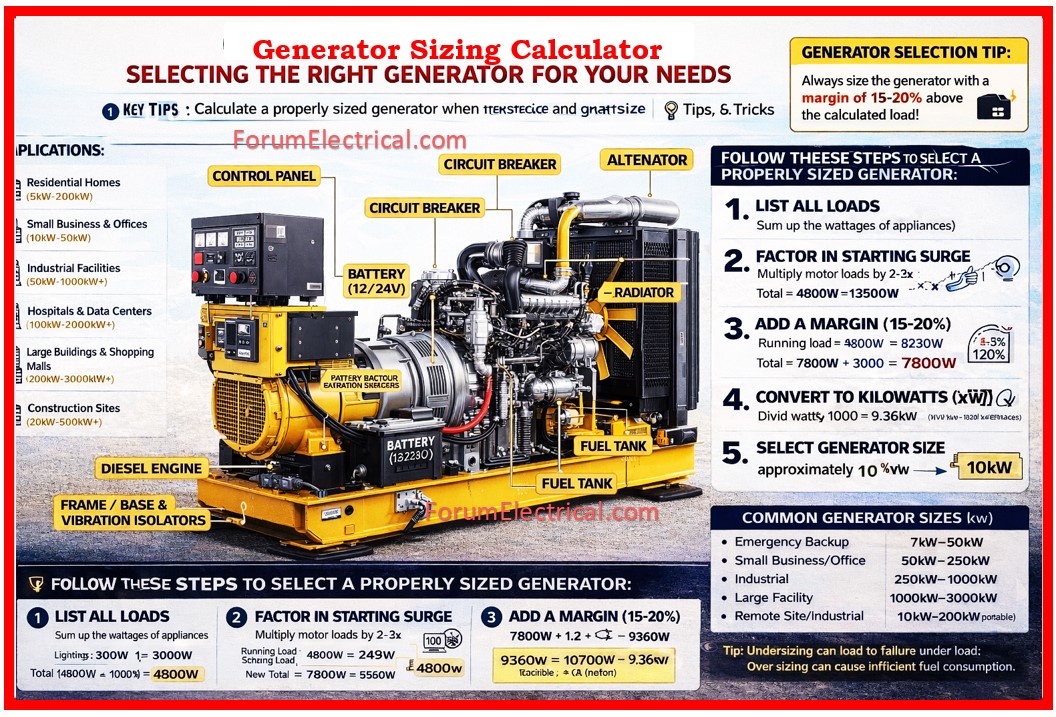
Calculator
The generator sizing calculator is a professional engineering online calculator tool designed to assist electrical engineers, project designers and facility managers in computing the maximum electrical demand of an installation and sizing the required standby (or) emergency generator accordingly.
Load Listing & Generator Sizing Calculator
Enter equipment loads, select load nature, and compute the recommended generator KVA with growth factor corrections.
Maximum Load = 100% of Continuous Load + 50% of Intermittent Load + 10% of Standby Load (or biggest individual standby load — whichever is higher)
| # | Equipment Name | Equip ID | Absorbed KW |
Rated KW |
Load Factor |
Eff η | Cos Ø | Nature C / I / S |
Cont KW |
Cont KVAR |
Inter KW |
Inter KVAR |
Stand KW |
Stand KVAR |
|
|---|---|---|---|---|---|---|---|---|---|---|---|---|---|---|---|
| ∑ TOTALS | 0.00 | 0.00 | 0.00 | 0.00 | 0.00 | 0.00 | |||||||||
Click here for more Electrical Calculators
The calculator follows industry standard methodologies aligned with IEC and IEEE practices for load estimation and generator sizing.
Electrical Concepts
Active Power (KW) and Reactive Power (KVAR)
Every electrical load consumes 2 components of power:
Active Power (KW)
The real power that performs useful work in driving motors, generating light, generating heat.
Reactive Power (KVAR)
The non working power that establishes and maintains the electromagnetic fields in inductive loads such as motors & transformers.
Together they form Apparent Power (KVA) that is what the generator must supply:
KVA = √( KW² + KVAR² )
Power Factor (Cos Ø)
Power Factor is the ratio of active power to apparent power.
It indicates how efficiently the load converts electrical power into useful work.
A power factor of 1.0 is ideal and most industrial loads operate between 0.70 and 0.95.
Power Factor (Cos Ø) = KW / KVA
The reactive component (KVAR) is derived from the active power and power factor using:
KVAR = KW × tan( arccos(Cos Ø) ) = KW × √(1 − Cos²Ø) / CosØ
Load Factor
The Load Factor accounts for the fact that the most equipments does not operate continuously at its rated capacity.
It is the ratio of the average load to the maximum possible (rated) load over a given period.
Load Factor = Average Load / Rated (Full Load) Capacity
The calculator uses this to calculate the effective absorbed demand.
Efficiency (η)
Electrical motors and other driven equipment have an efficiency factor.
Not all the electrical power drawn from the supply is converted to mechanical output, some is lost as heat.
Input KW = Absorbed KW / ( Efficiency × Load Factor )
Load Classification
All equipment loads in the schedule are classified into 3 operational categories.
This classification derives the maximum demand calculation.
| C – Continuous Load Loads that operate continuously for 3 hours (or) more without interruption during normal operation. These are counted at 100% of their calculated demand. Examples: pumps supplying a running process, lighting systems, HVAC air handling units. | I – Intermittent Load Loads that operate for short (or) irregular periods during normal operation. Only a fraction (typically 50%) of the intermittent load total is counted in the maximum demand calculation, reflecting that not all intermittent loads run simultaneously. |
| S – Standby Load Loads that operate only when the primary (duty) equipment is unavailable. i.e., Backup equipment. A small percentage (typically 10%) (or) the single largest individual standby load (whichever is >) is included in the maximum demand calculation. | Emergency Loads Loads powered from the emergency bus (e.g., fire fighting pumps, emergency lighting). These are essential loads that must be supplied by the generator in a power failure condition and are therefore included in the generator sizing calculation. |
Input Parameters
The equipment load schedule requires the following inputs for each part of equipment.
All fields default to zero on a new row and so only actual values need to be entered.
| Parameter | Description | Typical Value |
|---|---|---|
| Equipment Name | Descriptive name of the equipment (e.g., Pump Water, Exhaust Fan) | Free text |
| Equip ID | Unique tag or identification number for the equipment as per the drawing register | e.g. WP-01, FP-1 |
| Absorbed KW | The actual mechanical/thermal power consumed by the load (shaft power for motors) | e.g. 11 KW |
| Rated KW | The nameplate rated power of the motor or equipment | e.g. 15 KW |
| Load Factor | Ratio of average load to rated capacity (0.0–1.0). Accounts for partial loading. | 0.70 – 0.80 |
| Efficiency (η) | Motor or equipment efficiency (0.0–1.0). Accounts for energy conversion losses. | 0.85 – 0.95 |
| Cos Ø | Power factor of the load (0.0–1.0). Inductive loads (motors) typically 0.75–0.90. | 0.75 – 0.85 |
| Nature (C/I/S) | Load classification: Continuous, Intermittent, or Standby. Drives demand factor application. | C, I, or S |
Terms
| Parameter | Description | Typical Value |
|---|---|---|
| KW | Kilowatt – unit of active (real) power | |
| KVAR | Kilovolt-Ampere Reactive – unit of reactive power | |
| KVA | Kilovolt-Ampere – unit of apparent power (KVA = √(KW² + KVAR²)) | |
| Cos Ø | Power Factor – ratio of KW to KVA | 0.0 – 1.0 |
| η (Eta) | Efficiency – ratio of output power to input power | 0.0 – 1.0 |
| Load Factor | Ratio of average operating load to installed rated capacity | 0.0 – 1.0 |
| Diversity | The probability that not all loads operate simultaneously at full capacity | Project specific |
| Demand Factor | Ratio of maximum demand to total connected load | Project specific |
| Growth Factor | Allowance for future load increases over the design life of the installation | Typically 10–20% |
| MCC | Motor Control Centre – the electrical panel distributing power to equipment | |
| C / I / S | Continuous / Intermittent / Standby – load nature classification codes |
Calculation Parameters
These global settings that control the demand factors applied across all equipment schedule.
They can be adjusted to match the project specifications (or) client requirements.
| Parameter | Description | Typical Value |
|---|---|---|
| System Voltage (V) | Line-to-line supply voltage used to calculate load current in Amps | 400 V (3-phase) |
| Intermittent Factor (%) | Percentage of the total intermittent load KW/KVAR included in the maximum demand | 50% |
| Standby Factor (%) | Percentage of the total standby load included, unless the largest single standby is greater | 10% |
| Growth Factor (%) | Allowance for future load expansion. Applied on top of the maximum demand figures. | 10% |
| Generator Loading (%) | The recommended operating loading of the generator — typically 70–80% for longevity. | 70% |
Points to Remember
Setting the generator loading to 70% means the generator runs at 70% of its rated KVA under peak conditions.
This provides a thermal margin, allows for transient starting currents of motors, and extends the service life of the generator set.
Step-by-Step Calculation
Step-1: Calculate Input Power per Equipment
For each row the calculator determines the electrical input power the supply must deliver:
Input KW = Absorbed KW / ( Efficiency x Load Factor )
Input KVAR = Input KW x √(1 − Cos²Ø) / CosØ
The result is assigned to the appropriate column that is Continuous, Intermittent (or) Standby based on the equipments classification.
Step-2: Sum by Category
The calculator totals the KW and KVAR for each of the 3 categories across all equipment :
- Total Continuous KW & KVAR (ΣC)
- Total Intermittent KW & KVAR (ΣI)
- Total Standby KW & KVAR (ΣS) and the single largest standby KW value
Step-3: Compute Normal Running Load (Maximum Demand)
The maximum demand under normal running conditions is the cornerstone result:
Max Demand KW = 100% x ΣCKW + i% x ΣIKW + MAX( s% x ΣSKW , Largest Standby KW )
Where
i% – Intermittent Factor
s% – Standby Factor
The same formula applies to KVAR.
The Apparent Power (KVA), Power Factor and Load Current are then derived:
Normal KVA = √( Normal KW² + Normal KVAR² )
Load Current (A) = KVA × 1000 / ( √3 x Voltage )
Step-4: Peak Load
The Peak Load represents the worst case condition where all loads are continuous, intermittent and standby that operate simultaneously at the full calculated demand:
Peak KW = ΣCKW + ΣIKW + ΣSKW
This value is used as the basis for generator sizing since the generator should be capable of handling this peak scenario.
Step-5: Apply Growth Factor
Both the normal and peak load figures are multiplied by the growth factor that to provide headroom for future load additions:
Adjusted KW = Calculated KW x ( 1 + Growth Factor / 100 )
Step-6: Recommended Generator Size
The final generator KVA recommendation is based on the peak load with growth factor that is divided by the recommended generator loading percentage.
This ensures the generator operates within its thermal comfort zone under peak conditions:
Generator KVA = Peak KW with Growth / (Generator Loading%/100) ÷ Power Factor
The recommended KVA is the minimum rated capacity the generator set should need.
The next standard commercial size above this value must be selected from the manufacturers range (e.g., if the result is 150.5 KVA then select a 175 KVA / 200 KVA unit).
Results
The calculator generate 4 results each showing KW, KVAR, KVA, Power Factor, Current (Amps) and Voltage.
| Normal Running Load The expected demand during normal plant operation after applying all demand diversity factors. This is used for cable sizing, busbar ratings, and transformer loading estimates. | Peak Load The maximum coincident demand if every installed load ran simultaneously. This is the worst case condition that is used as the generator sizing basis before the growth factor is applied. |
| Normal Load + Growth Factor The normal running load adjusted upward by the growth factor percentage. This accounts for planned future expansion & ensures the installation remains adequate for its full design life. | Recommended Generator Size The minimum KVA of generator set required. Calculated from the peak load with growth factor divided by the generator loading factor. Select the next available standard commercial rating. |
How to use the Calculator?
- Open the calculator and all default values are set to the worked example above.
- Review the calculation parameters at the top. Adjust system voltage, demand factors and growth factor to match your specification.
- In the equipment load schedule review (or) edit each row. The equipment name, ID and electrical parameters (Absorbed KW, Rated KW, Load Factor, Efficiency, Cos Ø) must reflect your actual equipment data sheet values.
- Set the nature of each load to C (Continuous), I (Intermittent) or S (Standby) using the dropdown selector. The KW and KVAR output columns will get update automatically.
- Use the + Add Equipment Row button to add new equipment. Use the red X button to remove rows that are not applicable.
- Click the Calculate Generator Size button. The 4 result cards will populate with Normal Load, Peak Load, Growth Adjusted Load and Recommended Generator KVA.
- The current (Amps) displayed in each result that can be used to verify the switchboard busbar and cable sizing.
- Select the next standard commercial generator size above the recommended KVA from your preferred generator suppliers range.
Points to Remember
Always use data from the equipment data sheets rather than estimated values.
For motors, use the nameplate efficiency and ensure the power factor matches the actual operating point.
If manufacturer data is unavailable use conservative typical values (e.g., efficiency = 0.85 & pf = 0.80 for general induction motors).
Standards and References
The calculation methodology used in this tool is consistent with the following international standards & engineering references:
- IEC 60076: Power transformers
- IEC 60034: Rotating electrical machines
- IEC 60364: Low-voltage electrical installations
- IEEE Std 141 (Red Book): Recommended Practice for Electric Power Distribution for Industrial Plants
- IEEE Std 242 (Buff Book): Recommended Practice for Protection and Coordination of Industrial and Commercial Power Systems
- IEEE Std 446: Recommended Practice for Emergency and Standby Power Systems
- BS 7671: Requirements for Electrical Installations (IET Wiring Regulations)

