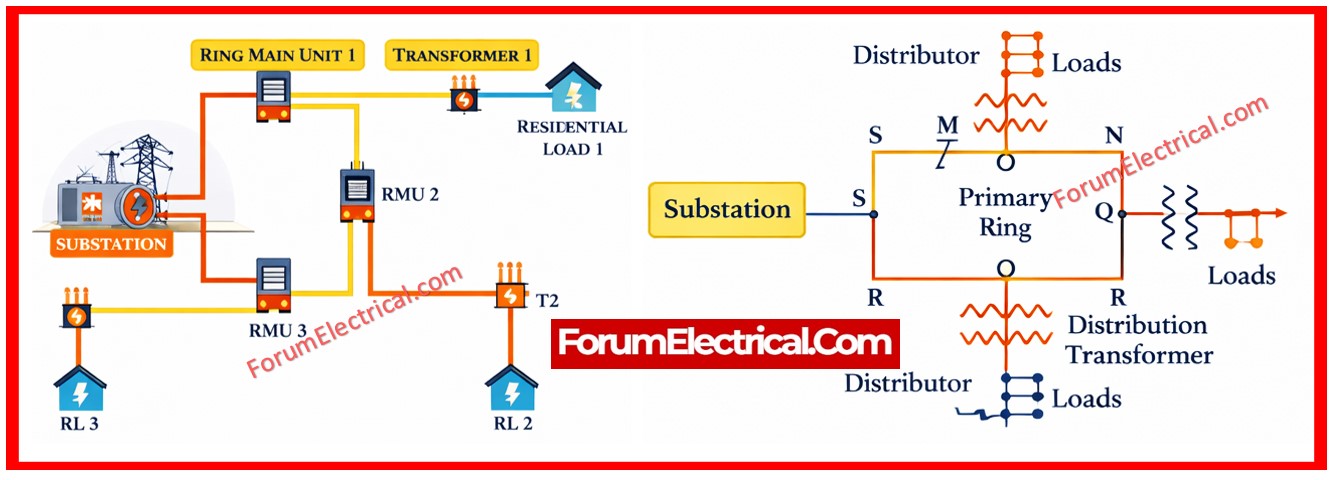
Medium-voltage (MV) systems play a crucial function in modern power distribution, even though many engineers primarily focus on low voltage (LV) systems.
Among MV equipment the Ring Main Unit (RMU) is one of the most important components for ensuring power reliability, operational flexibility and continuity of supply.
A Ring Main Unit (RMU) is a compact, factory-assembled medium-voltage switchgear designed for use in ring distribution networks.
In this configuration, the power supply is fed from 2 directions allowing uninterrupted service even during faults (or) maintenance conditions.
What is a Ring Main Unit (RMU)?
A Ring Main Unit (RMU) is a factory assembled, metal-enclosed medium-voltage switchgear utilized in secondary distribution networks.
It operates in a ring configuration where power can flow from two directions ensuring redundancy and reliability.
Working Principle of RMU
Normal Operating Condition
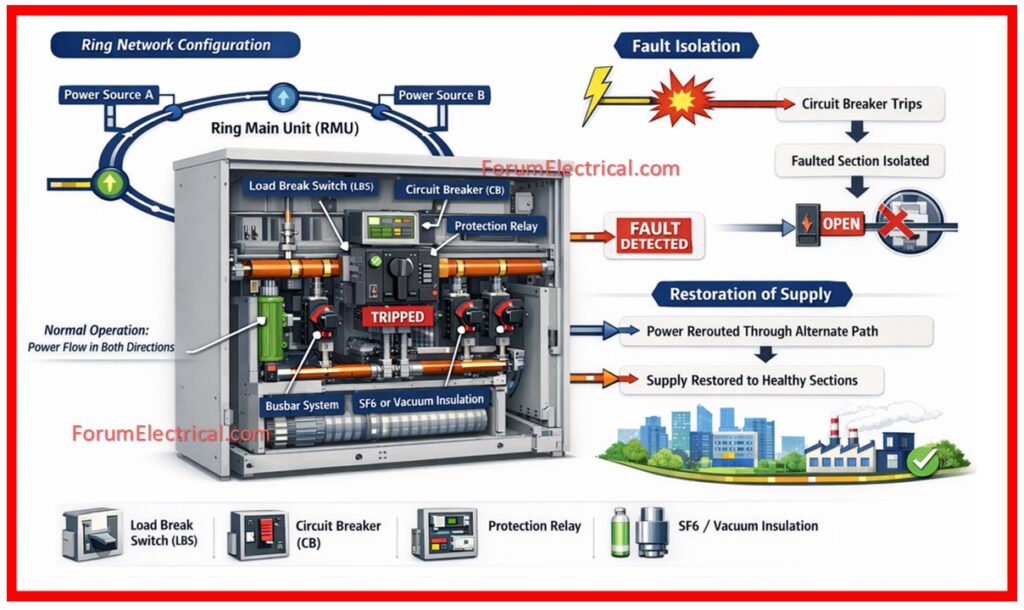
In normal operation electrical power flows through the network in a closed loop (ring) configuration.
All switches within the RMU remain in the closed position, enabling continuous power flow throughout the network.
This arrangement allows loads to receive power from multiple directions, improving system reliability and load sharing.
If one side of the ring experiences a disturbance, the other side can still maintain supply without interruption.
Fault Condition
When a fault occurs in the network it is quickly detected by protective devices.
Protection relays such as overcurrent relays identify excessive current conditions caused by short circuits.
Earth fault relays detect leakage currents flowing to the ground due to insulation failure or cable faults.
Once the fault is detected the RMU initiates a sequence of protective actions to isolate the affected section.
Fault Isolation and Supply Restoration
The circuit breaker in the RMU automatically trips when a fault is detected.
The faulty section of the network is then isolated using load break switches.
These switches allow safe disconnection of the affected portion without interrupting the entire network.
After isolation the power supply is restored through the alternate path of the ring network.
This ensures that healthy sections of the network continue to receive power without a complete outage.
Main Components of RMU
1). Load Break Switch (LBS)
The Load Break Switch is used to switch load currents under normal operating conditions.
It can safely make or break circuits carrying current without causing damage to the system.
However it is not designed to interrupt high fault currents.
2). Circuit Breaker (CB)
The Circuit Breaker is responsible for interrupting fault currents during abnormal conditions.
It operates automatically based on signals received from protection relays.
It provides critical protection to both equipment and the network.
3). Protection Relay
The Protection Relay continuously monitors electrical parameters such as current and voltage.
It detects abnormal conditions like overloads, short circuits, and earth faults.
Upon detection it sends a trip signal to the circuit breaker to isolate the fault.
4). Busbar System
The Busbar system acts as a common electrical junction within the RMU.
It distributes incoming power to multiple outgoing feeders.
It ensures efficient and reliable power flow inside the unit.
5). Insulation & Arc Extinction Medium
RMUs commonly use SF₆ gas or vacuum technology for insulation and arc quenching.
SF₆ gas provides excellent dielectric strength and arc suppression properties.
Vacuum interrupters offer a safer and environmentally friendly alternative with minimal maintenance requirements.
Advantages of RMU
- Ring network configurations provide high operational flexibility in power distribution systems.
- They significantly reduce downtime by allowing quick isolation of faulted sections.
- They ensure continuous power supply to critical loads even during faults.
- They improve system reliability in applications where interruptions are unacceptable.
Applications of RMU
- RMUs are widely used in data centers where uninterrupted power is critical for operations.
- They are commonly installed in industrial plants to ensure reliable power for machinery and processes.
- They are essential in electrical distribution networks especially in urban and underground cable systems.
Ring Main Units function as a vital one in modern electrical distribution systems by ensuring reliability, safety and continuity of supply.
Their ability to isolate faults and maintain power flow makes them essential in essential applications.
FAQ
Q: What is RMU?
A: RMU is a medium-voltage switchgear used in ring networks.
Q: What is the function of RMU?
A: It ensures continuous power supply and fault isolation.
Q: Where is RMU used?
A: Used in data centers, industries, and distribution networks.
Q: What insulation is used in RMU?
A: SF6 gas or vacuum insulation is used.

 works in electrical distribution including its components, working principle, advantages and applications in modern power distribution.)