
Calculator
This online calculator tool eliminates manual calculation errors and saves hours of engineering time.
| Step # | kVAr / Step | Capacitance (µF) | Rated Current (A) | MCCB / Fuse Rating |
|---|
Click here for more Electrical Calculators
You can also follow us on Facebook and Linkedin to receive daily updates.
What is an APFC Panel?
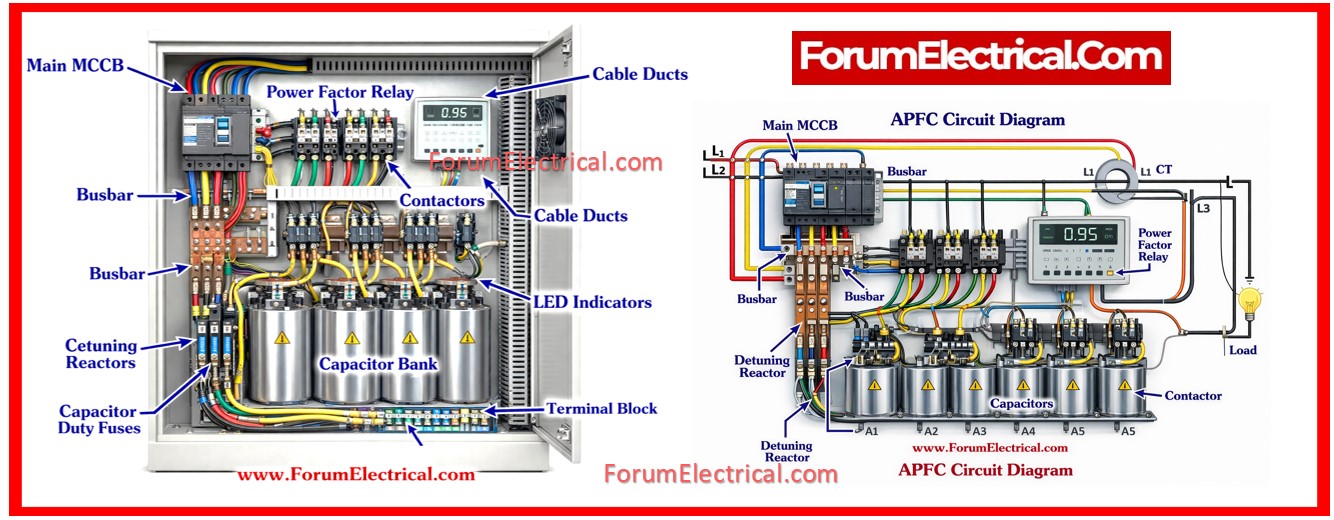
An Automatic Power Factor Correction (APFC) panel is an electrical switchboard that automatically switches capacitor banks in and out of a circuit to maintain the power factor of an electrical installation close to a preset target value typically 0.95 to 0.99 lagging.
Unlike fixed capacitor banks an APFC panel utilizes a programmable Power Factor Relay (PFR) to monitor the power factor in real time at the Point of Common Coupling (PCC) and switch individual capacitor steps using contactors, Thyristor Switched Capacitors (TSC) (or) IGBT-based static switches.
Why use this APFC Panel Design Calculator?
This online calculator tool eliminates manual calculation errors and saves hours of engineering time.
- Calculates exact kVAr requirement using the tangent formula (kVAr = kW x (tan φ1 − tan φ2))
- Applies detuning factor for 7%, 14% and 5.67% detuned reactor systems
- Applies the standard IS 13585 temperature derating for ambient temperatures above 40°C
- Sizes each capacitor step individually: equal ratio, 1:2 ratio and 1:2:4 binary ratio
- Calculates the exact capacitance in microfarads (µF) per step for 3 phase and 1 phase systems
- Recommends MCCB/fuse rating per step with IS 13585 overload factor (1.3x to 1.5x)
- Provides main panel MCCB rating, incoming cable size and total panel kVAr rating
- Generates smart advisory warnings for harmonic distortion, over correction risk and ambient temperature
- 100% free: no login, no subscription, no download required.
How to Use the APFC Panel Design Calculator?
Using our APFC calculator is simple.
Follow these 5 steps to get your complete panel design data:
Step-1: Enter your System Voltage (e.g., 415 V for LT or 11000 V for HT) and select 3-phase or 1-phase.
Step-2: Enter the Active Power (kW) from your energy meter, maximum demand report (or) load schedule.
Step-3: Enter the Existing Power Factor (measured from your utility bill / energy analyzer) and the Target Power Factor required by your utility / project specification.
Step-4: Select the Number of Capacitor Steps, step ratio, detuning requirement and switching device type.
Step-5: Click calculate APFC design to instantly get kVAr sizing, capacitance values, MCCB ratings and cable sizing.
APFC Panel Design Formulas and Calculations
1). Required Reactive Power (kVAr)
The fundamental formula for calculating the capacitor bank size required for power factor correction (PFC) is:
kVAr (Required) = kW x (tan φ1 - tan φ2)
Where
kW - Active power of the load
φ1 - cos-1(existing power factor) angle before correction
φ2 - cos-1(target power factor) angle after correction
tan - tangent of the phase angle
For example: A 500 kW load at 0.75 p.f. to be improved to 0.97 p.f.:
kVAr = 500 × (tan(41.4°) − tan(14.1°)) = 500 × (0.882 − 0.251) = 315.5 kVAr
2). Capacitance per Step (µF)
For 3 Phase System
C (F) = Qstep (VAr) / (3 x 2π f x Vphase²)
For 1 Phase System
C (F) = Qstep (VAr) / (2π f x V²)
Convert to µF by multiplying result by 1000000
3). Detuning Factor for Harmonic Environments
When non linear loads (VFDs, UPS, rectifiers, arc furnaces) are present the capacitor bank rating should be increased by the detuning factor to account for reactor voltage drop:
kVArinstalled = kVArrequired x (1 / (1 - p))
Where
p = detuning ratio
p = 0.07 for 7% detuned reactor (fr ≈ 189 Hz - most common)
p = 0.14 for 14% detuned reactor (fr ≈ 134 Hz - for 5th harmonic)
p = 0.0567 for 5.67% detuned (fr ≈ 210 Hz - IEC preference)
4). Temperature Derating (IS 13585)
Standard capacitors are rated at 40°C ambient.
For higher ambient temperatures the kVAr output should be derated per IS 13585 Clause 4.3.
Derating Factor = 1 - 0.005 x (Tambient – 40)
Minimum derating factor: 0.80 (i.e., 20% maximum derating)
At 50°C ambient: Factor = 1 - 0.005 x 10 = 0.95 (5% derating)
At 55°C ambient: Factor = 1 - 0.005 x 15 = 0.925 (7.5% derating)
5). Rated Current and Switchgear Sizing
For 3 Phase: Ic = Q (kVAr x 1000) / (√3 x VL-L)
For 1 Phase: Ic = Q (kVAr x 1000) / VL-L
MCCB / Fuse Rating = Ic x Overload Factor
IS 13585 Standard Overload Factor = 1.3x
With 10% voltage + harmonics = 1.43x
Standards and Codes for APFC Panel Design
Our calculator follows these internationally recognized electrical standards for the power factor correction equipment:
| Standard / Code | Scope and Application |
| IS 13585 : 1994 | Indian Standard for Shunt Capacitors for AC Power Systems: covers ratings, testing, overload factors and temperature derating for LT capacitor banks |
| IEC 60831-1 | International standard for shunt power capacitors: defines capacitance tolerance, loss angle, overvoltage and overcurrent limits |
| IEC 60831-2 | Test methods for shunt power capacitors including self-healing, endurance and destruction tests |
| IEEE 18-2012 | IEEE Standard for Shunt Power Capacitors: US-oriented standard covering ratings, overcurrent protection, and switching transients |
| IEC 61642 | Industrial AC networks affected by harmonics: application of filters and shunt capacitors; guides detuning reactor selection |
| IS 2516 | Indian Standard for AC Circuit Breakers: referenced for MCCB sizing in capacitor feeder circuits |
| IEC 60947-4-1 | Standard for contactors and motor starters: defines capacitor duty contactors (AC-6b utilization category) |
Frequently Asked Questions
1). How many steps should an APFC panel have?
The number of steps depends on load variation and the minimum step size acceptable without causing power factor hunting (over-correction oscillation).
As a thumb rule each step should be no more than 5–8% of the total kVAr requirement. For a 300 kVAr APFC panel, 6–10 steps of 30–50 kVAr each is a good design.
More steps give finer regulation but increase cost and panel size.
2). Can this calculator be used for HT (High Tension) APFC panels?
Yes. By entering the actual HT line voltage (e.g., 11,000 V or 33,000 V) and the active power in kW, the calculator correctly computes kVAr requirements, capacitance in µF and rated currents for HT capacitor banks.
Note that HT APFC panels typically use outdoor-type capacitor banks with PT metering, oil-immersed or dry-type detuned reactors and vacuum contactors (or) SF6 switches rather than standard LT contactors.