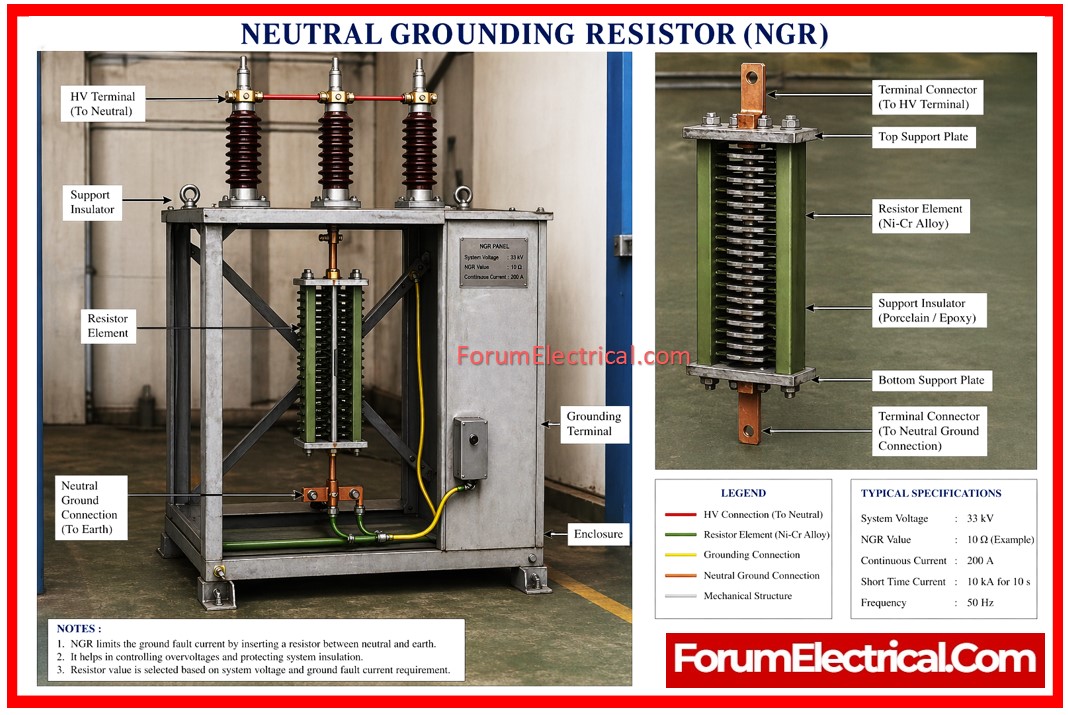
A Neutral Grounding Resistor (NGR) is connected between the neutral point of a power system and earth ground
Calculator
Click here for more Electrical Calculators
You can also follow us on Facebook and Linkedin to receive daily updates.
Its purpose is to limit ground fault current to a safe and controlled level while providing a reliable path for fault detection relays.
NGRs are essential in
- Generators,
- Transformers,
- Motors and
- Bus/switchgear installations
across industrial, utility and commercial power systems worldwide.
Why Neutral Grounding is required?
Fault Current Control
Fault current control limits ground fault current to a predetermined safe level
Equipment Protection
Equipment protection reduces mechanical and thermal stress on windings and cores
Continuous Operation
HRGN systems can run through a single ground fault without shutdown
Arc Flash Reduction
Lower fault current directly reduces arc flash incident energy
Relay Sensitivity
Relay sensitivity provides a controlled reference for 51G / 64 ground protection relays
Standards Compliance
It satisfies IEEE Std 142, IEC 60034, IEC 60364 and NEC Article 250
Equipment Required
The NGR Calculator covers 4 principal equipment categories.
Each has distinct grounding considerations set out in the relevant IEEE and IEC standards.
| Equipment Type | Typical Voltage | Preferred Method |
|---|---|---|
| Generator | 0.4 kV – 25 kV | HRGN (unit-connected) |
| Transformer (HV / LV) | 0.4 kV – 33 kV | LRGN or HRGN |
| Motor | 3.3 kV – 13.8 kV | HRGN (continuous process) |
| Bus / Switchgear | 3.3 kV – 33 kV | LRGN with 51G relay |
Input Parameters
Power Factor is only applicable when the equipment type is generator (or) motor.
| Input Parameter | Description and Typical Values |
|---|---|
| System Voltage VLL (kV) | Line-to-line voltage in kilovolts, e.g. 0.415 / 3.3 / 6.6 / 11 / 33 kV |
| Rated Current (A) | Full load current of the equipment in Amperes |
| Rated Power (MVA) | Rated capacity of the equipment in Megavolt-Amperes |
| Ground Fault Current Limit (A) | Max allowable fault current: typically 5–10 A (HRGN) or 200–1000 A (LRGN) |
| Fault Duration (s) | Seconds the NGR must sustain fault current; typical 10 s (HRGN), 1–2 s (LRGN) |
| Power Factor | Equipment PF from 0.10 to 1.00; required for generators and motors only |
| Grounding Method | High Resistance Grounding (HRGN) or Low Resistance Grounding (LRGN) |
Formulas and Calculations
The calculator applies the following standard electrical engineering formulas assuming a balanced three-phase system.
Phase-to-Neutral Voltage
The NGR sits between the neutral point and earth so its operating voltage equals the phase-to-neutral voltage.
Vn = VLL÷√3
Example: For an 11 kV system, Vn = 11000 ÷ 1.7321 = 6351 V
NGR Resistance
The resistance is selected to limit the ground fault current to the specified maximum:
R = Vn÷Ifault(Ω)
Continuous Power Rating
Power continuously dissipated in the NGR during a sustained fault:
P = Vn x Ifault (W)
Short-Time Energy Rating
Total thermal energy the NGR must absorb within the fault duration. This determines the thermal withstand class required when ordering:
E = P x t ÷ 1000(kJ)
Zero Sequence Current
The zero-sequence current flowing through the NGR is used to set the 51G relay pickup threshold:
I₀ = Ifault ÷ 3 (A)
Fault Current as Percentage of Rated Current
This ratio indicates protection sensitivity: typically less than 1% for HRGN and 5–25% for LRGN:
%If = (Ifault ÷ Irated) x 100(%)
Output Parameters
| Output | Significance and Application |
|---|---|
| Phase-to-Neutral Voltage Vn (V) | Voltage rating of the NGR that is used for insulation co-ordination and purchasing spec |
| NGR Resistance R (Ω) | Core resistor specification; primary ordering parameter |
| Continuous Power Rating (W) | Wattage the NGR must withstand indefinitely during a sustained fault (HRGN) |
| Short-Time Energy Rating (kJ) | Thermal energy the NGR must absorb within the specified fault duration |
| Zero Sequence Current I₀ (A) | Set point for 51G relay pickup, where I₀ = Ifault ÷ 3 |
| Ground Fault Current Igf (A) | Confirms the design fault current limit selected by the engineer |
| NGR Voltage Rating (V) | Equal to Vn that specifies the dielectric withstand level for the resistor |
| Fault Current % of Rated (%) | Protection sensitivity indicator: < 1% for HRGN, 5-25% for LRGN |
Grounding Method Comparison: HRGN vs LRGN
| Characteristic | HRGN | LRGN |
|---|---|---|
| Fault Current | < 10 A | 200 – 1000 A |
| Continued Operation | Yes - operate through fault | No - rapid clearance required |
| Arc Flash Risk | Very Low | Moderate to High |
| Relay Type | 59G / 64 (alarm) | 51G (trip) |
| Fault Detection | High sensitivity | Lower sensitivity |
| Typical Application | Generators, continuous motors | Bus, switchgear, transformers |
| Typical Fault Duration | 10 s (or) longer | 1 – 2 s |
| Standards Reference | IEEE 142, IEC 60034-3 | IEEE 142, IEC 60364-4-41 |
Solved Example
11 kV Generator with HRGN, fault current limited to 10 A.
Input Values
- Equipment: Generator
- VLL: 11 kV
- Rated Current: 524 A
- Rated Power: 10 MVA
- Fault Current Limit: 10 A
- Fault Duration: 10 seconds
- Power Factor: 0.85
- Grounding Method: High Resistance Grounding (HRGN)
Calculated Results
| Parameter | Calculated Value |
|---|---|
| Phase-to-Neutral Voltage Vn | 6350.9 V |
| NGR Resistance R | 635.09 Ω |
| Continuous Power Rating | 63,509 W (63.5 kW) |
| Short-Time Energy Rating | 635.09 kJ |
| Zero Sequence Current I₀ | 3.33 A |
| Ground Fault Current Igf | 10.0 A |
| NGR Voltage Rating | 6350.9 V |
| Fault Current % of Rated | 1.91% |
At 1.91% of rated current, the fault current is well within HRGN limits (< 10 A). The NGR should be rated for 635.09 Ω, 6.35 kV and capable of absorbing 635 kJ within 10 seconds. The 51G relay should be set to detect zero sequence current above approximately 3.33 A.

 values using our Neutral Grounding Resistor (NGR) calculator to limit fault current, enhance system protection, and ensure safe, reliable electrical operation.)