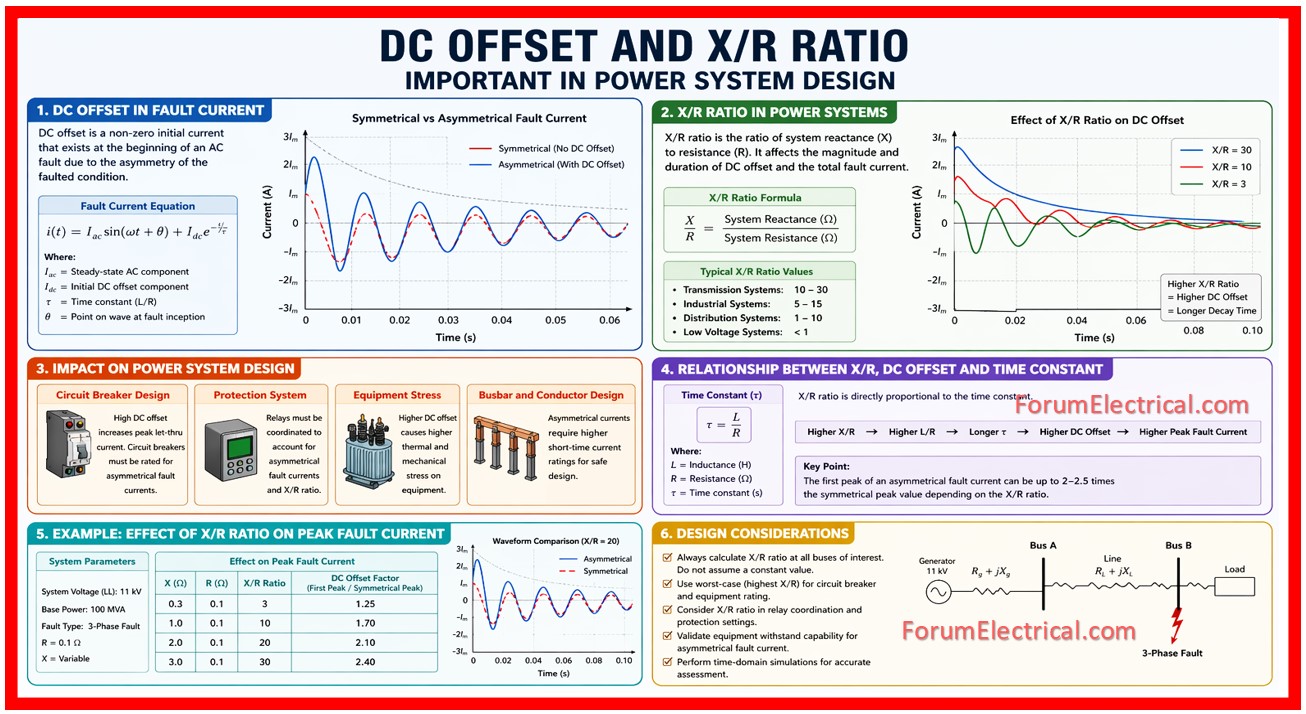
What is DC Offset?
DC offset is a transient phenomenon that appears in fault current immediately after a short circuit occurs.
Under ideal steady state conditions AC current is perfectly symmetrical about the zero axis.
However at the instant of fault initiation depending on the point on the voltage wave at which the fault occurs a decaying DC component gets superimposed on the AC waveform.
This causes the current waveform to become asymmetrical where one peak becomes significantly higher than the other.
This DC component does not remain constant.
It decays exponentially with time governed by the system time constant (L/R).
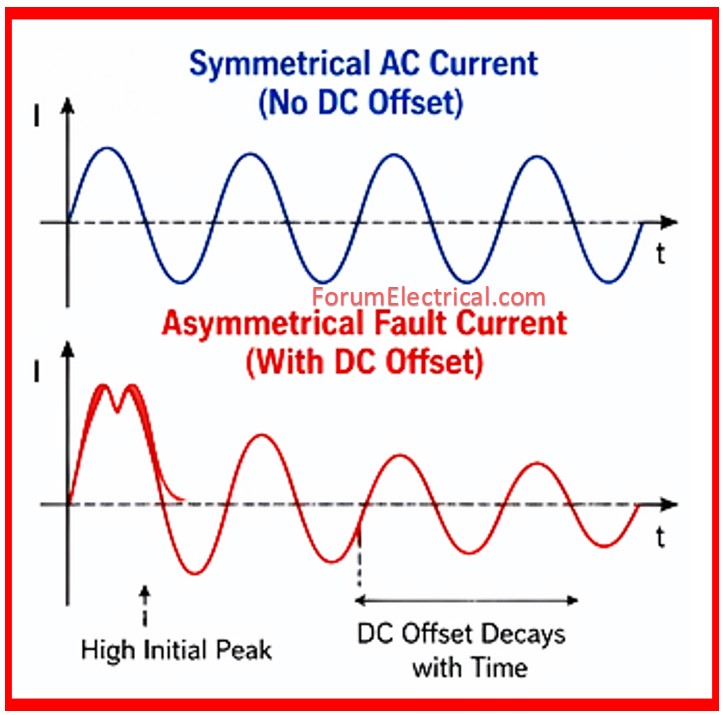
During the first few cycles of the fault the presence of DC offset can result in extremely high instantaneous peak currents which is often much higher than the steady state symmetrical RMS fault current.
This initial asymmetry is essential because most mechanical and electrodynamic stresses on the equipment occur during this short duration.
What is X/R Ratio?
The X/R ratio is the ratio of system reactance (X) to resistance (R) that is representing how inductive a power system is functions.
In electrical networks reactance is primarily due to inductance in
- Generators,
- Transformers and
- Transmission lines
while resistance comes from the conductor losses.
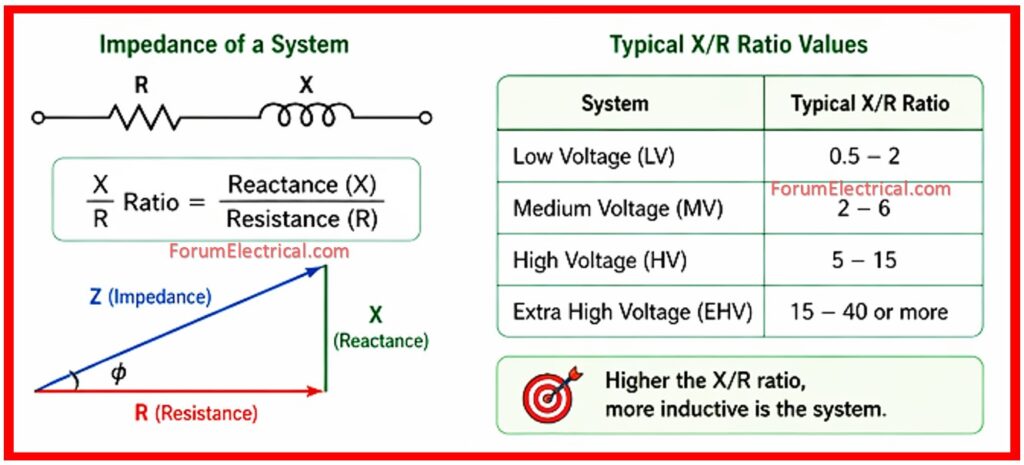
In low voltage (LV) systems resistance is relatively significant that is resulting in a lower X/R ratio.
However in high voltage (HV) and extra high voltage (EHV) systems, inductive reactance dominates that is leading to a high X/R ratio.
This ratio is not just a theoretical value and it directly influences the transient function of fault currents particularly the rate at which the DC offset decays.
A higher X/R ratio indicates a more inductive system that is meaning energy stored in magnetic fields is higher which impacts fault current characteristics is directly.
How DC Offset and X/R Ratio are related?
The relationship between DC offset and X/R ratio is fundamental to understanding short circuit characteristics.
The decay rate of the DC component is governed by the time constant of the system that is given by L/R.
Since reactance (X) is proportional to inductance (L), a higher X/R ratio effectively means a larger time constant.
As a result in systems with a high X/R ratio the DC offset decays more slowly.
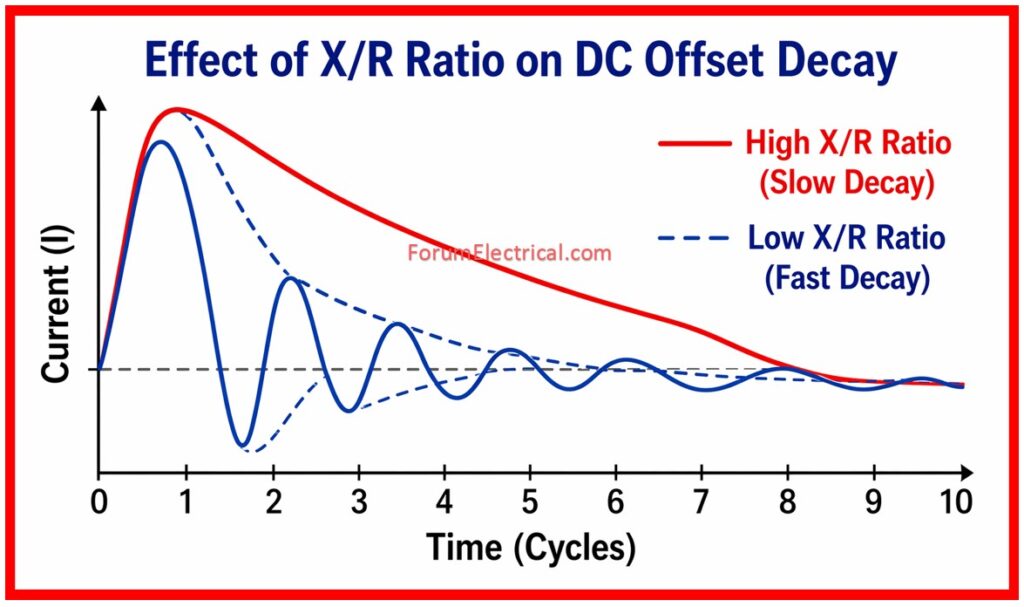
This prolongs the asymmetrical condition of the fault current and increases the magnitude of the first few peak currents.
Conversely in systems with a low X/R ratio, the DC component decays rapidly and the waveform becomes symmetrical much faster.
This explains that the 2 systems with identical RMS fault current values can behave very differently in reality.
The system with the higher X/R ratio will experience more severe initial peak currents due to sustained DC offset.
What happens if X/R Ratio is too high?
A high X/R ratio significantly increases the severity of transient fault conditions.
One of the most essential impacts is the increase in peak asymmetrical current which directly affects the making capacity of circuit breakers.
Breakers must be capable of closing onto a fault and withstanding this high peak current without mechanical damage.
Additionally
- Busbars and
- Switchgear
experience strong electrodynamic forces proportional to the square of the instantaneous current.
Higher peak currents mean higher mechanical stress that is requiring more robust designs and supports.
Current transformers (CTs) are also heavily affected.
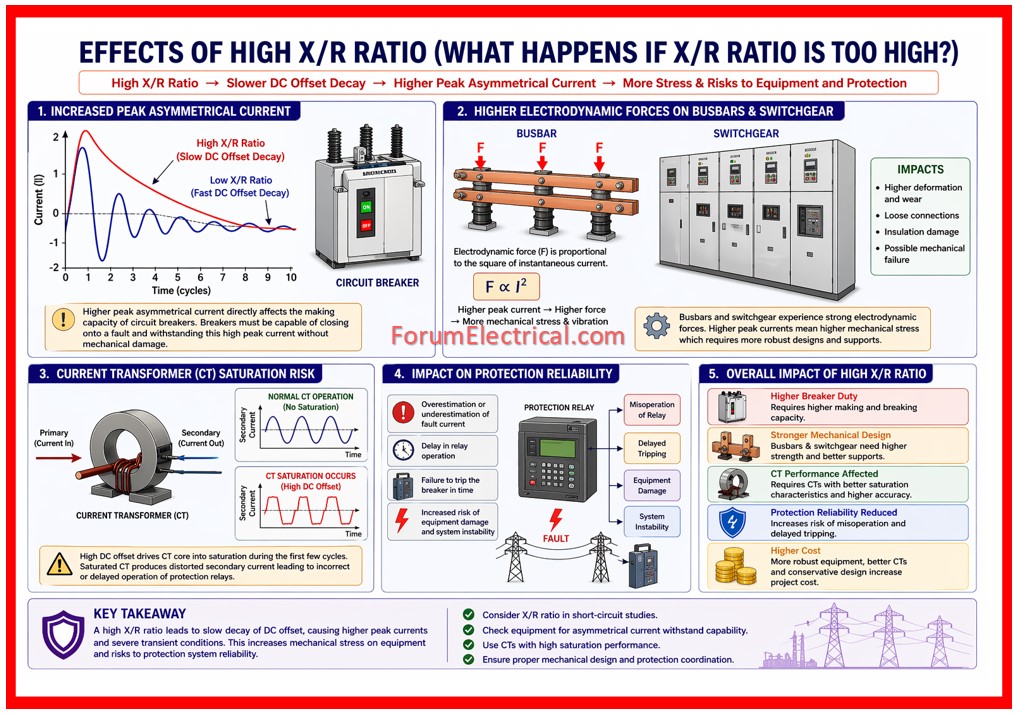
High DC offset can drive CT cores into saturation during the 1st few cycles of the fault.
When CT saturation occurs the secondary current becomes distorted which can lead to incorrect operation (or) delayed response of protection relays.
Thus a high X/R ratio introduces risks not only to equipment integrity but also to the protection system reliability.
Financial & Design Impact
The influence of DC offset and X/R ratio extends beyond technical performance into project economics.
Equipment in power systems is not selected independently based on symmetrical RMS fault current and it must also withstand the peak asymmetrical current caused by DC offset.
A system with a higher X/R ratio may require circuit breakers with
- Higher making capacity,
- Stronger busbar supports and
- Higher class cts
with better saturation performance.
These requirements directly increase capital costs.
Furthermore protection systems may need more conservative settings (or) advanced relays to ensure reliability under a high asymmetrical conditions. Even cable sizing and structural design may be influenced by the increased mechanical forces.
Therefore 2 systems with identical fault levels (in kA RMS) can have significantly different project costs depending on their X/R ratio.
Ignoring this factor during design can lead to under rated equipment (or) costly redesigns later.
Conclusion
DC offset and X/R ratio are not just theoretical parameters; they are essential factors that define the real stress experienced by power system equipment during faults.
While symmetrical fault current provides a baseline for the analysis it does not represent the actual transient severity of the system.
A high X/R ratio leads to slower decay of DC offset resulting in
- Higher peak currents,
- Increased mechanical stress,
- Potential CT saturation and
- Greater demands on circuit breakers.
This directly affects equipment selection, protection reliability and overall project cost.
Effective power system design should therefore consider both the magnitude of fault current and the nature of its waveform.
Understanding and accounting for DC offset and X/R ratio ensures safer, more reliable and economically optimized systems.

