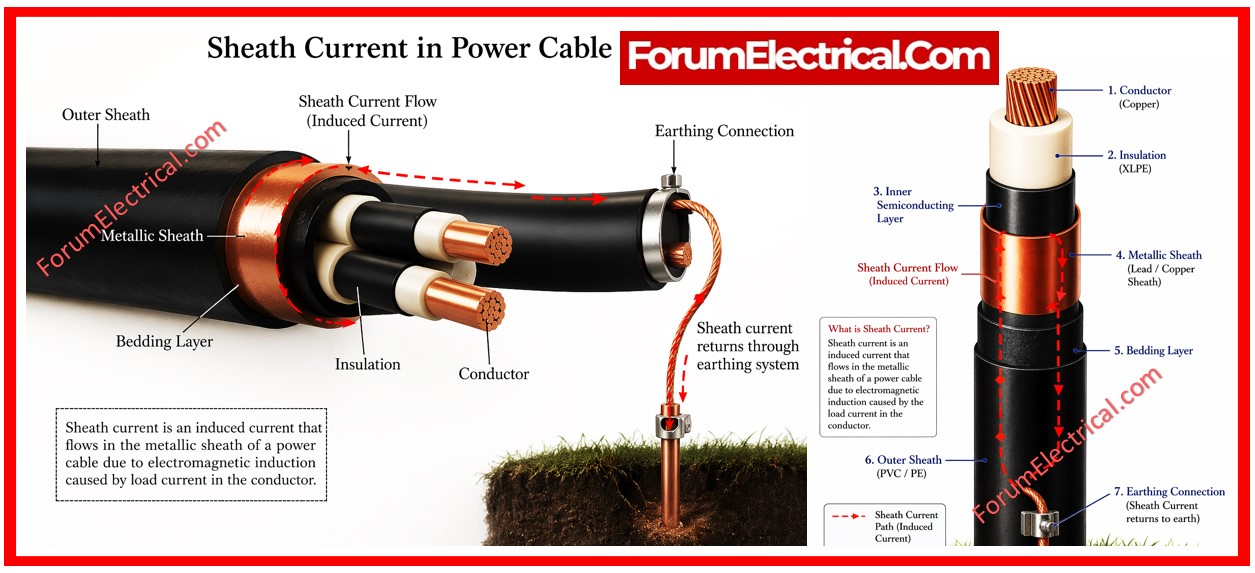
Three phase power cables represent the basis of electrical distribution systems.
Calculator
Sheath Current Calculator
Calculate sheath current for three-phase power cables with grounding
Click here for more Electrical Calculators
You can also follow us on Facebook and Linkedin to receive daily updates.
Understanding the purpose of these cables particularly regarding sheath current and charging effects is essential for:
- Preventing excessive heating and insulation degradation,
- Ensuring the stability of power transmission systems,
- Optimizing the power factor (PF) for efficient energy utilization and
- Reducing reactive power charges from the utility providers.
Cable Capacitance Fundamentals
Every power cable acts as a distributed capacitor.
The capacitance exists between the conductor and the grounded cable sheath with the insulation serving as the dielectric material.
This capacitive effect has 2 important implications.
Charging Current
When voltage is applied across the cable a charging current flows to develop the electric field.
This current is independent of the load current.
Sheath Current
The combination of the charging current and load current that creates the total sheath current that should be properly managed to avoid safety hazards and equipment damage.
Formulas & Calculations
Total Capacitance
Formula: C = Capacitance per km x Cable Length
The total capacitance is calculated by multiplying the specific capacitance that is (typically 0.2-0.3 µF/km for standard power cables) by the total length of the power cable.
This value represents the cumulative capacitive reactance effect of the complete cable run.
Example: A 10 km cable with 0.25 µF/km capacitance / km = 2.5 µF total capacitance
Capacitive Reactance
Formula: Xc = 1 / (2π x f x C)
Where
f – System frequency (50 Hz / 60 Hz)
C – Total capacitance in Farads
Capacitive reactance is inversely proportional to frequency.
Higher frequencies result in lower reactance which is allowing more charging current to flow.
Charging Current
Formula: Ic = V / Xc
Where
V – Voltage to earth (phase-to-ground voltage)
Xc – Capacitive reactance
The charging current increases with voltage & cable length.
This is a pure reactive current that leads the voltage by 900.
Load Current
Formula: IL = P / (√3 × V × cos φ)
Where
P – Active power (W – Watts)
V – Line-to-Line voltage (V – Volts)
cos φ – power factor (0 to 1)
The load current is determined by the actual electrical load that is being supplied via the cable.
This current is in phase with the voltage for resistive loads and lags the voltage for the inductive loads.
Sheath Current
Formula: Is = √(Ic² + IL²)
The sheath current is calculated as the vector sum of charging current and load current.
As these currents are randomly perpendicular (different phases) they combine vectorially rather than arithmetically.
Power Factor Correction
The calculator determines the needed capacitor bank size to bring the power factor to a desired value (typically 0.95).
The reactive power that should be supplied by the capacitor bank is calculated as
QCAP = QCurrent – QDesired
Where
Q- Reactive power in (kVAR) kilovars
This ensures an efficient power utilization and reduces the penalties from utility companies.
Input Parameters
Cable Parameters
| Parameter | Description | Unit |
| Voltage to Earth | Phase-to-ground voltage in the power system | V (Volts) |
| Cable Length | Total length of the power cable run | km |
| Capacitance per km | Specific capacitance of the cable type (typically 0.2-0.35) | µF/km |
| Power Frequency | System frequency (usually 50 Hz/60 Hz) | Hz |
Electrical Load Parameters
| Parameter | Description | Unit |
| Voltage (Line-to-Line) | Rated voltage of the 3 phase system | V |
| Active Power | Real power being consumed by load | kW |
| Current Power Factor | Cosine of phase angle between voltage & current | cos φ |
Advanced Settings
Desired Power Factor
Target power factor after the capacitor installation (typically 0.95).
Temperature Derating
Temperature derating accounts for the 10% reduction in the current carrying capacity due to ambient temperature.
Harmonics Factor
Multiplier of 1.2x applied to the charging current to account for the harmonic distortion in modern power systems.
Step by Step Calculation
Data Collection
Step-1: Gather the cable specifications from manufacturer data sheets.
Step-2: Identify the system voltage & frequency.
Step-3: Determine the current & desired power factors.
Step-4: Verify cable length & routing.
Calculator Input
Step-5: Enter voltage to earth value (typically phase voltage for the system).
Step-6: Enter the cable length in kilometers (km).
Step-7: Specify the required capacitance per km (µF/km) from cable specifications.
Step-8: Enter the system frequency (usually 50 / 60 Hz).
Step-9: Select the appropriate line-to-line voltage.
Step-10: Input active power in kilowatts (kw).
Step-11: Enter the current power factor (PF).
Results
Step-12: Review the calculated sheath current & compare to cable rating.
Step-13: Note the required capacitor bank size in (kVAR).
Step-14: Verify that corrected power factor that meets utility requirements.
Step-15: Document the results for design and procurement.
Output Results
Calculated Parameters
| Output | Significance | Unit |
| Total Capacitance | Total capacitive effect of the complete cable. | µF |
| Charging Current | Pure capacitive current flowing due to cable capacitance. | A |
| Load Current | Three phase current that is carrying the active power. | A |
| Sheath Current | Total current flow via cable sheath (essential parameter). | A |
| Capacitive Reactance | Opposition to capacitive current at system frequency. | Ω |
| Capacitor Bank Size | Rating of capacitor bank needed for the power factor correction (PFC). | kVAR |
| Corrected Power Factor | Power factor (PF) after capacitor bank is installed. | cos φ |
Applications of Sheath Current in Cables
Power Factor Correction
One of the major primary applications is determining the correct size of capacitor banks.
Poor power factor results in:
- Higher energy bills (utility penalties for PF < 0.95).
- Increased cable heating.
- Reduced transmission capacity.
- Greater voltage drop along the line.
Cable Sizing
The sheath current value is essential for selecting the appropriate cable cross sections.
The calculated sheath current ensures that the cable cross section has adequate capacity to manage not just the load current but also the additional thermal stress from the capacitive charging.
System Protection
Understanding the sheath current is essential for:
- Setting protective relay thresholds.
- Preventing nuisance trips during the normal operation.
- Ensuring the proper fault detection.
Reference
Standard Cable Capacitance Values
| Cable Type | Capacitance (µF/km) |
| Single core, XLPE, Cu conductor | 0.18 – 0.24 |
| Single core, PVC, Cu conductor | 0.22 – 0.28 |
| 3-core cable, XLPE | 0.25 – 0.35 |
| Medium voltage (11kV – 33kV) | 0.15 – 0.20 |
Common System Voltages
| System Type | Voltage (V) | Region |
| Low Voltage | 380-400 | Europe/Asia |
| Low Voltage | 480 | North America |
| Medium Voltage | 3300-6600 | Industrial |
| High Voltage | 11000-33000 | Transmission |
Recommended Power Factor Values
- Industrial: 0.95 – 0.98
- Commercial: 0.90 – 0.95
- Utility Standard: ≥ 0.95

