Calculator
Power Factor is the ratio of real power (Watts) to apparent power (VA). It indicates how efficiently your equipment uses electricity. As a result, a high power factor leads to increased efficiency and a lower expense.
This calculator will allow us to calculate the appropriate size of the capacitor bank for power factor correction.
Formulas used:
Reactive power compensation: Qc = P × (tan φ₁ − tan φ₂)
Capacitance per phase: C = Qc / (2π × f × V²) (÷3 for 3-phase delta)
Line current (3-phase): I = S / (√3 × V) | Single phase: I = S / V
Apparent power: S = P / cos φ | Reactive power: Q = P × tan φ
Click here for more Electrical Calculators
Power factor correction (PFC)is fundamental to carry out an efficient electrical power distribution.
- Poor power factor inflates
- Apparent power demand,
- Increases current draw,
- Raises utility penalties and
- Accelerates cable and transformer ageing.
This post presents the engineering principles behind PFC that the
- Calculation of capacitor bank sizing,
- Practical installation considerations and
- Structured economic analysis framework.
Power Factor:Engineering Fundamentals
Power factor (PF) is the ratio of active (real) power P to apparent power S in an AC electrical system.
It is a dimensionless number ranging from 0 to 1 and represents how efficiently electrical power is being converted into useful work.
How to calculate Power Factor?
Power Factor Calculation Formula
Power Factor Formula:
Reactive power compensation: Qc=P x (tan φ₁ − tan φ₂)
Capacitance per phase: C=Qc / (2π x f x V²) (÷3 for 3-phase delta)
Line current (3-phase): I=S / (√3 x V)
Single phase: I=S / V
Apparent power: S=P / cos φ
Reactive power: Q=P x tan φ
Power Triangle
AC power systems carry 3 different forms of power that interact according to the power triangle:
Active Power (P):Measured in kilowatts (kW). Convert kVA to kW (kilovolt ampere to kilowatt)to determine kW for some cases. The real power that performs actual work:driving motors,heating elements &lighting.
Reactive Power (Q):Measured in kilovolt-amperes reactive (kVAr). Required to maintain electromagnetic fields in inductive loads. It is interchanged between source and load each cycle and does no network.
Apparent Power (S):Measured in kilovolt-amperes (kVA). The vector sum of P and Q;this is the total power the utility must supply.
S²=P²+Q²
Power Factor (PF)=cos φ=P / S
tan φ=Q / P ⇒ Q=P x tan φ
Inductive vs Capacitive Loads
Most industrial loads are inductive that are
- AC induction motors,
- Transformers,
- Arc furnaces and
- Fluorescent lighting ballasts
that all draw lagging reactive current.
This explains the current waveform lags behind the voltage waveform by a phase angle φ.
| Load Type | Phase Relationship | PF Character | Common Examples |
|---|---|---|---|
| Inductive | Current lags voltage | Lagging (most common) | Motors,transformers,chokes |
| Capacitive | Current leads voltage | Leading (less common) | VFDs,SMPS,capacitor banks |
| Resistive | In phase | Unity (PF=1.0) | Heaters,incandescent lamps |
Why Power Factor Important?
A low power factor forces the electrical system to carry a higher current for the same amount of useful work.
This has cascading effects across the complete installation:
Increased Line Current
I=P / (V x PF)
Cables,switchgear and transformers should be rated for higher currents.
Higher I²R losses in Conductors
Heat dissipation increases as the square of current,reducing efficiency and shortening insulation life.
Voltage Drop
Excessive reactive current causes elevated voltage drop across impedances,degrading supply quality at load terminals.
Transformer Loading
kVA capacity is consumed by reactive current leaving less headroom for productive load growth.
Capacitor Bank Sizing
Core Formula
The required reactive power compensation Qc is derived from the difference in tangent values of the existing and target phase angles:
Qc=P × (tan φ₁− tan φ₂)
Where
P –active power (kW)
cosφ₁ –existing power factor
cosφ₂ –target power factor
The correction factor K=(tanφ₁ − tanφ₂) is tabulated in IEC and IS standards for common PF pairs.
For accurate calculation always calculate from first principles using trigonometric identities.
Why accurate Capacitor Bank sizing is Required ?
Accurate capacitor bank sizing is essential to ensure an efficient power factor correction and safe electrical system operation.
Proper sizing helps to deliver only the required reactive power without causing instability (or) losses.
- Ensures optimal power factor close to unity.
- Prevents overcompensation (leading PF) and voltage rise.
- Avoids under compensation and utility penalties.
- Reduces I²R losses and improves efficiency.
- Minimizes risk of harmonic resonance and equipment damage.
Capacitance Calculation
Once Qcis determined the required capacitance C is calculated from:
C=Qc/ (2π × f × V²)
For 3-phase delta-connected capacitors
Divide C by 3 to get capacitance per phase.
For 3-phase star-connected capacitors
Multiply V by √3 in the denominator.
Capacitor Bank Types &Selection
Fixed vs Automatic PFC
| Feature | Fixed Bank | Automatic APFC |
|---|---|---|
| Cost | Low | Medium to High |
| Load suitability | Constant loads | Variable / dynamic loads |
| Control | Manual switching | PF relay+contactors/thyristors |
| Switching | Fixed on/off | Step-based (4–12 steps typical) |
| Over-compensation risk | High if load varies | Minimal (steps self-regulate) |
| Maintenance | Minimal | Relay calibration,contactor wear |
APFC Step Sizing
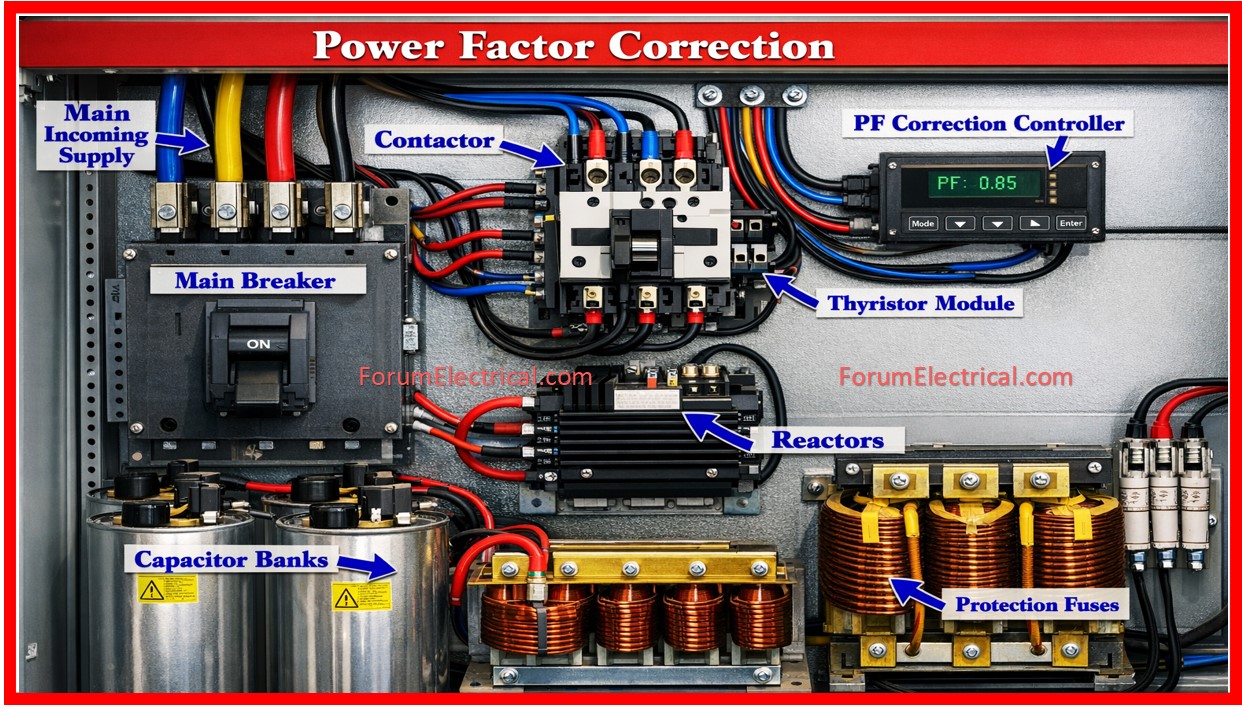
For Automatic Power Factor Controllers (APFC)the total Qc is divided into discrete switchable steps.
The first step is typically 1/2 the step size (the “C/K”or 1:1:1 or 1:2:4 progression) to allow fine resolution at light loads:
Step size=Qc/ n (n=number of steps typically 4–12)
Detuned (Filtered) Capacitor Banks
In systems with significant harmonic distortion (THD>8%) a plain capacitor bankscan cause
- Harmonic resonance,
- Overheating and
- Premature failure.
Detuned (or) filtered banks include a series reactor (typically 5.67%,7% or 14% impedance) to shift the resonant frequency below the dominant harmonic:
p=7% reactor:resonant frequency ≈ 189 Hz (between 3rd and 5th harmonic) is suitable for most VFD dominated plants.
p=14% reactor:resonant frequency ≈ 134 Hz it is applicable for heavily distorted systems.
Active harmonic filters (AHF):Inject inverse harmonic currents that is preferred where THD >20% (or) IEEE 519 compliance is mandated.
Protection Requirements
| Protection | Device / Method | Standard |
|---|---|---|
| Overcurrent | HRC fuses or MCCBs rated at 1.5× capacitor In | IS 13947 / IEC 60947 |
| Overvoltage | Voltage relay (disconnect at >110% Vn) | IEC 60831-2 |
| Overtemperature | Thermal relay or internal PTC sensor | IS 13340 |
| Harmonic protection | Series reactor (detuning) | IEC 60831 / IEEE 519 |
| Discharge | Discharge resistor (discharge to <50V in 1 min) | IEC 60831-1 cl.22 |
| Earthing | Capacitor case and panel earthed to IS 3043 | IS 3043 |
Applicable Standards &References
| Standard | Scope |
|---|---|
| IS 13340:1993 (IEC 60831-1) | Shunt power capacitors –general performance,testing and rating |
| IS 13585:1994 (IEC 60871) | Shunt capacitors for HV AC systems above 1 kV |
| IEC 61921 | Power capacitors –low voltage PFC capacitor banks |
| IEEE 519-2022 | Recommended practice for harmonic control in power systems |
| IS 14772 | Automatic power factor correction (APFC) relay specification |
| BEE PAT Scheme | Perform,Achieve &Trade –energy efficiency targets for industry |
| IPMVP Vol. 1 | Measurement &Verification for energy savings quantification |

