
In transmission lines, two types of protective relays that are frequently employed are differential protection and distance protection.
The following are a few general recommendations on when to utilize each of all of the types of protection:
What is Differential Protection?
Differential protection is commonly employed for short transmission lines or busbars with a low impedance across the 2 ends of the protected zone.
Differential protection compares the currents entering & exiting the protected zone and trips the circuit breaker if the two currents differentiate.
Differential protection is very sensitive to faults inside the protected zone & can quickly isolate them lowering the risk of equipment damage and increasing system reliability.
Differential protection is a type of protection method that compares currents at two (or) more places on protected equipment, such as
- Transformers,
- Generators or
- Busbars.
The basic assumption is that under typical working conditions, the current entering the device equals the current leaving it (after accounting for transformation ratio & phase shift).
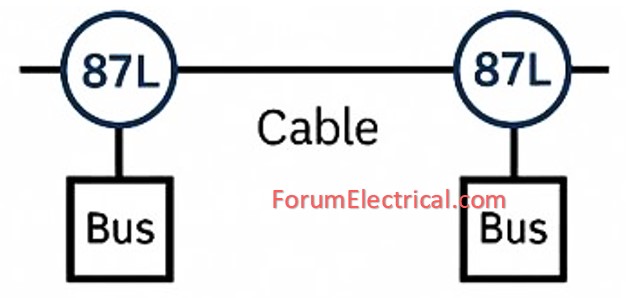
If an internal fault happens such as a winding short circuit (or) a phase-to-phase fault, the incoming & outgoing currents diverge resulting in a differential current.
This differential current activates the protection relay, isolating the problematic part within seconds.
Differential protection is extremely sensitive, operates quickly and is mostly utilized for internal faults providing exact differentiation between internal & external defects.
Applications: Applications include transformers, generators, busbars and reactors.
Standards: IEC 60255-27 and IEEE C37.91.
What is a Differential Relay?
A differential relay is a safety device that detects faults within a specific zone of a power system through the comparison of equivalent electrical quantities such as currents as they enter and exit the zone.
If the difference between these values reaches a predetermined threshold, the relay activates, delivering a signal that trips a circuit breaker and isolates the faulty portion protecting equipment such as generators & transformers from internal failures.
What is Distance Protection?
Distance protection is commonly employed on longer transmission lines with relatively high impedance between the 2 ends of protected zone.
Distance protection works by detecting the impedance across the fault location & the relay & tripping the circuit breaker if it falls below a predetermined level.
Distance protection is less sensitive to failures within the protected zone and is primarily intended to safeguard the transmission line from faults occurring outside the zone such as lightning strikes (or) faults in nearby circuits.
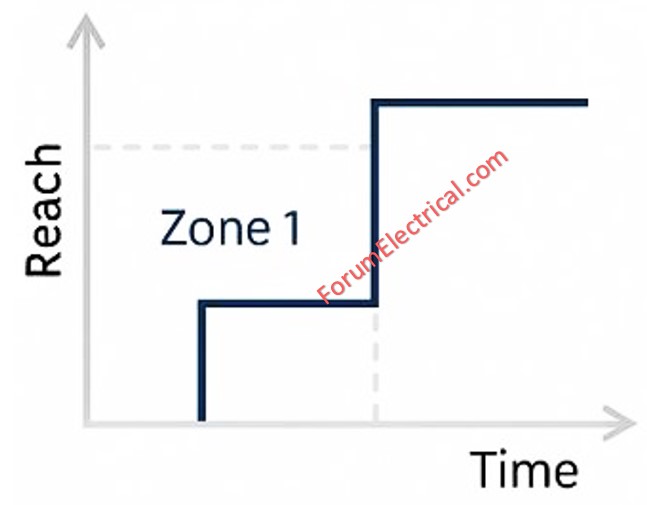
Distance protection (also known as impedance protection) is mostly used for transmission lines.
It works by detecting the impedance (voltage-to-current ratio) of the line at the relay position.
Under typical conditions, the measured impedance is proportional to the line length and parameters.
When a fault develops on the transmission line, the impedance decreases proportionately to its distance from the relay.
The relay then isolates the problematic area using specified zones (Zones 1, 2, and 3) to make sure selective tripping.
Distance protection is extremely effective for the overhead transmission lines, ensuring speed and synchronization even on high-voltage long-distance lines.
It is less sensitive to fault type and prioritizes location over current comparison.
Applications: Applications include overhead transmission lines (EHV/HV) and lengthy feeders.
Standards: IEC 60255-151 and IEEE C37.113.
What is a Distance Relay?
A distance relay is a safety device that uses electrical impedance to calculate the distance to a defect on the power transmission line.
It works by measuring voltage to current (V/I) which is directly proportional to impedance.
By specifying an impedance value, the relay can trip a circuit breaker and isolate the faulty segment of the line enabling both primary and backup protection against different types of faults.
Difference between Differential Protection and Distance Protection
Differential Protection vs Distance Protection
| Differential Protection | Distance Protection |
| To detect internal faults, differential protection compares currents at 2 or more ends of the equipment. | Distance protection detects faults by measuring the transmission line’s impedance (voltage-to-current ratio). |
| Its primary application is to identify internal defects in transformers, generators, busbars and reactors. | It is mostly used for detecting defects in overhead transmission lines & long distance feeders. |
| Differential protection responds quickly, typically within milliseconds giving immediate isolation. | Distance protection works quickly based on the fault distance, however this can vary according to line length & zone parameters. |
| It is extremely sensitive and can distinguish between internal & external faults. | It is more sensitive to fault location than fault type and if not properly coordinated might affect adjacent lines. |
| Differential protection is highly selective that isolating only problematic equipment. | Distance protection uses specified zones (Zones 1, 2, and 3) to locate the fault and trip accordingly. |
| IEEE C37.91 and IEC 60255-27 are examples of applicable standards. | IEEE C37.113 and IEC 60255-151 are examples of applicable standards. |
Integrated Protection Schemes for Transmission Lines
In certain conditions, differential and distance protection can be utilized together to give additional protection & redundancy.
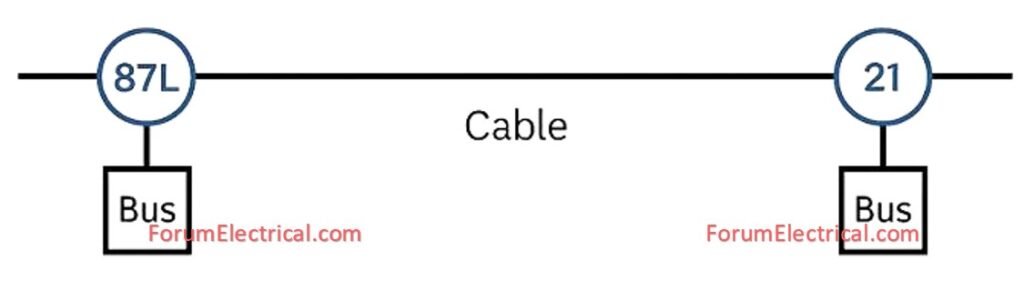
The type of protection mechanism used is determined by the transmission line’s individual characteristics & the types of faults which are most probable to occur.
To determine the most effective protection method, an in-depth analysis of the overhead transmission line’s properties is required as well as careful evaluation of the system’s protection requirements.

