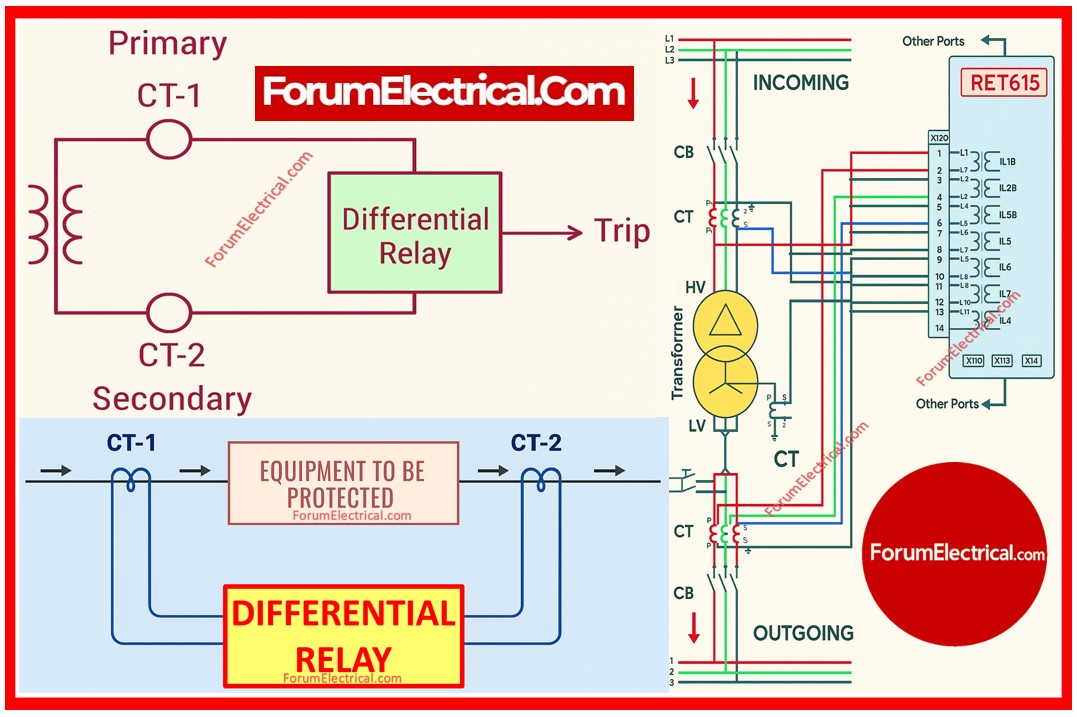
What is Differential Protection?
Differential protection is a unit protection technique used in power systems to safeguard equipment like
- What is Differential Protection?
- Differential Protection Zone
- Types of Differential Protection
- Where are the Differential Protection methods and Relays used?
- Line Differential Protection
- Transformer Differential Protection
- Why Differential Protection is called Unit Protection?
- Standards & References
- Summary
- Transformers,
- Generators,
- Busbars and
- Transmission lines.
It operates on the basis of comparing the current entering and departing a protected zone.
If both currents are equal, there is no problem in the zone. If the difference exceeds the defined limit, an internal fault is detected.
Typically, it operates on the basis of continually comparing the current entering (or) leaving the protected zone (or) equipment.
Differential Protection Zone
The “zone of protection” is determined by the CTs (Current Transformers) put at either end of the system.
CTs are used on both the high voltage and low voltage sides of a transformer.
CTs are located at the stator terminals of a generator.
All incoming & outgoing feeds for a busbar are equipped with CTs.
Types of Differential Protection
Current Differential Protection (Conventional)
The comparison of currents at 2 ends is simple.
Percentage (Biased) Differential Protection
A restraining current is introduced in order to prevent maloperation that may occur as a result of CT mistakes, tap-changer operations (or) external faults taking place.
High-impedance Differential Protection
The busbar protection is provided by a high impedance relay, which is stable against CT saturation protection.
Where are the Differential Protection methods and Relays used?
A differential protection scheme is a type of unit protection method that protects a specific zone or piece of equipment; the scheme is unaffected by external faults.
Differential protection schemes are typically employed to protect the most valuable & sensitive equipment from harm in the event of a breakdown. It is used in:
> Protection for large generators (or) generator-transformer sets.
> Protection for large power transformers (> 5MVA).
> The feeder (transmission line) is made protected with the pilot wire differential protection.
> Protection for huge industrial motors.
> Bus zone protection.
Differential relay is primarily used in application of the differential protection.

Line Differential Protection
Differential protection is an emerging line protection principle.
Differential protection is based on Kirchhoff’s laws, which state that all current entering a network node should total up to zero in an ideal system.
This means that in a line protection application, the current measured to flow into line must also be measured to exit.
The only thing that appears to be a simple subtracting of the outgoing current from the ingoing current is not, because the power system is far from ideal.
- Capacitive charging currents,
- Non-transposed lines,
- Asymmetrical communication
causing phase rotation, drifting time synchronization, tapped lines and transformers are some examples of features that leak or transform current flowing through a line or influence data sent from an IED (Intelligent Electronic Device).
To develop the dependable line differential protection scheme, improved stabilization methods are need to be implemented.
Transformer Differential Protection
Transformer Differential Protection is a unit protection technique that compares the currents entering and leaving a transformer to detect internal defects such as
- Winding short circuits,
- Inter-turn faults and
- Phase-to-phase (or) phase-to-ground faults.
If the difference or variation (differential current) exceeds a pre-determined threshold, the relay is used to trip the transformer.
Working Principle
CTs (Current Transformers) are located on both the primary & secondary sides of the transformer.
The secondary currents from these CTs are sent into a differential relay.
During normal operating conditions including load, external faults & magnetizing inrush current, the input and output currents should be identical (given the CT ratio).
If an internal fault happens, the currents become unequal, resulting in a differential current.
IDiff = IPrimary – ISecondary
If IDiff > Set Value – Relay Operated – Circuit Breaker trips the Transformer
Protects against:
- Internal phase-to-phase faults,
- Winding Short Circuits,
- Phase-to-ground faults within the transformer.

Does not work for:
- Load current,
- External Faults (Outside Transformer Zone) and
- Magnetizing inrush (or) over-excitation (with restraining features).
Use the correct ratios and connections (for example, delta-wye compensation for the star-delta transformers).
A second harmonic restraint is used to prevent malfunction during energization.
The relay must be stable under external faults and CT saturation.
Why Differential Protection is called Unit Protection?
The concept of “Differential Protection” is primarily to detect the difference in the currents across the unit’s incoming and outgoing terminals and it is generally called as “Unit Protection.”

Standards & References
IEC 60255: Measuring Relays and Protection Equipment.
IEEE C37.91: Guide for the Protective Relay Applications to the Power Transformers.
IEC 61850: Communication Networks and Systems in Substations
Summary
Differential protection is the most (one among protection) dependable and selective protection mechanisms in power systems.
By comparing the current entering and exiting a protected zone, only internal problems in equipment like as transformers, generators, busbars & transmission lines are recognized and isolated.
Its great sensitivity and rapid operation make it important in reducing damage, improving stability of the system & ensuring safety.
However, adequate CT selection, harmonic restraint (for inrush conditions) & slope settings are required to prevent maloperation during external faults, CT mistakes (or) switching transients.
Despite these problems, differential protection is still the preferred primary protection for important power system components due to its accuracy, speed & dependability.

