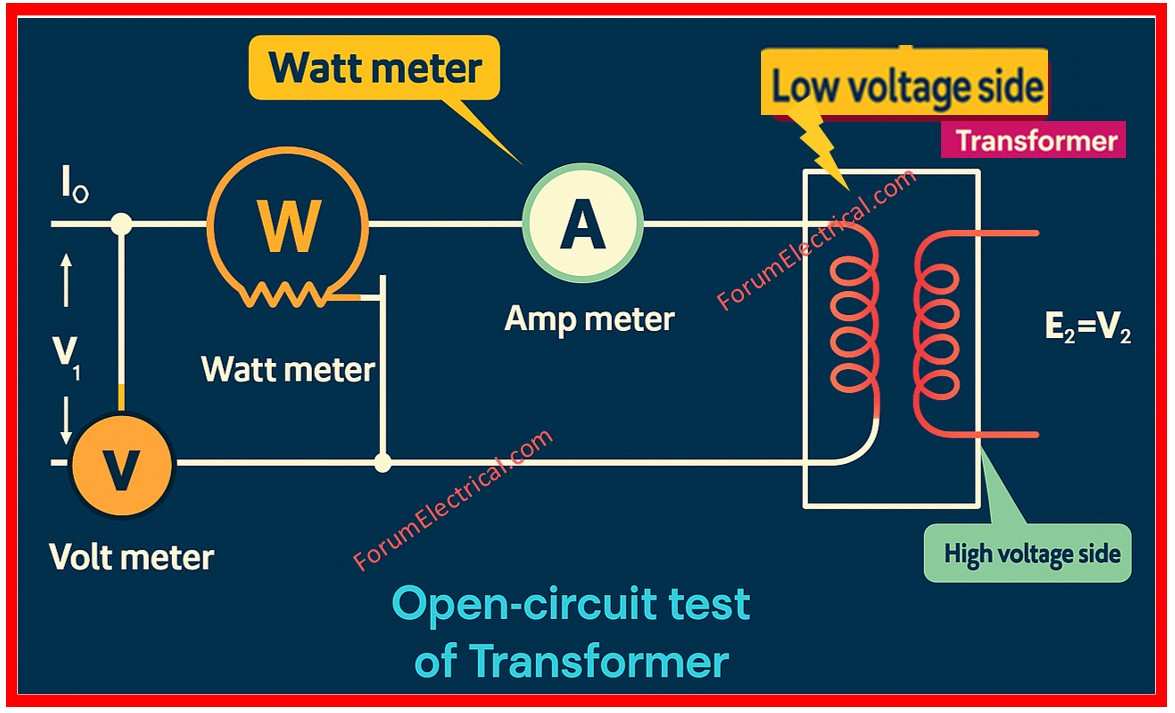
Testing a transformer before commissioning is important in ensuring its performance, efficiency and safety.
IEC 60076 recommends two fundamental routine tests:
- No-Load (Open-Circuit) Test and
- Load (Short-Circuit) Test.
These tests help to estimate the transformer’s
- Iron losses,
- Copper losses,
- Magnetizing current and
- Impedance voltage.
This post provides a detailed explanation of the tests’ purpose, protocol and usual values.
1). No-load test (Open Circuit Test)
Purpose
The no-load test evaluates the following important parameters:
Core (iron) losses occur in transformers.
The transformer draws magnetizing current.
Transformer power factor when no load is applied.
This test is often performed on the low-voltage (LV) side, leaving the high-voltage (HV) winding open.

Procedure (as per IEC 60076)
Connect the rated voltage (230 or 400 volts, or the LV side rated voltage).
Maintain the HV side open to prevent current from passing through it.
Utilizing a Digital Display System (DDS) (or) power analyzer, record the input voltage, current, and power levels.
Typical Test Values
Voltage: The rated LV voltage (for example, 230 or 400 volts).
Frequency: 50 Hz (normal IEC testing frequency).
Current: Low (about 1-5% of full load current based on magnetizing reactance).
Power: The core loss (iron loss) is typically 0.2-0.5% of the transformer’s kVA rating.
2). Load Test (Short-Circuit Test)
Purpose
The short-circuit test evaluates:
Copper losses (I²R) in transformer windings.
Impedance voltage.
Transformer’s percentage impedance (%Z).
This test is often performed on the HV side, with the LV side short-circuited utilizing copper bars.

Procedure (as per IEC 60076)
Use a lower voltage (5-12% of the rated HV voltage) to distribute full-load current.
Short-circuit the LV winding with a solid conductor (copper bars).
Use DDS to record the input voltage, current & power.
Typical Test Values
Voltage: 5-12% of rated HV voltage (enough to circulate the rated current).
Current: The rated current of the winding being tested.
Frequency: 50 Hz.
Power: Power represents copper loss at full load (FLC).
Differences Between No-Load and Load (Short-Circuit) Tests
| Aspect | No-Load Test (Open-Circuit) | Load Test (Short-Circuit) |
| Side of Test | In the no-load test, the low-voltage (LV) side is energized with the rated supply. | In the load test, the high-voltage (HV) side is energized with the reduced voltage. |
| Other Side Condition | During this test, the high-voltage (HV) winding is kept open so that no current flows through it. | In this test, the low-voltage (LV) winding is short-circuited using copper bars (or) solid conductors. |
| Loss Measured | The test is used to measure the core (iron) loss & magnetizing current of the transformer. | This test is conducted to measure the copper (I²R) loss of the transformer windings. |
| Applied Voltage | A rated voltage is applied to the LV side, which is usually 230 V (or) 400 V depending on the transformer rating. | Only 5–12% of the rated HV voltage is applied to circulate the full-load current in the transformer. |
| Current | The transformer draws only a small current (1–5% of full-load current) because the test measures magnetizing characteristics. | The transformer carries its full-load current which allows measurement of copper losses accurately. |
What is the Megger test for a Short Circuit?
A short circuit is just a direct path for the current to flow with no resistance. Megger assesses insulating resistance.
As a result, if a short circuit exists the megger will register 0 Ω indicating that there is no resistance and a short.
Conclusion
IEC 60076 defines two standard transformer tests: the no-load test and the load test.
The No-Load Test aids in detecting iron losses & magnetizing current, whereas the Load Test identifies copper losses, impedance voltage and %Z.
They give essential information for evaluating transformer performance, efficiency & thermal capacity before it is put into service.

 Tests per IEC 60076 to measure core losses, winding resistance, efficiency and voltage regulation accurately.)