
What is an Electrical Panel Board?
- What is an Electrical Panel Board?
- Types of Electrical Panel Boards
- 1). Main Distribution Panel (MDP)
- 2). Sub Distribution Panels (SDP)
- 3). Power Control Center (PCC)
- 4). Motor Control Center (MCC)
- 5). Automatic Transfer Switch (ATS) Panel
- 6). Synchronization Panel
- 7). APFC/Capacitor Panel
- 8). Lighting Distribution Boards (LDB)
- 9). Power Distribution Board (PDB)
- 10). High Tension Panel (HT Panel)
- 11). Low Tension Panel (LT Panel)
- Electrical Panel Boards Testing
- How to choose the right Electrical Panel Board?
- Compliance with IEC/IS Standards
- Why are Electrical Panels Powder coated?
- Conclusion
An Electrical Panel Board is also called as a
- Distribution Board (DB),
- Switchboard,
- PCC (Power Control Center),
- MCC (Motor Control Center)
is a metal enclosure that stores essential electrical components such circuit breakers, fuses, relays, switches, meters, busbars and protective devices.
Its primary function is to safely transfer the electrical power from an incoming supply to multiple outgoing feeders thereby protecting, controlling & monitoring the electrical system.
Electrical panel boards are primarily utilized in residential, commercial & industrial applications to manage the power efficiently.
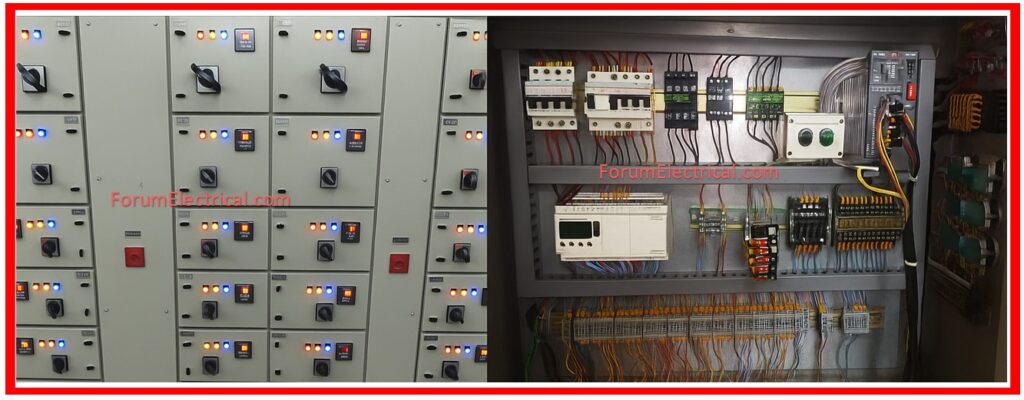
Types of Electrical Panel Boards
Electrical panels are divided into 11 different types based on their function, voltage rating & application.
The following are the various types:
1). Main Distribution Panel (MDP)
2). Sub Distribution Panels (SDP)
3). Power Control Center (PCC)
4). Motor Control Center (MCC)
5). Automatic Transfer Switch (ATS) Panel
6). Synchronization Panel
8). Lighting Distribution Boards (LDB)
9). Power Distribution Board (PDB)
10). High Tension Panel (HT Panel)
11). Low Tension Panel (LT Panel)
1). Main Distribution Panel (MDP)
The Main Distribution Panel serves as the principal point of power distribution in the facility. It takes power from the primary incoming source (utility or transformer) and distributes it to several sub-panels or feeders.
It is used in factories, commercial complexes, and huge structures.
Large Air Circuit Breakers (ACB) (or) MCCBs are commonly used for protection.
It provides safe load management & energy monitoring.
2). Sub Distribution Panels (SDP)
The Sub Distribution Panel obtains the electrical power from the MDP and delivers it to a specified load regions (or) parts of a building.
It provides localized control over electrical loads.
It reduces the number of wires from the main panel.
It is commonly utilized in large office buildings, shopping malls & factories.
3). Power Control Center (PCC)
The Power Control Center is intended to control and monitor the complete power system of an industry.
Installed near the primary power source (transformer or generator).
It contains circuit breakers, protection relays, metering set devices & control units.

It ensures the effective power distribution, monitoring & fault protection.
4). Motor Control Center (MCC)
The Motor Control Center is utilized to get start, control and protect the motors in industrial plants.
It includes starters, overload relays, contactors & protection devices.
It is depending on the motor application, the drive can be DOL, Star-Delta or VFD.
MCCs are widely employed in several industries, including cement, steel, oil and gas, water treatment and manufacturing.
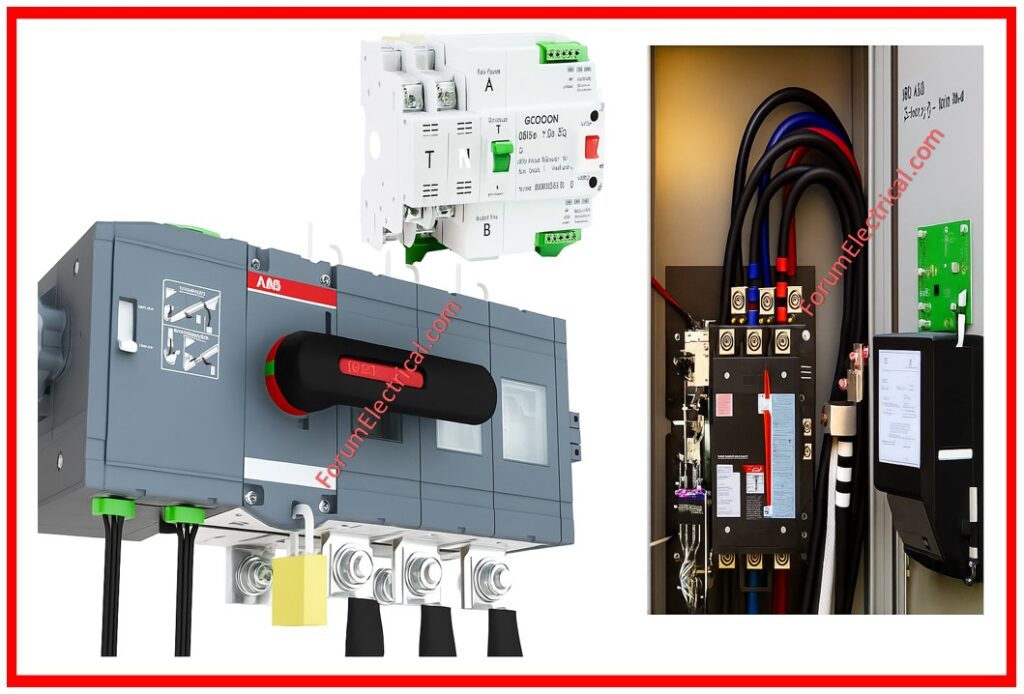
5). Automatic Transfer Switch (ATS) Panel
An ATS Panel provides automatic power transfer between 2 sources often the main utility supply and a generator.
It ensures smooth supply transition during power outages.
It eliminates downtime in important applications such as hospitals, data centers & industries.
It can be manual, semi-automatic (or) fully automatic.
6). Synchronization Panel
The Synchronization Panel is utilized when multiple generators (DG sets) (or) power sources are running in parallel.
Balances the load sharing between multiple generators.
It maintains frequency, voltage and phase synchronization.
It is used extensively in major businesses, airports & power plants.
7). APFC/Capacitor Panel
The Automatic Power Factor Control (APFC) Panel is mainly designed to increase the power factor of the system by utilizing capacitor banks.
It monitors the power factor & automatically turns capacitors ON/OFF.
It helps to lower the utility penalty payments and also assist in improving system efficiency.
It is essential for the industries with heavy inductive loads primarily motors and transformers.
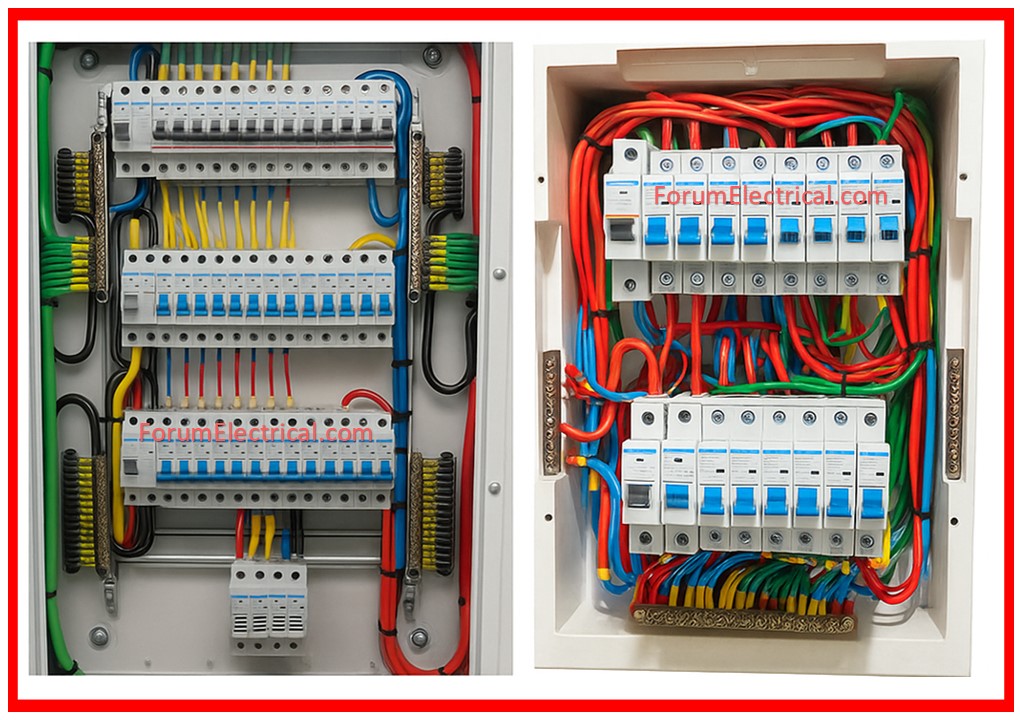
8). Lighting Distribution Boards (LDB)
An LDB is mainly designed for distributing power to the lighting circuits in residential, commercial & industrial buildings.
It contains MCBs & RCCBs to ensure safe operation.
It provides specific protection for the lighting loads.
9). Power Distribution Board (PDB)
The PDB (Power Distribution Board) provides electricity to socket outlets, tiny machinery and equipment.
It is typically found in workshops, commercial buildings and industrial facilities.
It protects against overloads & short circuits.
10). High Tension Panel (HT Panel)
The HT Panel functions at a voltage level above 1 kV & is utilized in the substations and businesses.
It is equipped using vacuum circuit breakers (VCB), SF6 breakers and protection relays.
It provides fault protection, metering & load control.
It is mainly suitable for the electricity distribution at 11kV, 33kV (or) greater voltages.
11). Low Tension Panel (LT Panel)
The LT Panel operates at voltages less than 1 kV (usually 415V AC in industry).
It is utilized for the low-voltage power distribution.
It contains MCCBs, ACBs, relays & metering devices.
It is often utilized in business buildings, enterprises, and huge residential apartments.
Electrical Panel Boards Testing
Temperature Rise Test: Temperature Rise Test ensures that components can bear the rated load without overheating.
Dielectric Withstand Test: Dielectric Withstand Test helps to determines insulation strength at high voltage.
Short-Circuit Withstand Test: Short-Circuit Withstand Test used to confirms that the panel can withstand fault currents.
Insulation Resistance Test: IR Test utilizes a Megger to assess the insulation quality.
IP Protection Test: IP Protection Test used to determines dust and water intrusion resistance.
Routine Test: Routine tests (performed on each panel before dispatch)
Visual & mechanical inspection.
Wiring and continuity checks.
Insulation resistance measurements.
High-voltage dielectric test.
Functional operation and interlock testing.
Earthing and safety checking.
How to choose the right Electrical Panel Board?
When selecting an electrical panel the following elements should be considered:
Load calculations (including future expansion).
Rated voltage and current capacity.
Short-circuit withstand capability (kA rating).
Busbar size and substance (copper/aluminum with tin/silver coating).
Quality switchgear (MCB, MCCB, ACB, and relays from well-known companies such as ABB, Siemens, L&T, Schneider).
Compliance with IEC/IS Standards
IP ratings are based on dust/water exposure (IP54, IP65, etc.).
Easy maintenance & accessibility.
Safety elements include earthing, interlocks and phase barriers.
Manufacturer quality certificates (ISO, CE, and UL).
Why are Electrical Panels Powder coated?
Powder coating is a dry finishing procedure that involves electrostatically spraying fine powder over the steel surface of panel enclosure & baking it in an oven.
Coating thickness is 60-100 microns.
Advantages of Powder Coating:
> It provides corrosion resistance.
> It provides a longer life and a smooth finish.
> It prevents scratch, heat & chemical resistance.
> It improves the electrical insulation support.
Conclusion
An electrical panel board is the heart (primary component) of every electrical distribution system ensuring that power is managed safely, reliably & efficiently.
From Main Distribution Panels (MDP) to Motor Control Centers (MCC) each type has different functions in residential, commercial (or) industrial settings.
By following to proper testing standards, manufacturing inspections and selection criteria you can assure that the installed panel is secure and durable and also meets international requirements.
Additionally features such as powder coating, quality switchgear and suitable IP protection extend the life & performance of the electrical panels.

