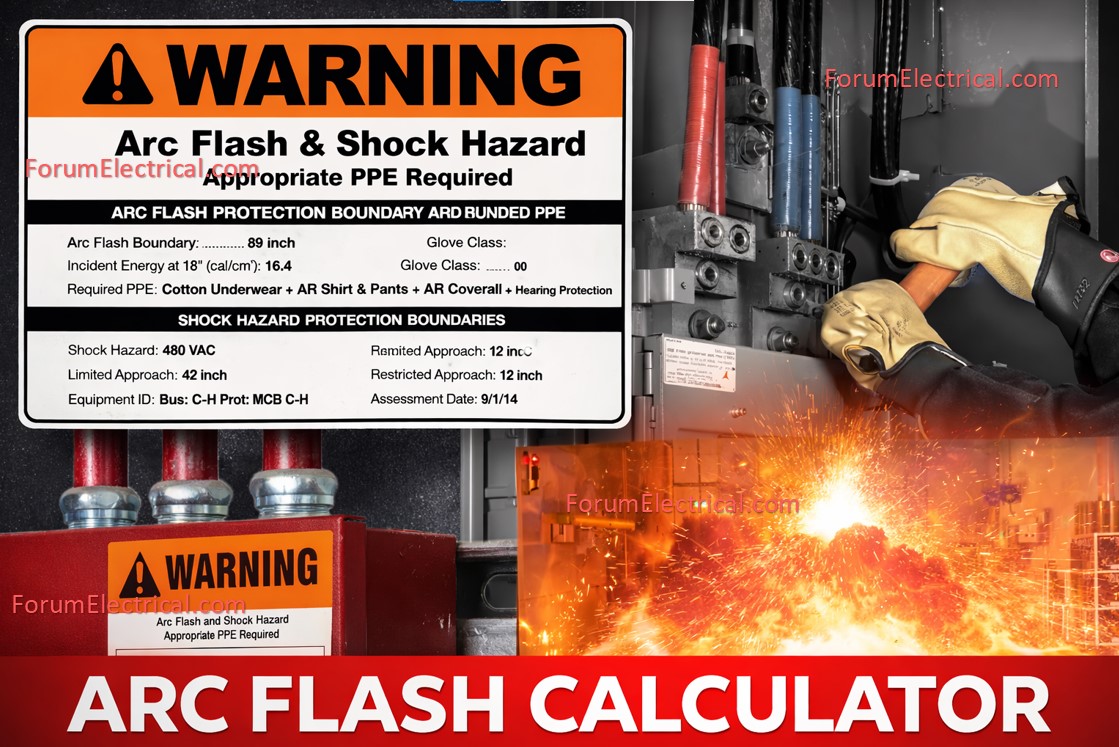
Calculator
Arc Flash Calculator allows electrical experts to quickly calculate incident energy, arc flash boundaries & required PPE using system specifications and safety requirements.
⚡ Advanced Arc Flash Calculator
IEEE 1584-2018 | ENA | DGUV | NFPA 70E | AC & DC Systems
Input Parameters
Results
🦺 PPE Minimum Requirements
Click here for more Electrical Calculators
Arc flash incidents represent one of the most dangerous hazards in the electrical systems capable of causing
1). Severe burns,
2). Injuries and
3). Fatalities within milliseconds.
An arc flash occurs when electrical current surpasses across a gap in air creating an extremely hot and energetic explosion.
Understanding and quantifying this hazard is essential for the workplace safety, regulatory compliance and worker protection.
The Arc Flash Calculator is a professional tool designed to assess arc flash incidents across various electrical systems and standards.
It integrates multiple international calculation methodologies and safety frameworks to provide the accurate incident energy predictions and appropriate personal protective equipment (PPE) recommendations.
This post explains how the calculator works, what inputs it needs and how to interpret its results.
What is Arc Flash?
Arc flash is the sudden release of electrical energy when the current arcs across a gap in an electrical circuit.
The consequences include:
Intense Heat
Temperatures can exceed > 19,000°C (comparable to surface of sun).
Pressure Waves
Creating blast forces that can knock workers down (or) cause trauma.
Light Radiation
Capable of causing temporary (or) permanent vision damage.
Projectiles
Vaporized conductive materials & debris flowing at high speeds.
Burns
Thermal injuries to exposed skin & potentially through clothing.
The severity of an arc flash depends on several factors which includes
1). System voltage,
2). Fault current available,
3). Arc duration and
4). Worker’s distance from the arc source.
This calculator used to perform complex electrical parameters into actionable safety information. It:
1). Calculates the arcing current in fault condition.
2). Determines the incident energy at a specified working distance.
3). Identifies the arc flash boundary (Distance beyond which thermal hazard becomes negligible).
4). Assigns a PPE category based on calculated energy.
5). Recommends appropriate protective equipment (PPE).
Standards & Methodologies
The calculator supports 7 different calculation methods to accommodate various electrical systems requirements:
IEEE 1584-2018 (AC Systems)
The most widely used standard in North America for three-phase (3 Phase) AC systems.
It uses empirical equations based on the extensive testing to predict the arcing current & incident energy.
ENA NENS 09-2014 (UK AC Systems)
The UK & European standard for the arc flash assessment in alternating current systems providing calculations to typical European electrical distributions.
DGUV 203-077 (German Standards)
It is available for both AC and DC systems.
This German safety standard provides an alternative methodology for calculating the arc flash hazards.
The AC type applies to conventional systems while the DC type uses iterative methods.
DC Methods
The calculator includes 2 DC calculation approaches:
1). Stokes method and
2). Maximum Power method.
These are essential for assessing hazards in
1). Battery systems,
2). Solar installations and
3). DC power distribution networks.
NFPA 70E (Table Method)
A simplified method utilized in North America that used to assigns PPE categories based on the equipment type and also voltage rather than the calculated incident energy.
Input Parameters
To utilize the calculator effectively you need to provide the accurate electrical system (power system) information:
Standard Selection
Choose the calculation method which is appropriate for your system type.
This determines which method and safety factors will be applied.
System Type
Select whether your system is
- 3-Phase (typical for industrial & large commercial installations) (or)
- 1-Phase (common in residential & smaller commercial systems).
Single-phase systems experience different arc characteristics and need a correction factor.
Electrode Configuration
Electrode configuration explains how the conductors are arranged in equipment where the arc might occur.
Common configurations include:
VCB (Vertical in Box)
Conductors arranged vertically within an enclosed cabinet.
VCBB (Vertical Insulated Box)
Similar to VCB but with additional insulation.
HCB (Horizontal in Box)
Conductors in the horizontal configuration inside a cabinet.
VOA (Vertical Open Air)
Vertical arrangement in open air.
HOA (Horizontal Open Air)
Horizontal arrangement in open air
The configuration significantly affects how the arc develops & therefore the magnitude of the resulting incident energy.
Each configuration has a specific factor that adjusts the calculated energy.
System Voltage
Enter the nominal operating voltage of the electrical system in volts.
This is fundamental one because the higher voltages create higher arcing currents and also greater incident energy.
Typical values range from 120V for small equipment to several 1000V for transmission systems.
Bolted Fault Current
This represents the maximum current that would flow if the circuit were directly short-circuited (a “bolted” fault with no arc resistance).
It’s typically obtained from a 3 phase power flow study (or) system analysis and is expressed in kiloamps (kA).
This value is essential because it directly determines the arcing current.
Working Distance
The distance in millimeters (mm) from the arc source to where a worker might be positioned.
Standard distances include
- 450 mm (18 inches) for switchboards and
- 600 mm (24 inches) for most industrial equipment.
Incident energy used to decreases rapidly with distance making this parameter essential for the accurate assessment.
Arc Duration
2 time values are specified by:
Normal Duration
The expected time for the protective devices to clear all the fault under recommended standard conditions
Reduced Duration
A faster clearing time that might be achieved with the enhanced protective relays (or) fast-acting devices
The calculator calculates incident energy for both the conditions allowing comparison of the hazard levels with & without enhanced protection systems.
Results
The calculator displays 5 primary important results:
Arcing Current (kA)
The actual current flowing via the arc itself which is typically lower than the bolted fault current because of arc resistance.
This value is expressed in kiloamps (kA) and provides insight into the arc electrical characteristics.
Incident Energy (cal/cm²)
The thermal energy per unit area that would be absorbed by skin (or) clothing at the specified working distance.
Measured in calories per square centimeter.
This is the primary hazard metric.
A 1.2 cal/cm² exposure level represents the threshold at which untreated cotton fabric ignites.
Reduced Energy (cal/cm²)
The incident energy calculated using the reduced arc duration time.
This shows how much the hazard decreases if faster protective device operation can be achieved detailing the advantage of enhanced protection systems.
Arc Flash Boundary (mm)
The distance at which the incident energy is used to drops is 1.2 cal/cm².
- Beyond this boundary the thermal hazard is considered manageable with standard clothing.
- Within this boundary arc-rated protective equipment is mandatory.
PPE Category
A classification (1 through 4) that establishes the minimum protective equipment level required based on the incident energy:
Category 1
Minimal hazard (≤4 cal/cm²).
Basic arc-rated clothing required.
Category 2
Moderate hazard (4–8 cal/cm²).
Enhanced protection needed.
Category 3
High hazard (8–25 cal/cm²).
Comprehensive arc-rated suit required.
Category 4
Extreme hazard (>25 cal/cm²).
Maximum protection with specialized equipment.
PPE Recommendations
The calculator automatically used to generates a customized list of minimum PPE requirements based on the calculated most dangerous hazard category.
These recommendations follow up with NFPA 70E standards & include:
Category 1 PPE
Suitable for lower-energy incidents & this includes arc-rated shirt & pants, face shield, safety glasses and also leather gloves. This level provides basic thermal protection without the full-body coverage.
Category 2 PPE
For moderate incidents arc-rated clothing (specifically designed clothes), an arc hood to protect the head & neck, rubber gloves & safety glasses provide enhanced thermal protection & better coverage.
Category 3 PPE
High-energy incidents require a complete arc flash suit that covers the entire body completely, an arc hood, arc-rated gloves and safety glasses.
This configuration provides the comprehensive thermal protection.
Category 4 PPE
Extreme hazard situations demand the multi-layer flash suits with additional specialized (PPE) protective equipment.
This maximum level of protection is sometimes supplemented with the additional barriers (or) remote operation methods.
Applications
The calculator serves several important functions in electrical safety management:
1). Hazard Assessment
2). Labeling & Warning Signs
3). Training & Awareness
4). System Improvement Analysis
Regulatory Compliance
NFPA 70E & OSHA with other regulatory bodies needs the arc flash hazard assessments.
The calculator helps meet these compliance obligations by providing this documented calculations.
Conclusion
The Advanced Arc Flash Calculator converts electrical system data into a clear safety insights by applying international standards & proven calculation methods.
It helps professionals assess
1). Arc flash hazards quickly,
2). Select proper PPE and
3). Improve workplace safety.
By utilizing this accurate inputs & understanding the results that helps the engineers & electricians can reduce arc flash risks (arc flash hazards) & support compliance with the electrical safety regulations.

