Calculator
⚡ AS/NZS 3008 Cable Calculator
Accurate Cable Sizing Based on Australian & New Zealand Standards
System Parameters
Cable Specifications
✓ Cable Sizing Results
Click here for Electrical Calculators
What is Cable Sizing?
Cable sizing is the method of determining the correct cross-sectional area (thickness) of electrical cable required for a specific installation. It is not just about making the cable thick enough to carry current. It Is about finding the MINIMUM size that:
• Safely carries the required load without overheating.
• Keeps the voltage drop within limits so equipment works properly.
• Complies with electrical standards (AS/NZS 3008).
• Provides the reasonable cost without wasting material.
Why is Correct Sizing important?
Undersized Cables
• Resistance causes heat & risk of fire.
• Equipment fails from low voltage.
• Safety risk to people and property.
• Violates electrical standards.
• May void coverage.
Oversized Cables
• Unnecessary material and cost
• Harder to install and terminate
• No added benefit
• Every unnecessary dollar spent
Correct Size
• Appropriate temperature rise
• Proper equipment operation
• Meets all standards
• Best cost-benefit ratio
• Industry best practice
What is AS/NZS 3008?
AS/NZS 3008 is the Australian/New Zealand standard for electrical installations.
It covers:
• Cable sizing requirements,
• Voltage drop limits,
• Current carrying capacity,
• Installation methods,
• Safety requirements &
• Testing procedures.
Standards like AS/NZS 3008 exist to ensure:
• Cables don’t overheat and cause fires,
• Equipment operates properly,
• Same installation anywhere in Australia/NZ,
• Compliance required for coverage,
• Property compliance adds value &
• Legal requirement for installations.
Voltage Types in Australia & New Zealand
Domestic
230V single-phase (standard home supply)
Commercial
230V single-phase (general distribution)
400V three-phase (larger installations)
Industrial
400V three-phase (standard)
11,000V (distribution level)
33,000V (transmission level)
Common Load Currents
Single Phase at 230V:
1kW = 4.3A
2kW = 8.7A
3kW = 13A
5kW = 21.7A
10kW = 43.5A
Three Phase at 400V:
1kW = 1.4A
5kW = 7.2A
10kW = 14.5A
15kW = 21.7A
22kW = 32A
30kW = 43.4A
(Calculation: I = P / (V x √3 x 0.85) for 3-phase)
Why Derating?
Cables operate at their best in ideal conditions:
• Moderate temperature (around 40°C ambient),
• Good air circulation &
• No thermal insulation around cable.
Real-world conditions are often different.
When conditions worsen, we apply derating factors – percentages that reduce the safe current capacity.
Common Derating Conditions
The common derating conditions are:
• Exposure to Sunlight,
• Thermal Insulation,
• Conduit Installation,
• Multiple Cables Together &
• High Ambient Temperature.
3 Keys to Cable Sizing
1). Current Carrying Capacity
The cable must be safely handle the expected load current without excessive heat.
It is based on material, size, insulation & installation method and follow AS/NZS 3008 capacity tables
Load current < Cable capacity
2). Voltage Drop
The cable resistance causes voltage loss over distance affecting equipment performance.
It is based on resistivity, current, distance & cross-sectional area and typically 2-5% depending on load type
Actual drop must be < Maximum allowed
3). Short Circuit Protection
The cable should work with protective devices. It is based on cable impedance and fault clearing time and follows manufacturer specifications.
Cable Components
Conductor
The metal that carries current (copper / aluminium).
• Copper: Better conductor & smaller sizes needed.
• Aluminium: Good conductor & larger sizes needed.
Insulation
Plastic covering that protects the conductor.
• PVC: Common & lower temperature rating.
• XLPE: Better & higher temperature rating.
Sheath
Outer covering that protects the whole cable.
• PVC: General purpose
• Other types: Special conditions (UV, water, etc.)
Core Configuration
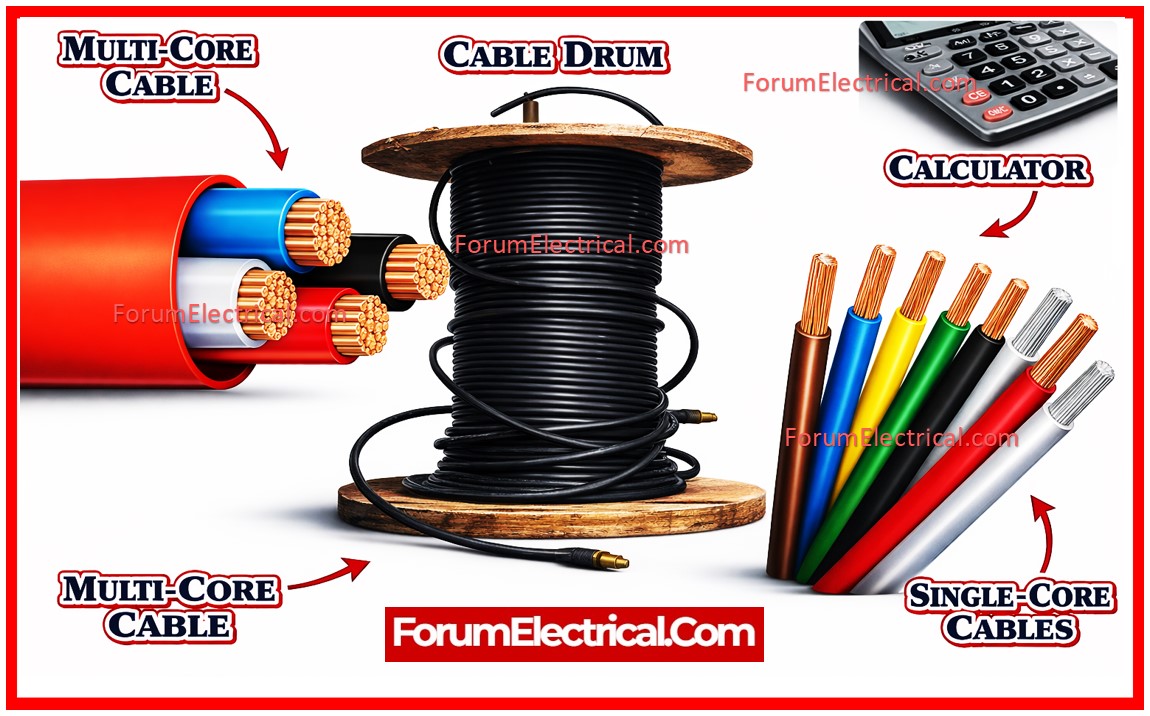
• Single-core: One conductor per cable
• Multi-core: Multiple conductors in one cable
Calculation
Voltage Drop Calculation
The voltage drop in a cable depends on:
How much current flows through it (I).
How long the cable is (L).
What material it is made of (ρ).
How thick it is (CSA).
Formula
VD = (ρ × I × L) / CSA
Voltage Drop = (Resistivity x Current x Length) / Cross-sectional Area
Example
Copper cable (ρ = 0.0186)
50A current
50m length
25mm² cable
VD = (0.0186 x 50 x 50) / 25 = 1.86V
To convert to percentage
VD% = (1.86 / 400V) x 100 = 0.465% (Good)
If we had used 16mm²
VD = (0.0186 x 50 x 50) / 16 = 2.91V
VD% = (2.91 / 400V) x 100 = 0.73% (Still acceptable)
If we had used 10mm²
VD = (0.0186 x 50 x 50) / 10 = 4.65V
VD% = (4.65 / 400V) x 100 = 1.16% (Exceeds 5% in single phase & acceptable in 3-phase)
Current Capacity Calculation
Current capacity depends on:
• Material (copper conducts better than aluminium)
• Insulation type (higher temp rating = higher capacity)
• Installation method (air cooling better than conduit)
• Cable size (larger = more current)
Current capacity values come from the AS/NZS 3008 tables developed through testing.
These tables account for:
• Heat dissipation rate
• Ambient temperature
• Thermal insulation effects
• Safety margins
Example
A 25mm² copper multi-core cable:
In air: 73A capacity
In conduit: ~62A (15% reduction)
In thermal insulation: ~50A (30% reduction)
CSA Calculation
To find the minimum cable size required:
Step-1: Determine limiting factor
Voltage drop limit usually is limiting for longer runs.
Current capacity usually is limiting for shorter runs.
Step-2: Calculate minimum CSA
For voltage drop
CSA = (ρ x I x L) / (V x VD%)
Cross-sectional Area = (Resistivity x Current x Length) / (Voltage x Voltage Drop %)
For current capacity
CSA selected from tables > Load current
Step-3: Select Standard Size
Round up to next standard size.
Step-4: Verify Both Limits
Check that final size meets the both voltage drop and current capacity requirements.
AS/NZS 3008 Cable Current Rating Tables
AS/NZS 3008.1.1 is the Australian/New Zealand standard used to determine current-carrying capacity, voltage drop and cable selection for LV and MV cables.
It provides detailed tables based on:
• Conductor material (Copper / Aluminium)
• Insulation type (PVC, XLPE, EPR)
• Installation method (air, conduit, buried, tray)
• Number of cores
• Ambient temperature
• Grouping factor
Below are the most commonly used AS/NZS 3008 current rating tables.
1). Copper Cable Current Rating – XLPE Insulation (90°C)
Single-Core Copper Cable in Air (Reference Method C)
| Size (mm²) | Current Rating (A) |
|---|---|
| 1.5 | 23 |
| 2.5 | 31 |
| 4 | 42 |
| 6 | 54 |
| 10 | 75 |
| 16 | 100 |
| 25 | 134 |
| 35 | 162 |
| 50 | 195 |
| 70 | 245 |
| 95 | 292 |
| 120 | 335 |
| 150 | 380 |
| 185 | 437 |
| 240 | 515 |
| 300 | 594 |
| 400 | 689 |
| 500 | 783 |
2). Copper Cable Current Rating – XLPE Insulation (Buried Direct)
| Size (mm²) | Current Rating (A) |
|---|---|
| 1.5 | 26 |
| 2.5 | 35 |
| 4 | 47 |
| 6 | 60 |
| 10 | 83 |
| 16 | 110 |
| 25 | 144 |
| 35 | 174 |
| 50 | 209 |
| 70 | 262 |
| 95 | 312 |
| 120 | 357 |
| 150 | 406 |
| 185 | 467 |
| 240 | 550 |
| 300 | 636 |
| 400 | 738 |
| 500 | 840 |
3). Multi-Core Copper Cable Current Rating – XLPE (3 Core)
| Size (mm²) | Current Rating (A) |
|---|---|
| 1.5 | 19 |
| 2.5 | 26 |
| 4 | 35 |
| 6 | 45 |
| 10 | 62 |
| 16 | 83 |
| 25 | 108 |
| 35 | 131 |
| 50 | 158 |
| 70 | 200 |
| 95 | 239 |
| 120 | 274 |
| 150 | 312 |
| 185 | 358 |
| 240 | 423 |
| 300 | 489 |
| 400 | 568 |
4). Aluminium Cable Current Rating – XLPE (Single Core in Air)
| Size (mm²) | Current Rating (A) |
|---|---|
| 16 | 76 |
| 25 | 100 |
| 35 | 121 |
| 50 | 146 |
| 70 | 183 |
| 95 | 218 |
| 120 | 250 |
| 150 | 284 |
| 185 | 327 |
| 240 | 385 |
| 300 | 443 |
| 400 | 515 |
| 500 | 585 |
5). AS/NZS 3008 Voltage Drop Values (Copper & 3-Phase)
| Size mm² | mV/A/m |
|---|---|
| 1.5 | 29 |
| 2.5 | 18 |
| 4 | 11 |
| 6 | 7.3 |
| 10 | 4.4 |
| 16 | 2.8 |
| 25 | 1.75 |
| 35 | 1.25 |
| 50 | 0.93 |
| 70 | 0.68 |
| 95 | 0.49 |
| 120 | 0.39 |
| 150 | 0.32 |
| 185 | 0.26 |
| 240 | 0.20 |
6). Installation Reference Methods (AS/NZS 3008)
| Method | Description |
|---|---|
| A | Enclosed in conduit in wall |
| B | Enclosed in conduit on wall |
| C | Clipped direct or on tray |
| D | Underground direct buried |
| E | In air on ladder/tray |
7). Temperature Correction Factors
| Temperature | Factor |
|---|---|
| 25°C | 1.03 |
| 30°C | 1.00 |
| 35°C | 0.96 |
| 40°C | 0.91 |
| 45°C | 0.87 |
| 50°C | 0.82 |
8). Grouping Correction Factor
| Number of Cables | Factor |
|---|---|
| 1 | 1.00 |
| 2 | 0.80 |
| 3 | 0.70 |
| 4 | 0.65 |
| 5 | 0.60 |
| 6 | 0.57 |
Cable Insulation Material for different Operating Temperatures
This table gives you a comprehensive operating temperature specifications for the various cable insulation types including PVC, Elastomer & XLPE cables.
| Type of Cable Insulation | Temp in Normal Use (°C) | Maximum Allowed Temp (°C) | Minimum Ambient Temp (°C) |
| V-75 | – | 75 | – |
| HFI-75-TP, TPE-75 | 75 | 75 | -20 |
| V-90 | 75 | 90 | – |
| HFI-90-TP | 75 | 90 | -20 |
| V-90HT | 75 | 105 | – |
| R-EP-90 | 90 | 90 | -40 |
| R-CPE-90, R-HF-90, R-CSP-90 | 90 | 90 | -40 |
| R-HF-110, R-E-110, R-CSP-90 | 90 | 90 | -20 |
| R-HF-110, R-E-110 | 110 | 110 | – |
| R-S-150 | 150 | 150 | -50 |
| X-90, X-90UV, X-HF-90 | 90 | 90 | – |
| X-HF-110 | 110 | 110 | – |

