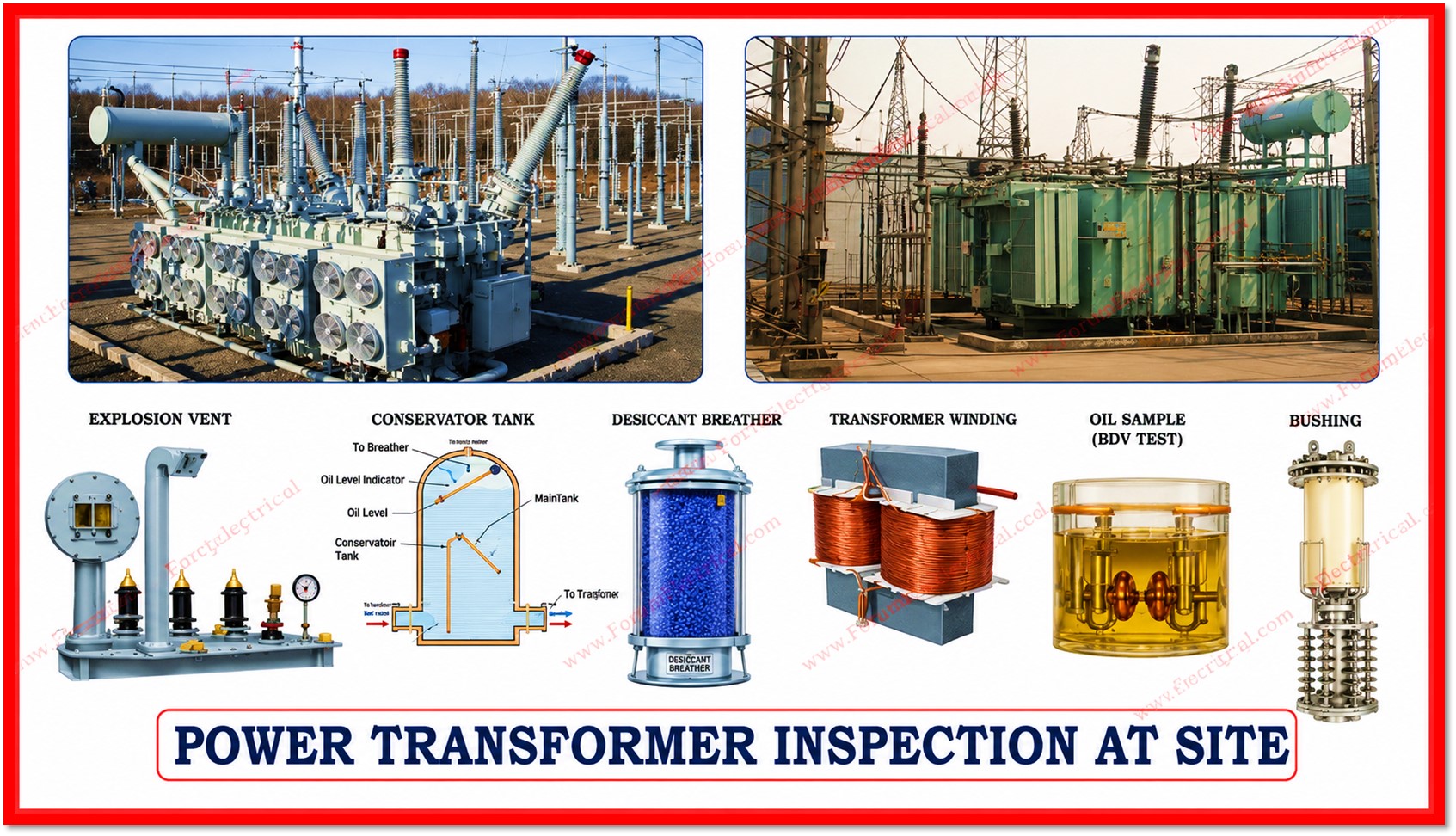
When a power transformer is set to arrive at site it is essential to conduct a detailed inspection before unloading, storage & installation.
- Purpose of Inspection
- Common Problems found during Transformer Arrival
- Safety Precautions
- Nitrogen Pressure Inspection (For Transformers Shipped Without Oil)
- Oil-Filled Transformer Inspection
- Mechanical and Physical Inspection
- Nameplate Verification
- Impact Recorder Inspection
- Accessories Inspection
- Transformer Arrival Inspection Checklist
- Photo Records
- Conclusion
Transportation, handling & storage conditions can affect the transformers insulation system, mechanical integrity and also operational reliability.
Proper inspection ensures that the transformer has not get damage, moisture ingress, oil contamination (or) mechanical deformation during transit.
This post provides a comprehensive inspection procedure, checklist and acceptance format for site engineers and inspectors.
Purpose of Inspection
• Verify the transformer condition after transportation.
• Detect the oil leakage, mechanical damage (or) moisture ingress.
• Ensure the completeness of accessories and their components.
• Confirm the compliance with the purchase order (PO) and manufacturer specifications.
• Ensure the safe installation and reliable operation of transformer.
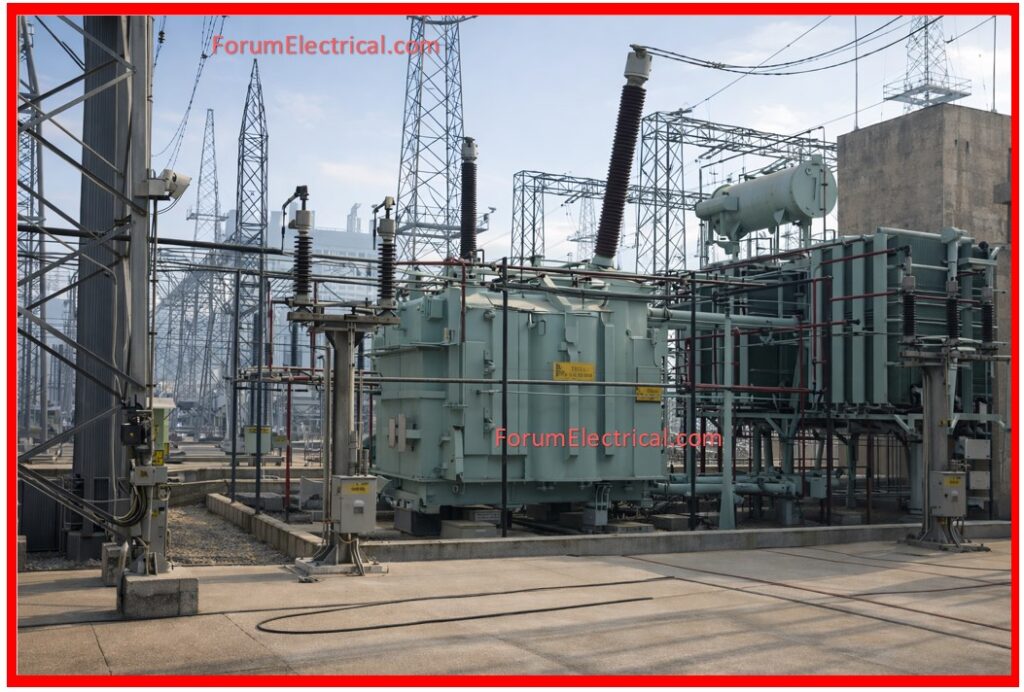
Common Problems found during Transformer Arrival
Typical issues include:
• Oil leakage,
• Nitrogen pressure loss,
• Damaged bushings,
• Missing accessories,
• Transport impact damage,
• Moisture ingress &
• Radiator damage.
Immediate corrective action is needed.
Safety Precautions
Always follow the essential safety guidelines:
• Use PPE equipment.
• Do not open transformer tank unnecessarily.
• Avoid exposure to moisture.
• Use proper lifting equipment.
• Follow the manufacturer instructions.
Nitrogen Pressure Inspection (For Transformers Shipped Without Oil)
If the transformer is shipped without oil & filled with the nitrogen gas carry out the following checks:
• Check the nitrogen pressure is (+) positive (typically 0.2 to 0.35 kg/cm²).
• Ensure that the nitrogen cylinders & pressure regulators are provided.
• Confirm the nitrogen purity meets IS 1747 standards.
• Dew point must be -55°C (or) lower.
• If pressure is zero (or) negative immediately inform the manufacturer.
• Moisture ingress is assumed if the pressure is lost.
Oil-Filled Transformer Inspection
• Check the oil level in main tank and conservator.
• Inspect for oil leakage at joints, valves, bushings and radiators.
• Collect the oil sample from the bottom valve.
• Perform the BDV test (minimum 60 kV for new oil typical).
• Perform moisture content test.
• • Inform the manufacturer if values are abnormal.
Mechanical and Physical Inspection
• Inspect the tank surface for dents, deformation (or) scratches.
• Check the radiators, valves and cooling fans.
• Inspect the paint condition.
• Check the bushings for any cracks (or) damage.
• Verify all the accessories are received.
• Match packing list with the received equipments.
Nameplate Verification
Verify following details:
• Transformer rating (MVA/kVA)
• Voltage ratio
• Current rating
• Impedance
• Frequency
• Vector group
• Serial number
Impact Recorder Inspection
• Check if the impact recorder is installed.
• Download & review the impact data.
• Verify the impact limits that is not exceeded.
• Inform the manufacturer if any abnormal impact detected.
Accessories Inspection
Ensure availability and condition of:
• Bushings,
• Radiators,
• Cooling fans,
• Conservator,
• Buchholz relay,
• Pressure relief device,
• Oil level indicator (OLI) &
• Winding temperature indicator (WTI).
Transformer Arrival Inspection Checklist
Photo Records
Conclusion
Transformer site arrival inspection is one of an essential SOP in ensuring a safe installation, reliable operation & long service life of the transformer.
Proper inspection helps to identify transportation damage, oil leakage, insulation issues and missing accessories before installation.
Key inspection areas of this procedure include:
• Nameplate verification,
• Nitrogen pressure check,
• Oil level & oil quality testing,
• Impact recorder analysis,
• Physical & accessory inspection,
• Documentation verification
Early detection of the problems prevents major failures, reduces downtime and protects the expensive electrical assets.
A securely inspected transformer assures a safe commissioning, improved reliability & also long operational life.

