
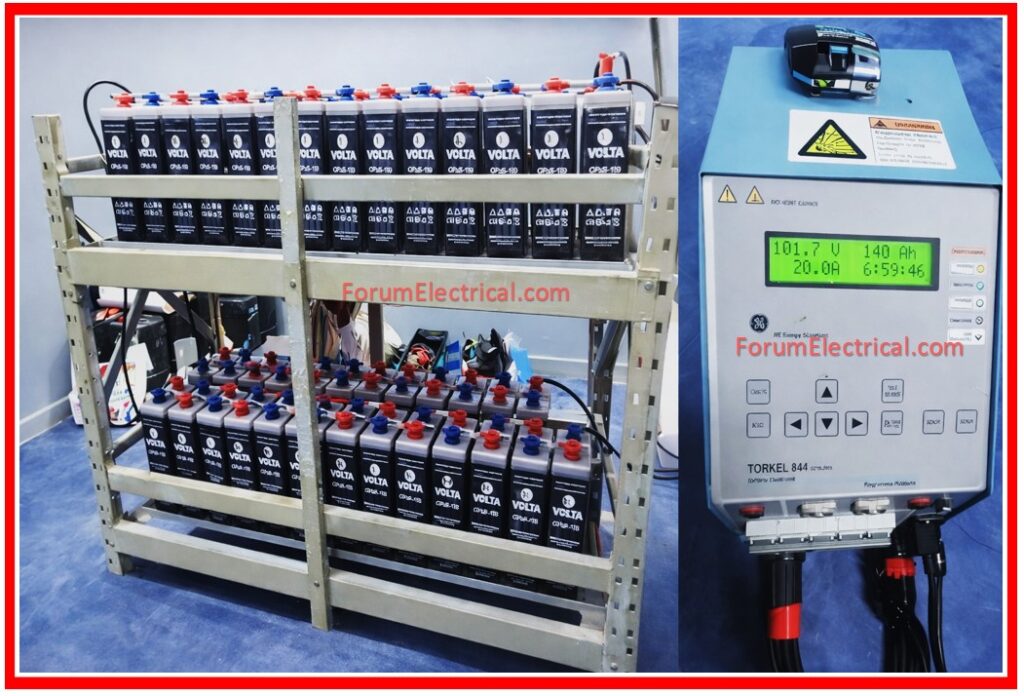
A battery discharge test also known as a battery load test (or) capacity test is a key maintenance procedure that assesses the real performance, capacity and health of a battery system.
- Purpose
- Equipment Required
- Safety Concerns
- Standards
- Battery Discharge Testing Procedure
- Step-1: Pre-Test Preparation
- Step-2: Equipment Setup
- Step-3: Establish Initial Conditions
- Step-4: Execute the Discharge
- Step-5: Monitor the Discharge
- Step-6: Post-Test Documentation
- Types of Battery Discharge Test
- 1). Constant Current Discharge Test
- 2). Constant Power Discharge Test
- 3). Constant Resistance Discharge Test
- 4). Load Profile Discharge Test
- Battery Discharge Test Results
- Factors Affecting Battery Discharge Test Results
- Conclusion
The test consists of draining the battery under controlled settings that measuring voltage, current, temperature and time.
It is commonly used in UPS systems, substations, DC systems, telecom batteries and energy storage systems that provide reliability during the power outages.
Purpose
Battery discharge tests assess battery system condition and performance.
It measures the battery genuine capacity against its rated value and also evaluates its state of health (SOH) and also ensures it can deliver the appropriate power throughout service.
In addition, this test helps to identify weak (or) damaged battery bank cells and promotes preventive maintenance planning by decreasing unexpected failures and downtime.
Equipment Required
1). Battery Load Bank/Battery Discharge Tester
2). Digital Multimeter
3). DC Clamp Meter
4). Battery Monitoring System
5). Temperature Sensors (or) Infrared Thermometer
6). Data Logging Software
7). Personal Protective Equipment (PPE)
8). Fire Extinguisher (Class C/Electrical)
Safety Concerns
1). Provide appropriate ventilation to the dissipate heat & gases.
2). Always utilize personal protective equipment (PPE) during testing.
3). Keep the fire extinguishers easily available.
4). Follow the manufacturer’s and IEEE’s safety standards strictly.
Standards
IEEE 1188: Recommended practice for valve-regulated lead-acid (VRLA) batteries.
IEEE 1549: Grid-connected energy storage & interconnection standards.
Battery Discharge Testing Procedure
Step-1: Pre-Test Preparation
Check the battery’s identification number, age, voltage rating and capacity rating.
Measure and record the battery’s starting temperature.
Inspect the battery for any apparent damage, corrosion (or) leaks.
Ensure that all safety equipment is present along with the work area is well ventilated.
Step-2: Equipment Setup
Securely connect the battery to the discharge load unit using the suitably rated cables and connections.
Install voltage and current monitoring equipment.
Position the temperature sensor on the battery surface.
Make sure all connections are tight and secure.
Do not start the test until all of the equipment is working properly.
Step-3: Establish Initial Conditions
Before you conduct the test, record the battery’s open-circuit voltage (OCV). Take note of the ambient temperature.
Set the discharge load to the specified current, power (or) resistance value based on your test procedure.
Step-4: Execute the Discharge
Start the discharge test procedure and start capturing data.
For constant current testing draw the predetermined current (usually at a C/10 or C/20 rate where C is battery’s capacity rating) till the battery achieves its minimal cutoff voltage.
Voltage, current and temperature should be measured at regular intervals (every minute for quick tests and every 5-10 minutes for longer tests).
Step-5: Monitor the Discharge
Continuously monitor the battery for any abnormalities such as high heat, odd sound (or) obvious damage.
If any safety hazards appear during the test, stop it immediately.
Continue recording data until the battery cut-off voltage is reached (or) the test requirements are fully met.
Step-6: Post-Test Documentation
Keep monitoring of the final time that the battery achieved its cutoff voltage.
Take note of the battery final temperature and then safely disconnect it from the load.
Allow the battery to cool to ambient temperature prior to removing it from the test stand.
Types of Battery Discharge Test
The different types of battery discharge tests are:
1). Constant Current Discharge Test
2). Constant Power Discharge Test
3). Constant Resistance Discharge Test
4). Load Profile Discharge Test
1). Constant Current Discharge Test
The procedure of this test draws a fixed current from the battery until the voltage reaches a predetermined cutoff point.
This is the most widely used test for lead-acid batteries for automotive applications.
The constant current method yields reliable and repeatable findings and is appropriate for comparing the batteries of similar types.
2). Constant Power Discharge Test
The battery generates a constant power output however current decreases as voltage drops.
This test is ideal for applications that require precise supply of power such as uninterruptible power supplies (UPS) & high-performance energy storage systems.
3). Constant Resistance Discharge Test
A fixed resistance is placed between the battery terminals causing the current to decrease proportionally as the voltage decreases.
This method accurately models real-world load conditions and also useful for determining realistic battery performance.
4). Load Profile Discharge Test
The battery goes through a certain discharge pattern that resembles its actual operational consumption.
This unique test delivers the most realistic assessment of battery performance under settings similar to real-world deployment making it essential for important applications.
Battery Discharge Test Results
Capacity Percentage
Determine the battery’s remaining capacity as a percentage of rated capacity.
A healthy battery typically retains 80-100% of its rated capacity.
When the battery capacity falls below 80% of its rated specifications and most standards recommend replacing it.
Points to Remember: Weak (or) failed cells must be replaced and testing should be repeated following corrective action.
Voltage Analysis
Observe how the voltage fluctuates during the discharge.
A slow & gradual reduction implies typical conduct whereas abrupt voltage drops could signal internal problems or damaged cells.
Temperature Rise
Remember of how much the battery temperature raised during the test.
Excessive temperature rise suggests an increase in internal resistance or other issues.
Cycle Life Assessment
If you run many tests over time compare the findings to determine capacity fade rates and anticipate the remaining usable life.
Factors Affecting Battery Discharge Test Results
Battery Type and Chemistry
The discharge properties of
- Lead-acid,
- Lithium-ion and
- Nickel-metal hydride batteries differ.
Battery chemistry must able to determine the test methodologies and cutoff voltages.
Operating Temperature
Temperature primarily affects the battery capacity and performance.
Lower temperatures limit capacity while higher temperatures enhance the capacity but also shorten battery life.
To ensure uniformity standardized tests are done at 25°C (77°F).
Discharge Rate
Capacity depends on energy extraction speed (C-rate).
High discharge rates reduce measured capacity because of the internal resistance (IR).
Battery Age & Cycling History
Older batteries with several cycles have lower capacity & higher internal resistance than new ones.
Ambient Conditions
Humidity and outdoor (exterior) temperature can have an impact on the test results and also battery performance.
Conclusion
A battery discharge test is an important diagnostic testing procedure for determining a battery health, capacity and reliability.
Companies can avoid unexpected (sudden) failures, improve battery life and assure continuous power during key usage by following appropriate procedures using essential equipment such as the Torkel 930 & adhering to IEEE standards.
Regular discharge testing is an important aspect of any efficient battery care schedule.

 as per IEEE 1188 standards.)