Calculator
A Circuit Breaker Size Calculator helps to determine the correct breaker rating based on load current, voltage and safety factors according to electrical standards such as NEC, IEC and IEEE.
Circuit Breaker Size Calculator
Enter parameters below → click CALCULATE for correct breaker size
// Step-by-Step Breakdown
Click here for more Electrical Calculators
What is a Circuit Breaker?
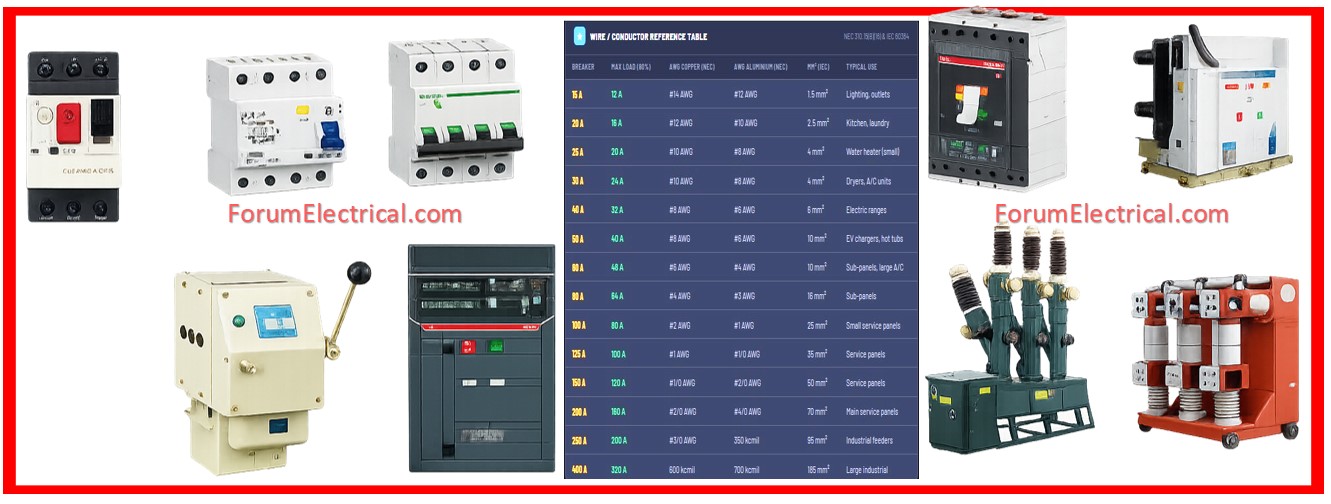
A circuit breaker (CB) is an electromechanical switching & protection device that serves as a 2 fundamental functions in an electrical system:
Switching
It makes (or) breaks a circuit manually (via remote control) under both the normal operating conditions & also deliberate shutdown conditions.
Automatic Protection
It trips automatically and disconnects the electrical circuit when the current exceeds its rated threshold thereby protecting cables, conductors and connected equipment from the thermal damage & fire hazards caused by over currents and short circuits.
In practical applications circuit breakers operate alongside the other protection devices such as
- Fuses,
- Residual Current Devices (RCDs/GFCIs),
- Surge Protectors &
- Earthing Systems
to create a complete protective network.
Their ratings are defined by 2 primary parameters:
- Voltage rating (Maximum system voltage they can safely interrupt) &
- Current rating (Continuous current they can carry without tripping).
Standard References
Circuit breaker specifications are governed by:
NEC Article 240 (USA) · IEC 60898-1 (low-voltage MCBs)
IEC 60947-2 (industrial circuit breakers)
IEEE Std 242 (Recommended practice for protection and coordination).
Working Principle
Under normal operating conditions the current flowing through the circuit is below the breakers rated value.
The breaker remains closed and can be manually opened (or) closed as required.
Under fault (or) overload conditions when the current exceeds the breakers rated threshold the internal tripping mechanism activates automatically via 2 different elements:
Thermal element (bimetallic strip)
Thermal element (bimetallic strip) responds to sustained over currents (overloads).
The bimetallic strip deflects due to heat & releases the trip latch after a time inverse delay proportional to the overload magnitude.
Magnetic element (solenoid)
Magnetic element (solenoid) responds instantaneously to large fault currents.
The solenoid force trips the breaker within milliseconds providing near instantaneous short circuit protection.
This thermal magnetic design means the breaker provides both time delayed overload protection and instantaneous short circuit protection which is two distinct but complementary functions essential to a strong electrical protection scheme.
Core Sizing Principle
The fundamental rule for circuit breaker sizing (NEC, IEC and IEEE) standards is:
| Load Type | Safety Factor | Code Reference | Operational Terms |
|---|---|---|---|
| Continuous load (≥3 hours) | 125% | NEC 210.20(A), IEC 60364 | CB operates at ≤80% rated capacity |
| Non-continuous load (<3 hours) | 100% | NEC 210.19, 240.4 | CB may operate at 100% rated capacity |
| Motor loads | 175–250% | NEC Article 430 | Accounts for motor starting inrush current |
| Welder loads | 200% | NEC Article 630 | Accounts for duty cycle and surge demands |
Once the minimum required CB rating is calculated and the next larger standard breaker size must be selected.
Standard Commercial Ratings: 1, 2, 3, 5, 6, 10, 12, 15, 16, 20, 25, 30, 32, 40, 50, 60, 63, 70, 80, 100, 125, 150, 160, 175, 200, 225, 250, 300, 350, 400 A.
Formula
General Sizing Formula
CB Rating = Load Current (I) × Safety Factor
Single Phase Current Formula
I = P ÷ (V × PF)
Where
P = Load (Watts)
V = Supply Voltage (V)
PF = Power Factor
Three Phase Current Formula
I = P ÷ (V(L-L) × √3 × PF)
Where
V(L-L) = Line-to-Line Voltage
√3 = 1.732
Single Phase Current Formula (NEC Standard)
Sizing for Circuits
NEC Standard
For single-phase AC circuits (standard in North American residential & light commercial installations) load current is calculated from the power relationship.
Three-phase power is standard in commercial and industrial installations. The line current formula incorporates the √3 (≈1.732) factor arising from the phase relationship between the three conductors.
IEC Standard
Under the IEC framework (applicable in Europe, the UK, India, Australia and most of the world), the standard supply for single-phase circuits is 230 V (phase-to-neutral). The sizing methodology follows the standards IEC 60364, IEC 60898-1 in UK – BS 7671 (IET Wiring Regulations).
In IEC countries, the standard 3 phase line voltage is 400 V (continental Europe) (or) 415 V (UK, India and associated territories). The same √3 factor applies as in NEC three-phase calculations.
Reference: Per NEC Table 310.15(B)(16), 14 AWG copper (rated 15 A) is appropriate. The 15 A breaker operates at 77.8% of its capacity within the 80% continuous load limit per NEC 210.20.
Solved Example
For a 480 V Three Phase / 6500 W Resistive Load, calculate the circuit breaker size.
Given
A 6.5 kW three-phase load on 480 V system (PF = 1.0, resistive).
Solution
Step-1
Calculate current: I = 6,500 ÷ (480 × 1.732) = 6,500 ÷ 831.4 = 7.82 A
Step-2
Apply 125% factor: 7.82 A × 1.25 = 9.77 A
Step-3
Next standard size = 10 A
Result
Use a 10 A, three pole circuit breaker.
Note: For inductive loads (motors, HVAC) on 3 phase systems refer to NEC Articles 430 & 440 which specify higher multipliers due to the motor starting inrush current.
Temperature Derating under IEC
IEC standards require that the breakers rated current be derated when ambient temperatures exceed 30°C (the IEC 60947-2 reference temperature).
The derated current must satisfy:
IEC Derated Capacity Check
Derated CB Current × 0.80 ≥ Load Current (I)
Continuous vs. Non-Continuous Loads
Continuous Loads
Under NEC Article 100, a continuous load is one where the maximum current is expected to continue for three hours (or) more.
Ex: include lighting circuits, electric water heaters, HVAC blowers, and process heating equipment.
Non-Continuous Loads
Non-continuous loads include receptacle circuits for portable appliances with shorter duty cycles.
| Condition | Load | Calculation | Required CB |
|---|---|---|---|
| Non-continuous only | 30 A | 30 A × 100% = 30 A | 30 A |
| Continuous only | 28 A | 28 A × 125% = 35 A | 40 A (next std) |
| Mixed: 28 A cont. + 30 A non-cont. | 58 A total | (28 × 1.25) + (30 × 1.0) = 35 + 30 = 65 A | 70 A (next std) |
Points to Remember
An oversized circuit breaker will not trip under fault conditions that would destroy conductors and equipment. it is not conservative & it is dangerous.
An undersized breaker will nuisance-trip repeatedly disrupting operations and accelerating breaker wear.
Only the correctly sized breaker satisfies both protection & operational reliability requirements simultaneously.
Temperature Derating & Correction Factors
All circuit breaker current ratings are specified at a defined reference ambient temperature:
- 40°C for NEC and
- 30°C for IEC.
When actual installation ambient temperature deviates from this reference the effective current-carrying capacity changes:
Higher ambient temperature: Higher ambient temperature → reduced heat dissipation → lower effective rating (derating required)
Lower ambient temperature: Lower ambient temperature → increased heat dissipation → higher effective rating (uprating possible)
Derating factors are published by the breaker manufacturers and in IEC 60947-2 tables.
For NEC installations conductor ampacity correction factors from NEC Table 310.15(B)(2)(a) apply simultaneously.
When multiple correction factors apply all must be multiplied together before application and the most restrictive correction governs the final selection.
Reference Tables
NEC – Breaker Size, Wire Gauge and Voltage (Single-Phase)
| Load (W) | 120 V Current (A) | CB @ 120 V | 240 V Current (A) | CB @ 240 V | Min Wire (AWG Cu) |
|---|---|---|---|---|---|
| 1,200 | 10.0 | 15 A | 5.0 | 10 A | 14 AWG |
| 1,800 | 15.0 | 20 A | 7.5 | 15 A | 14 AWG |
| 2,400 | 20.0 | 25 A | 10.0 | 15 A | 12 AWG |
| 3,600 | 30.0 | 40 A | 15.0 | 20 A | 10 AWG |
| 4,800 | 40.0 | 50 A | 20.0 | 25 A | 8 AWG |
| 7,200 | 60.0 | 80 A | 30.0 | 40 A | 6 AWG |
| 9,600 | 80.0 | 100 A | 40.0 | 50 A | 4 AWG |
| 12,000 | 100.0 | 125 A | 50.0 | 60 A | 2 AWG |
Note: CB sizes assume continuous load (125% factor applied). Wire sizes are minimum per NEC Table 310.15(B)(16) at 75°C termination rating.
IEC – MCB Selection for Common Domestic Appliances (230 V, 50 Hz)
| Appliance / Circuit | Typical Load (W) | Current (A) | Recommended MCB | MCB Type | Min Cable (mm²) |
|---|---|---|---|---|---|
| Lighting circuit | 1,000 | 4.35 | 6 A | B | 1.0 mm² |
| Socket outlets (ring) | 3,000 | 13.04 | 16 A | B | 2.5 mm² |
| Immersion heater | 3,000 | 13.04 | 16 A | B | 2.5 mm² |
| Electric shower | 7,200–10,800 | 31–47 | 40–50 A | B/C | 6–10 mm² |
| Cooker / range | 10,000–12,000 | 43–52 | 50–63 A | B/C | 10 mm² |
| Air conditioner | 2,000–3,500 | 9–15 | 16–20 A | C | 2.5–4 mm² |
| EV charging (Mode 3 / 7 kW) | 7,200 | 31.3 | 40 A | B/C | 6 mm² |
Safety Factor Summary by Load Type (NEC)
| Load Category | NEC Multiplier | Code Reference |
|---|---|---|
| Resistive / general (continuous) | 125% | NEC 210.20(A) |
| Lighting (continuous) | 125% | NEC 210.20, 220.14 |
| Non-continuous loads | 100% | NEC 240.4 |
| Motors — hermetically sealed (A/C, heat pumps) | 175% | NEC 440.22, 430.52 |
| Motors — general (Table 430.52) | 150–250% | NEC 430.52 |
| Welders — resistance | 200% | NEC 630.12 |
Frequently Asked Questions
1). Why is the circuit breaker sized at 125% rather than 100% of load current?
Circuit breakers are thermal-magnetic devices that generate heat under continuous current flow.
At 100% rated current for sustained periods the internal thermal mass reaches temperatures that reduce insulation life and may cause nuisance tripping.
The 125% sizing rule provides a thermal margin ensuring reliable long-term operation without degrading the breakers protective characteristics.
2). What is the difference between MCB Types B, C and D (IEC 60898-1)?
IEC 60898-1 classifies MCBs by their instantaneous (magnetic) trip threshold relative to rated current (In):
Type B
Type B trips instantaneously at 3–5× In. Used for resistive loads: lighting, heating and domestic circuits.
Type C
Type C trips at 5–10× In. Used for inductive loads with moderate starting currents: motors, transformers and fluorescent lighting.
Type D
Type D trips at 10–20× In. Used for high-inrush loads: large motors, welders and medical imaging equipment.
3). How does power factor affect circuit breaker sizing?
Power factor (PF) is used to determine how much current a load draws relative to its apparent power demand.
A load with PF < 1 is used to draws more current than a purely resistive load of the same watts (wattage).
Since the circuit breakers respond to current (not watts) a lower PF (power factor) increases the load current and therefore needs a larger circuit breaker.
- For a resistive loads (water heaters & incandescent lighting) PF(power factor) is 1.0
- For a inductive loads (motors & transformers) PF(power factor) typically ranges from 0.7 to 0.95.

