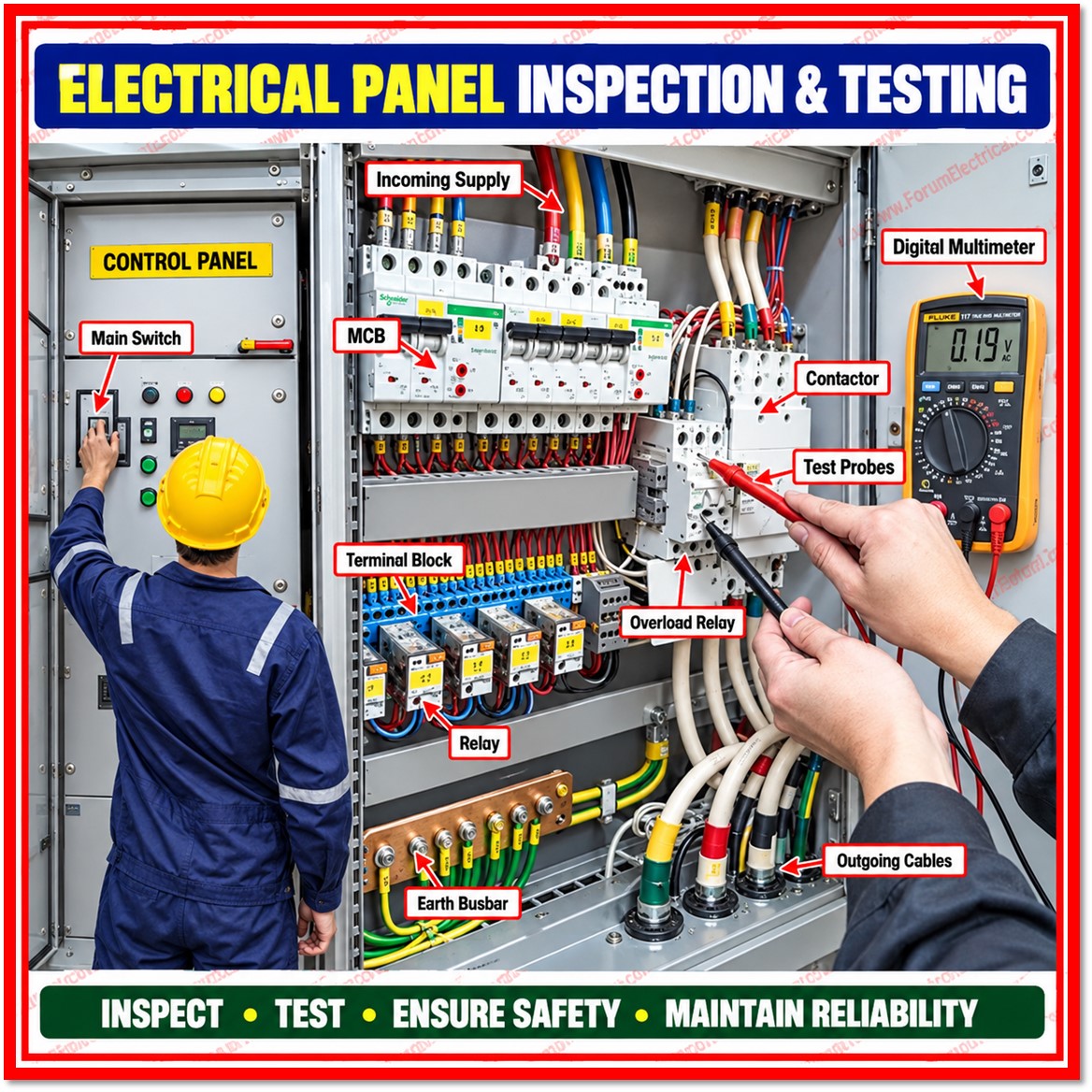
1). What is the test for an electrical cable?
The tests performed on an electrical cable are the Insulation Resistance (IR) Test and the Continuity Test.
For medium voltage (MV) cables, a Hi-Pot Test is additionally performed.
2). What is the difference between a cable and a wire?
A wire is a single conductor that carries a signal, whereas a cable is a bundle of two or more wires that are surrounded and protected by an insulation sheath.
3). What are the parts of a cable?
A cable is made up of the conductor, insulation, inner sheath, armor, and PVC outer sheath.
4). What is the difference between XLPE and PVC cables?
XLPE (Cross-Linked Polyethylene) insulated cables are used for both High Tension (HT) and Low Tension (LT) applications whereas PVC (Polyvinyl Chloride) insulated cables are used only for Low Tension (LT) applications.
5). What are the two international standards for cables?
The two international standards for cables are the
- IEC (International Electrotechnical Commission) and
- NEC (National Electrical Code).
6). What is the temperature rating for a cable?
As per SAES-P-104, the temperature rating for a cable is 90% dry and 75% wet for a 600V NEC-rated cable, and 85% for a 450/750V IEC-rated cable with 70% for IEC-rated cables in wet conditions.
7). What type of cable can be used in an exposed location?
Armored cables and metal-clad cables can be used in exposed locations because they provide mechanical protection against physical damage.
8). What is the voltage rating for LV and MV cables?
- Low Voltage (LV) cables are rated below 1kV while
- Medium Voltage (MV) cables are rated below 35kV.
9). What is the SAMSS reference for a power cable?
The SAMSS reference for a power cable is 15-SAMSS-502.
10). What is the SAES reference for a power cable?
The SAES reference for a power cable is SAES-P-104.
11). How much voltage is injected during an LV/MV cable test?
As per the Pre-Commissioning Form, the test voltage injected is
- 500V for cables rated 100–250V,
- 1000V for cables rated 251–600V,
- 2500V for cables rated 601–5000V and
- 5000V for cables rated over 5000V.
12). For how long is voltage injected during an LV/MV cable test and why?
DC voltage is injected for one minute for LV cables (1kV) and for MV cables (5kV) while the Hi-Pot test is carried out for 15 minutes in order to check the condition of the cable insulation.
13). What is the minimum resistance value for the LV test and as per which standard?
The minimum acceptable resistance value for the LV test is 50 megaohms as per the NETA ATS standard.
14). Do we use AC or DC for the megger test and why?
DC is used for the megger test because AC does not give an accurate insulation resistance value whereas DC provides a stable and accurate reading.
15). What are the components of a megger device?
The main components of a megger device are the
- Digital meter,
- Wire leads,
- Discharge stick and
- Selection switch.
16). What is the maximum cable bend radius for an LV cable?
As per NEC Article 300, the maximum bend radius is 8 times the cable diameter for non-shielded cables and 12 times the cable diameter for shielded cables.
17). What is the color coding for a power cable?
For AC power cables, the color coding is black and white while for DC power cables, the color coding is red and white.
18). How do you select the cable size?
The cable size is selected as per SAES-P-104, Table 1.
19). How many times is the cable tested?
The cable is tested twice using the megger test and once using the Hi-Pot test.
20). What tests are required for a transformer during pre-commissioning?
The tests required for a transformer during pre-commissioning are the
- Winding Resistance Test,
- Winding Insulation Test,
- Turn Ratio Test,
- Polarization Index (PI) Test,
- Tap Changer Setting Check,
- Phase-to-Phase Distance Check,
- Lightning Arrestor Test and
- Core-to-Ground and Tank-to-Ground Test,
Pressure Relief Device Check and a tightness check of all connections as per the manufacturer’s recommendations.
21). What is the Polarization Index (PI) test? Why is it performed on a cable?
The PI test is the ratio of the insulation resistance (IR) measured at 10 minutes to the insulation resistance measured at 1 minute during a megger test.
PI test is performed to assess the dryness and overall condition of the cable insulation; a PI value greater than 2 (PI Value >2) is generally considered a good indication of healthy insulation.
22). What is the purpose of a cable fault locator test?
A cable fault locator test is performed to identify the exact location of a fault, such as an open circuit, short circuit (or) earth fault along the cable route that is typically using a Time Domain Reflectometer (TDR) (or) a similar fault locating device.
23). What precautions should be taken before performing a Hi-Pot test on a cable?
Before performing a Hi-Pot test, the cable must be fully isolated from the system and both ends should be properly discharged and grounded before and after the test, personnel should be kept clear of the test area and appropriate PPE along with warning signs and barricades should be used.
24). What is the standard core color coding used for identifying cable cores as per IEC?
As per IEC standards, three phase cable cores are typically identified using Brown, Black, and Grey for the three phases (L1, L2, L3), Blue for the neutral conductor & Green/Yellow for the earth conductor.
25). What is the difference between a shielded and an unshielded (non-shielded) cable?
| Shielded Cable | Unshielded Cable |
| A shielded cable has a metallic screen, such as a copper tape or braid, wrapped around the insulation to block electromagnetic interference and to provide a controlled path for fault (or) leakage current; such cables are commonly used for MV applications. | An unshielded cable does not have this metallic screen and is generally used for LV applications where interference and fault-current control are less essential. |

