
Industry utilizes electric motors to power the electrical machinery in factories, utilities, HVAC systems & more.
Electric motors are reliable & efficient but maintaining and testing them pose electrical hazards that need careful safety standards.
- Motor Electrical Hazards
- Electric Shock
- Arc Flash and Arc Blast
- Stored Energy Hazards
- Standards
- Lockout/Tagout (LOTO) Procedures
- Personal Protective Equipment (PPE)
- Electrical Safety during Motor Testing
- Insulation Resistance (Megger) Testing
- High-Potential (Hi-Pot) Testing
- No-Load & Load Testing
- Maintaining a Safe Work Environment
- Training & Competency Requirements
- Conclusion
Electrical faults during motor maintenance can cause serious injuries, deaths, equipment damage and costly downtime.
Motor system technicians and engineers must understand electrical safety, standards, and PPE.
This post covers electric motor maintenance and testing safety, best practices and regulations.
Motor Electrical Hazards
Before undertaking any motor maintenance procedure it is essential to recognize and understand the primary electrical hazards present in motor environments.
Electric Shock
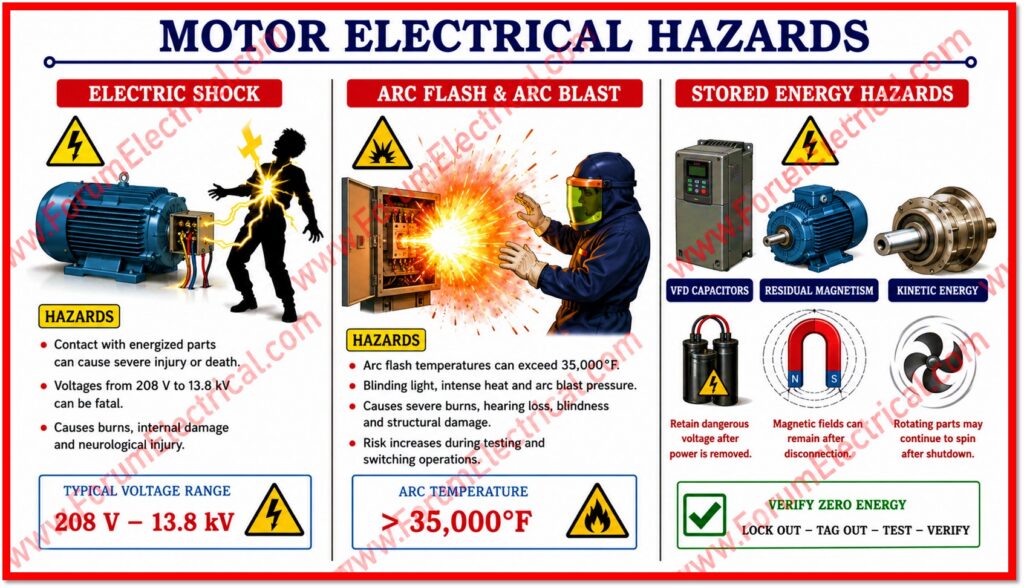
Electric shock is the most immediate & life threatening hazard.
Even relatively low voltages (as low as 50V AC) can cause ventricular fibrillation & cardiac arrest.
Industrial motors typically operate at voltages ranging from 208 V to 13.8 kV.
Contact with energized components may cause severe burns at the point of entry & exit, internal tissue damage and permanent neurological injury.
Arc Flash and Arc Blast
Arc flash is a sudden release of electrical energy through the air when a fault occurs across energized conductors.
The resulting arc can generate temperatures exceeding 35,000°F, a blinding flash of light and a pressure wave known as arc blast.
Arc flash incidents can cause severe burns, hearing loss, blindness and structural damage.
During motor testing and switching operations the risk of arc flash is elevated and should be carefully managed.
Stored Energy Hazards
Electric motors and associated drive systems can contain stored energy including capacitors in variable frequency drives (VFDs) that can retain dangerous voltage levels even after the electrical power is disconnected, residual magnetic fields in permanent magnet motors and kinetic energy of rotating components that may continue to spin after disconnection.
These stored energy sources should be fully dissipated & verified safe before any maintenance work starts.
Standards
Electrical safety during motor maintenance is governed by important standards and regulations that all technicians should comply with:
- NFPA 70E,
- OSHA 29 CFR 1910.147,
- IEEE 45 and IEEE 112,
- IEC 60034 and
- NEC (NFPA 70)
Lockout/Tagout (LOTO) Procedures
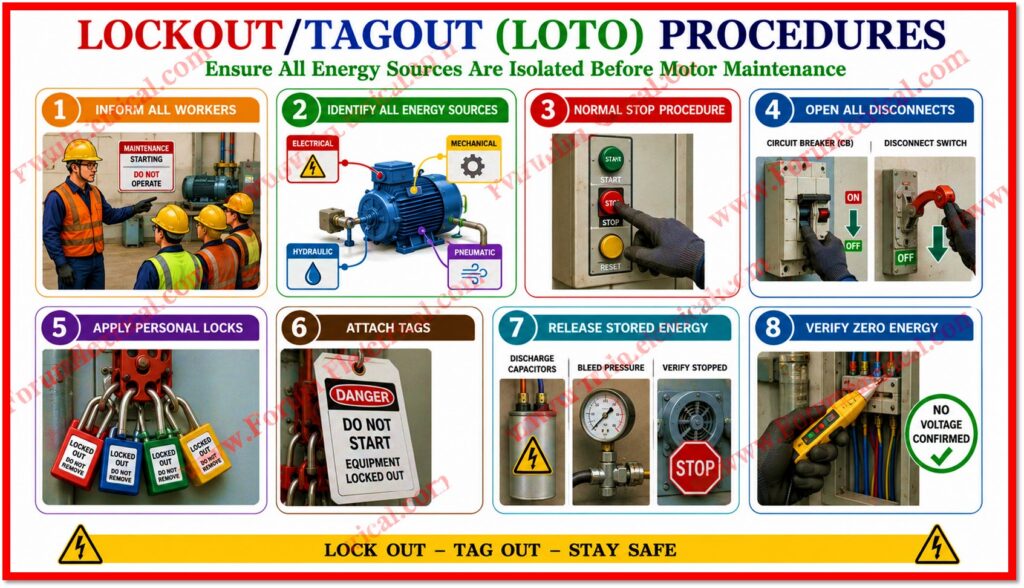
The core of electrical safety during motor maintenance is the proper implementation of Lockout/Tagout (LOTO) procedures.
LOTO ensures that all form of energy sources are isolated & rendered incapable of re-energization before electrical maintenance starts.
The essential LOTO steps include
- Inform all the relevant workers that electrical maintenance is about to start.
- Locate all electrical, mechanical, hydraulic& pneumatic energy sources connected to the motor.
- Utilize the normal stopping procedure to bring the motor to rest (ideal) safely.
- Open all disconnecting means including circuit breakers (CB) and disconnect switches.
- Allow capacitors to discharge, bleed hydraulic pressure & verify rotation has stopped.
- Utilize a calibrated voltage tester to confirm every circuits are de-energized before touching any of the electrical components.
Personal Protective Equipment (PPE)
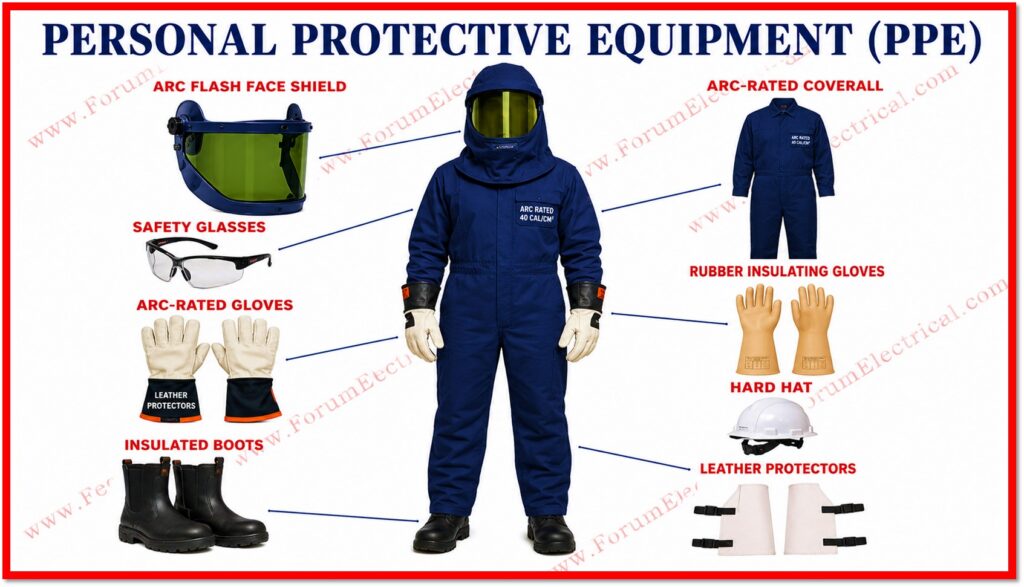
Selecting an appropriate PPE is essential to protecting workers from any form of electrical hazards.
PPE requirements are determined through arc flash risk assessments that establish the Incident Energy level at the point of work.
Based on the hazard/risk category defined in NFPA 70E required PPE typically includes:
- Flash suits, arc-rated coveralls and shirts rated in calories per square centimeter (cal/cm²) appropriate to the incident energy level.
- Arc flash face shields & safety glasses rated for the applicable arc flash boundary.
- Rated for the working voltage class with leather outer protectors for the mechanical protection.
- Insulated boots (or) overshoes to protect against ground fault current paths.
- Required for overhead work near energized components.
- Mandatory when working in high current arc flash potential zones.
Electrical Safety during Motor Testing
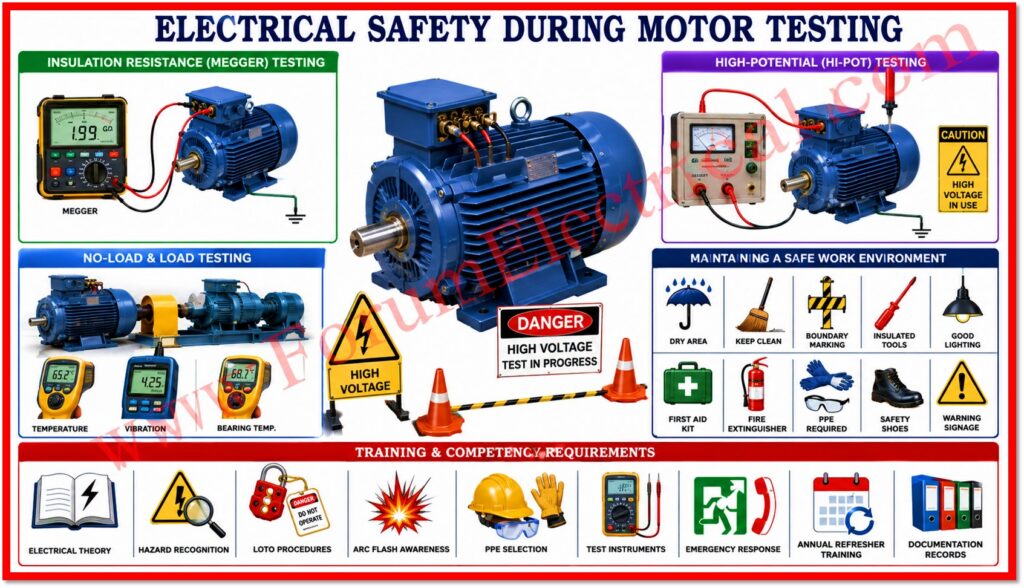
Motor testing introduces unique hazards compared to routine maintenance as tests often require energizing circuits (or) applying high voltages to verify insulation integrity & performance characteristics.
Insulation Resistance (Megger) Testing
Megohmmeter testing (megger testing) applies high DC voltage (typically 500V to 5000V) to motor windings to assess the insulation integrity.
The motor should be completely disconnected from all supply circuits before testing.
After testing always discharge the windings through a grounding lead held in place for at least one minute per 1000V of test voltage to avoid accidental shock from residual capacitive charge in the windings.
High-Potential (Hi-Pot) Testing
Hi-Pot testing subjects motor insulation to voltages significantly above the normal operating levels to detect weaknesses.
This test needs establishing a clearly marked restricted zone around the test area using insulated & calibrated test equipment and ensuring all personnel are clear before voltage is applied.
A trained safety observer should be present throughout all high voltage testing activities.
No-Load & Load Testing
When testing an electrical motor under power, rotating components present both electrical & mechanical hazards.
Shaft guards and coupling covers should be installed before energizing the motor.
Personnel must stand to the side of the motor shaft, never in line with it.
- Motor surface temperatures,
- Bearing temperatures and
- Vibration levels
should be monitored continuously during load tests utilizing calibrated instruments from a safe distance.
Maintaining a Safe Work Environment
- Moisture significantly increases the risk of electric shock. Utilize drip protection & maintain good housekeeping standards around all motor work areas.
- Mark Limited Approach, Restricted Approach & Arc Flash Boundaries per NFPA 70E to control access for unqualified personnel.
- Insulated electrical tools rated for the working voltage should be used exclusively. Inspect all the tools for damaged insulation prior to each use.
- Poor visibility increases the risk of accidental contact with energized components during the electrical maintenance tasks.
- Ensure accessible first aid kits, appropriate fire extinguishers & that all personnel are trained in CPR & electrical emergency response procedures.
Training & Competency Requirements
Only the qualified electrical workers with documented training in electrical safety must perform motor maintenance and testing.
Training programs should cover electrical theory & hazard recognition, LOTO procedures and proper application, arc flash awareness and PPE selection, safe use of test instruments and emergency response procedures.
Refresher training must be conducted annually (or) whenever a change in job duties, equipment (or) processes introduces new hazards.
Documentation of all training records should be maintained in accordance with OSHA regulations.
Conclusion
Electrical safety in motor maintenance and testing is a primary and professional obligation.
Electrical accidents can be prevented by hazard identification, LOTO protocols, PPE, industry standards and training.
A strong electrical safety culture protects workers from deadly injuries, preserves equipment integrity, reduces unscheduled downtime and ensures compliance with laws.
No motor repair operation is too important to start and finish safely.

