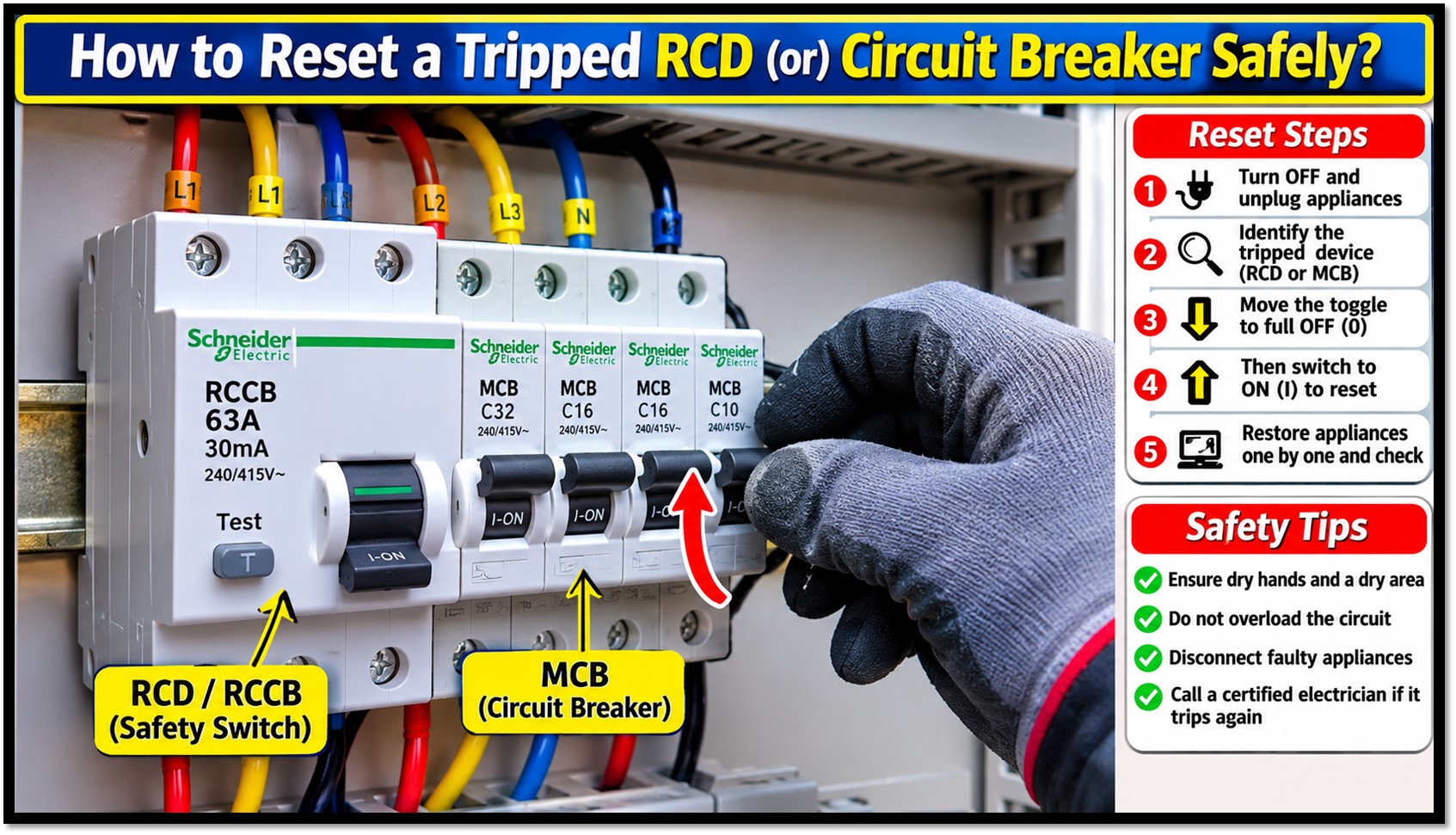
- Residual Current Devices (RCDs) and
- Overcurrent circuit-breakers
are protective devices used in low-voltage electrical installations.
They detect different abnormal conditions and disconnect the supply to reduce the risk of electric shock, fire, equipment damage and conductor overheating.
- How an RCD works?
- RCD Types
- Common causes of RCD or Circuit-Breaker Tripping
- 1). Circuit Overload
- 2). Short Circuit
- 3). Earth Fault / Ground Fault
- 4). Faulty or Deteriorated Appliances
- 5). Damaged Wiring, Accessories (or) Connections
- 6). Moisture, Water Ingress and Contamination
- 7). Cumulative Leakage and Transient
- What to do when an RCD or Circuit-Breaker trips?
- Trip Indication
- RCD Test Button: Purpose and Limitations
- Common Misconceptions
- Relevant Standards
- Conclusion
The correct response is to identify the likely cause safely and have the installation (or) appliance repaired.
This post explains the operating principles of RCDs, MCBs and RCBOs; common reasons for tripping; a safe user-level response and the standards commonly relevant to Indian installations.
It does not replace an installation inspection, testing, risk assessment or the manufacturer’s instructions.
An RCD detects residual current (an imbalance between the currents in the live and neutral conductors, or the equivalent vector sum of all live conductors).
An MCB detects overcurrent caused by overloads and short circuits. A combined device called an RCBO provides both residual-current and overcurrent protection.
| Device | What it detects | What it generally protects against | Important limitation |
| RCD / RCCB | Residual current (earth-leakage imbalance) | Electric-shock risk and, where suitably selected, certain earth-fault fire risks | A standard RCCB does not provide overload or short-circuit protection; it must be coordinated with suitable overcurrent protection. |
| MCB | Overload and short-circuit current | Conductors and circuits against thermal and magnetic overcurrent effects | A conventional MCB is not a substitute for 30 mA additional protection against electric shock. |
| RCBO | Residual current plus overload and short-circuit current | Combines RCD and MCB functions for an individual circuit | Selection, breaking capacity, residual-current type and coordination still need engineering verification. |
How an RCD works?
In a typical single-phase circuit the RCD monitors the current in the line (live) and neutral conductors through a summation current transformer.
Under normal conditions, the current leaving through line is equal to the current returning through neutral, so the vector sum is approximately zero.
If some current returns by an unintended path such as protective earth, bonded metalwork or a person’s body the currents no longer balance.
When the residual current reaches the device’s operating threshold under the specified test conditions, the RCD opens the circuit.
For a three-phase circuit, all relevant live conductors (and neutral, where present) pass through the sensing system.
The protective conductor (PE) is not routed through the RCD sensing core as a normal current-carrying conductor.
The rated residual operating current is commonly marked IΔn.
A 30 mA (0.03 A) RCD is widely used for additional protection against electric shock in applications where required by the applicable wiring rules.
Other sensitivities, such as 100 mA (or) 300 mA may be used for different protection objectives and coordination arrangements; they are not interchangeable with 30 mA additional protection.
RCD Types
RCDs are available in different types (for example AC, A, F and B) to detect different residual-current waveforms.
The correct type depends on the connected loads and the manufacturer’s requirements.
- Modern electronic equipment,
- Variable-speed drives,
- Inverters,
- EV charging equipment and
- Power-conversion systems
can generate residual-current waveforms that make device selection important.
Do not replace an RCD with a different type or rating merely to stop nuisance tripping; have the load characteristics and installation assessed.
Common causes of RCD or Circuit-Breaker Tripping
1). Circuit Overload
An overload occurs when the current drawn by connected loads exceeds the circuit’s permitted current for long enough to operate the overcurrent protection.
Typical causes include too many high-power appliances operating on one circuit, an appliance drawing abnormal current, or an incorrectly designed/loaded circuit.
An RCCB alone normally does not trip solely because the load current is too high if line and neutral currents remain balanced.
An MCB or the overcurrent element of an RCBO is expected to respond.
2). Short Circuit
A short circuit is a low-impedance connection between conductors at different potentials, such as line-to-neutral or line-to-line.
It can produce very high fault current and rapid heating.
The MCB, fuse or other correctly rated overcurrent protective device should disconnect the fault within the time required by its characteristic and the installation design.
An RCD may also operate if the fault creates residual current to earth, but it is not the primary short-circuit protective device.
3). Earth Fault / Ground Fault
An earth fault occurs when a live conductor contacts an earthed conductive part or the earth path.
An RCD detects the resulting residual current if it passes through an unintended return path outside the monitored live conductors.
An MCB may also trip if the earth-fault loop impedance permits sufficient fault current.
It is not correct to assume that every earth fault will necessarily trip a conventional MCB; protective-device operation depends on the fault-loop impedance, earthing arrangement and protection design.
4). Faulty or Deteriorated Appliances
Damaged insulation, moisture inside an appliance, failed heating elements, damaged cords, filters or electronic components can create leakage current to earth.
A connected appliance may therefore cause an RCD or RCBO to trip.
A fault may occur only when the appliance heats up, starts, changes operating mode or becomes damp.
5). Damaged Wiring, Accessories (or) Connections
Nicked cable insulation,
- Loose or overheated terminals,
- Crushed cables,
- Damaged socket outlets,
- Incorrect connections,
- Neutral-to-earth contact downstream of an rcd or
can cause tripping.
These conditions require inspection and electrical testing by a qualified person; they should not be investigated by opening accessories or the distribution board as a homeowner.
6). Moisture, Water Ingress and Contamination
Water or condensation in outdoor fittings, bathrooms, pumps, water heaters, junction boxes, switchboards or appliances can reduce insulation resistance and create leakage paths.
Do not touch wet electrical equipment or attempt to dry, dismantle or energise it. Keep people away and arrange safe isolation and inspection.
7). Cumulative Leakage and Transient
Several electronic appliances may each contribute a small normal leakage current.
Their combined leakage can approach the RCD operating threshold.
- Switching transients,
- Surge protective devices,
- Long cable runs, filters,
- Inverter equipment or
- Insulation deterioration
may also contribute.
A competent electrician can measure leakage, divide circuits, check neutral arrangements and assess whether the RCD type and rating are suitable.
Increasing the trip threshold or bypassing the RCD is not an acceptable shortcut.
What to do when an RCD or Circuit-Breaker trips?
Safe checks for an Ordinary User
- Stop using the affected circuit. If it is safe to do so, switch off appliances using their normal controls and unplug accessible appliances by holding the plug body—not by pulling the cable. Do not touch equipment that is wet, hot, damaged or suspected to be faulty.
- Identify what lost power and note what was operating immediately before the trip. Record whether the device appears to be an RCD/RCCB, MCB or RCBO only if its front label is clearly visible; do not remove a cover to identify it.
- If the cause is not obvious, or if the circuit is wet, damaged, smells burnt or has tripped more than once, leave it off and arrange an electrician. Do not keep experimenting with the switch.
- Only if there are no danger signs, the switchboard is dry and undamaged, and the manufacturer/user instructions permit it, a user may make one reset attempt using the external operating handle. Move the handle fully to OFF/reset as indicated on the device, then to ON. Do not force it.
- If it will not latch, trips immediately, or trips again when a load is reconnected, switch it OFF (if safe) and leave it OFF. Do not repeatedly reset it. A persistent fault needs professional diagnosis.
- If the circuit remains energised, reconnect or switch on only essential, known-good appliances one at a time, provided there are no warning signs and the appliance and socket are dry and undamaged. Stop immediately if the protective device trips again. This limited observation can help identify a suspect load; it is not a substitute for testing.
- Have the cause investigated and repaired. Ask the electrician to verify the protective device selection and operation, circuit insulation, earthing/protective-conductor continuity, polarity, fault-loop conditions and RCD operating characteristics as applicable.
What not to do?
- Do not repeatedly reset a breaker or RCD that trips again.
- Do not bypass, bridge, tape, wedge or hold a protective device in the ON position.
- Do not replace a breaker with a higher current rating unless the circuit design, cable capacity, fault level and applicable rules have been verified by a competent designer/electrician.
- Do not open the distribution board, remove dead-front covers, tighten terminals or probe live parts.
- Do not touch the panel or appliances with wet hands, bare feet or while standing on a wet surface.
- Do not rely on rubber footwear, gloves or an insulating mat as permission to work on live equipment. These do not make an unsafe task safe.
- Do not assume an RCD trip proves that a person was shocked, or that no trip means the installation is safe.
Trip Indication
A tripped device may have its handle in an intermediate position but handle indications vary by manufacturer and product.
Some devices require the handle to be moved fully to OFF before it can be reset to ON.
Follow the manufacturer’s instructions printed on the device or supplied with it.
Do not infer the cause from handle position alone; many devices do not provide a reliable fault-cause indication.
RCD Test Button: Purpose and Limitations
Many RCDs have a TEST or T button.
Operating it creates an internal test condition intended to verify the device’s basic tripping mechanism.
Use the test button at the interval stated by the manufacturer and any applicable local requirements.
The test button does not measure the actual trip current or trip time and it does not verify the installation’s earthing, wiring, protective-conductor continuity or complete disconnection times.
A qualified person must perform instrument-based tests during commissioning, periodic inspection or fault investigation as required.
Common Misconceptions
| Misconception | Technical Correction |
| An RCD and an MCB are the same. | Incorrect. They detect different fault conditions. An RCBO combines both functions. |
| Every RCD trips in 30 ms. | Incorrect. Operating time is specified under defined test conditions and varies with device class and residual-current magnitude. |
| An RCD trips whenever a circuit is overloaded. | Usually incorrect for an RCCB. A balanced overload is detected by overcurrent protection, not residual-current detection. |
| Every earth fault trips an MCB. | Not necessarily. MCB operation depends on sufficient fault current and the protective-device/earthing design. An RCD may detect residual current. |
| If the breaker resets, the installation is safe. | Incorrect. Resetting does not identify or repair the underlying fault. |
| Rubber shoes make panel work safe. | Dangerous misconception. Do not undertake electrical work based on footwear or improvised insulation. |
| The RCD test button proves the whole installation. | Incorrect. It checks basic device operation only; instrument testing and installation verification are separate. |
Relevant Standards
- IS 732:2019 – Code of practice for electrical wiring installations (Fourth Revision). Indian installation code covering wiring design, selection, erection and verification topics. BIS listing indicates it was reviewed in 2024.
- IS/IEC 60898-1:2015 – Circuit-breakers for overcurrent protection for household and similar installations, Part 1: Circuit-breakers for AC operation. Verify current BIS status and amendments.
- IEC 60364-4-43 – Low-voltage electrical installations—Protection for safety-Protection against overcurrent. Relevant to overload and short-circuit protection.
Conclusion
An RCD/RCCB, an MCB and an RCBO are not interchangeable.
An RCD responds to residual current, an MCB responds to overload and short-circuit current, and an RCBO combines both protective functions.
Tripping can be caused by overload, short circuit, earth leakage, damaged wiring, moisture, faulty appliances or cumulative leakage.
The safest response is to stop using the affected circuit, look for danger signs without touching electrical parts, avoid repeated resets and obtain qualified assistance when the cause is not clear or the trip recurs.
A protective device must never be bypassed or uprated simply to prevent nuisance tripping.

