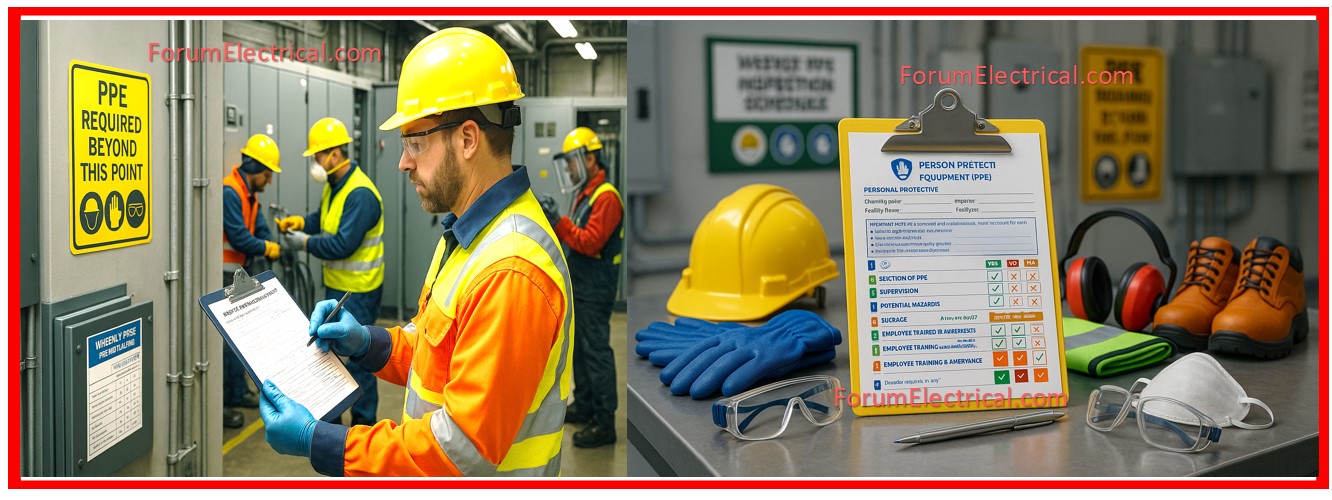
Personal protective equipment (PPE) is an essential component of every organization’s safety management procedure.
- Checklist
- Facility Information
- 1). Selection of Personal Protective Equipment (PPE)
- 2). Supervision and Enforcement
- 3). Identification of Potential Hazards requiring PPE
- 4). PPE Signage and Standards Compliance
- 5). Employee Training and Awareness
- 6). PPE Availability
- 7). Weekly PPE Inspection
- 8). Head Protection
- 9). Eye and Facial Protection
- 10). Hearing Protection
- 11). Hand and Arm Protection
- 12). Foot Protection
- 13). Respiratory Protection
- 14). High-Visibility Clothing
- 15). Fall Protection
- Action Summary
- Notes & Remarks
- Statement of Approval
- Conclusion
It acts as the final line of defense toward potential workplace dangers that cannot be completely addressed by engineering or administrative methods.
Checklist
This PPE Inspection Checklist guarantees compliance with safety standards encourages a proactive safety culture and reduces the risks associated with the physical, chemical, electrical & ecological dangers.
When purchasing and maintaining personal protective equipment, each worker’s physical condition, comfort and job responsibilities must be taken into attention.
Proper training, supervision & regular inspections ensure that PPE is still effective in protecting employees during normal operations.
The checklist below provides a complete guidance for firms to evaluate their PPE program covering everything from selection, training and use to weekly inspections and corrective measures.
Facility Information
Before start the inspection, note basic information about the facility such as the checklist date, review date, inspector’s name, department and month/year.
This provides traceability and responsibility for all PPE inspections.
1). Selection of Personal Protective Equipment (PPE)
The foundation for every PPE procedure starts with good selection based upon a thorough risk assessment.
Every occupational hazard should be examined to identify the appropriate protective gear taking into account the arranged order of controls.
Before ordering, workers should be informed to ensure that the chosen PPE provides both comfort & protection.
The checklist determines if personnel have received enough training in PPE fitting, usage & maintenance.
It also ensures that PPE is stored appropriately and maintained on a regular basis as well as that any medical (or) physical concerns of personnel are addressed.
2). Supervision and Enforcement
Effective PPE implementation necessitates constant supervision.
Supervisors must be sufficiently taught to select, fit & maintain personal protective equipment (PPE) as well as comprehend their enforcement obligations.
Senior management should offer monitoring and ensure that the PPE policy is followed regularly.
Employees need to be aware of disciplinary measures in the event of non-compliance.
This assures consistent adherence to safety standards among all departments.
3). Identification of Potential Hazards requiring PPE
Workplace dangers might range from physical impacts to chemical exposure.
This section ensures that workers are equipped with appropriate personal protective equipment (PPE) for operations requiring corrosive, chemical or infectious materials.
Hard helmets must be accessible when there is a risk of falling objects.
Safety shoes must be worn in conditions where there is a risk of foot injuries and safety goggles should be worn in settings with flying debris or sparks.
Respiratory protection must be provided in places with gas or dust and specialist PPE should be accessible for high-temperature jobs or duties that involve moving machinery.
4). PPE Signage and Standards Compliance
Signage is essential for reminding personnel to wear personal protective equipment (PPE) in defined areas.
This section determines whether safety signs are properly placed and meet international standards such as ISO or OSHA.
Additionally, it guarantees that all PPE products are approved and marked in accordance with applicable safety regulations.
5). Employee Training and Awareness
Training & awareness are essential elements of PPE usage.
Employees must get hands-on instruction in proper PPE use, fitting and maintenance.
Their training documents should be kept up to date to ensure ongoing competency.
Staff should also be given regular reminders to ensure their understanding and compliance.
6). PPE Availability
No safety program will be effective without easily available personal protective equipment (PPE).
The checklist validates that all needed safety equipment is available for each job role as well as a variety of sizes and varieties to fit all personnel.
7). Weekly PPE Inspection
Routine inspections are essential for ensuring PPE condition.
The weekly inspection portion follows a standard procedure to check
- Footwear,
- Gloves,
- Safety glasses,
- Earplugs &
- Dust masks
for signs of wear, damage or contamination.
Each PPE category is assessed for fit, cleanliness and general condition.
This preventative procedure minimizes potential breakdowns during essential operations and maintains consistent safety performance.
8). Head Protection
This section discusses head protection standards.
It ensures that all employees wear hard hats in locations where there are possible falling hazards and that workers with long hair tie it properly to avoid entanglement.
Helmets that are damaged or have expired must be replaced immediately.
9). Eye and Facial Protection
Eyes are especially vulnerable in many industrial settings.
When there is a possibility of flying particles or chemical spills, wear safety glasses, goggles (or) face shields.
Employees who need prescription lenses should be given suitable safety glasses that satisfy regulatory requirements.
10). Hearing Protection
In noisy environments, suitable hearing protection, such as earplugs or earmuffs should be given and properly placed.
This section determines whether employees utilize them regularly in defined zones & whether equipment is kept in sanitary conditions.
11). Hand and Arm Protection
Gloves are essential for preventing injury from sharp tools, chemicals & heat.
The checklist ensures that gloves are worn for all necessary tasks appropriately fitted, and replaced if damaged.
Workers should also know their gloves’ limitations and choose the proper type for each hazard.
12). Foot Protection
Safety shoes and boots are essential in places with heavy machinery, electrical risks and sharp objects.
This provision requires that personnel wear protective footwear that meets safety standards and that regular inspections are performed to detect worn-out soles, damaged steel toes (or) other faults.
13). Respiratory Protection
Respirators are required when working in environments with respiratory dangers such as dust, fumes (or) vapor.
Employees must be fit tested and trained on usage, cleaning & maintenance.
A documented respiratory protection schedule should also be implemented to verify compliance and efficiency.
14). High-Visibility Clothing
High-visibility vests & jackets are necessary in areas with moving vehicles or limited visibility. This section ensures that personnel in these regions wear suitable luminous apparel & that replacements are accessible if the garments become faded or destroyed.
15). Fall Protection
Tasks accomplished at heights carry significant risks.
Workers must have harnesses, lifelines & other fall arrest systems that fulfill regulatory standards.
Regular inspections and fall protection training are required to ensure safety during elevated operations.
Action Summary
After completing the checklist, all faults, non-compliance issues and corrective actions should be documented.
This summary allows management to monitor follow-ups, prioritize repairs (or) replacements & continue a continuous improvement process in the PPE management.
Notes & Remarks
Any findings or remarks made during the inspection should be reported.
These may contain suggestions for improvement, training gaps (or) reoccurring safety issues that necessitate additional management supervision.
Statement of Approval
The inspector has to confirm that the inspection was done correctly and that the data provided appropriately reflects the actual state of PPE in the facility.
To ensure compliance the approving authority (or) senior safety management should evaluate and sign off on the checklist.
Conclusion
Personal Protective Equipment (PPE) is more than just a general obligation; it is also a moral responsibility for the safety of workers.
Consistent inspection, training & maintenance of PPE ensures that workers are safe and confident while executing their responsibilities.
A systematic and well-documented PPE checklist like the one shown above improves workplace safety culture, reduces accident risks and displays the dedication of management to health & safety excellence.
Organizations can cultivate a safe, productive & compliant working environment for all employees through the implementation of frequent inspections and training programs.

