
The induction motor operates on the principle of electromagnetic induction inducing current in the rotor and producing torque.
- Crawling of Induction Motor
- Causes for Crawling in Induction Motors
- Effects of Crawling in Induction Motors
- How to prevent Crawling in an Induction Motor?
- Cogging of Induction Motor
- Causes for Cogging in Induction Motors
- Effects of Cogging in Induction Motors
- How to prevent Cogging in an Induction Motor?
- Difference between Crawling and Cogging
- Crawling vs Cogging
It is widely employed in a wide range of industries due to its efficiency and dependability.
However, it sometimes faces operational issues such as crawling and cogging, which reduces the effectiveness of the induction motor.
So, in order for an induction motor to function properly, these issues must be resolved.
In this post, we will discuss Crawling and Cogging of Induction Motors and the causes of these operating issues and also how to prevent them.
Crawling of Induction Motor
Crawling is a low-speed phenomena that occurs when an induction motor is unsure of its next move.
In this case, the motor exhibits unusual activity affecting the efficiency of an induction motor.
The motor’s motion resembles a crawl rather than a smooth speed.
This occurs when the magnetic field is asymmetric, resulting in uneven torque.
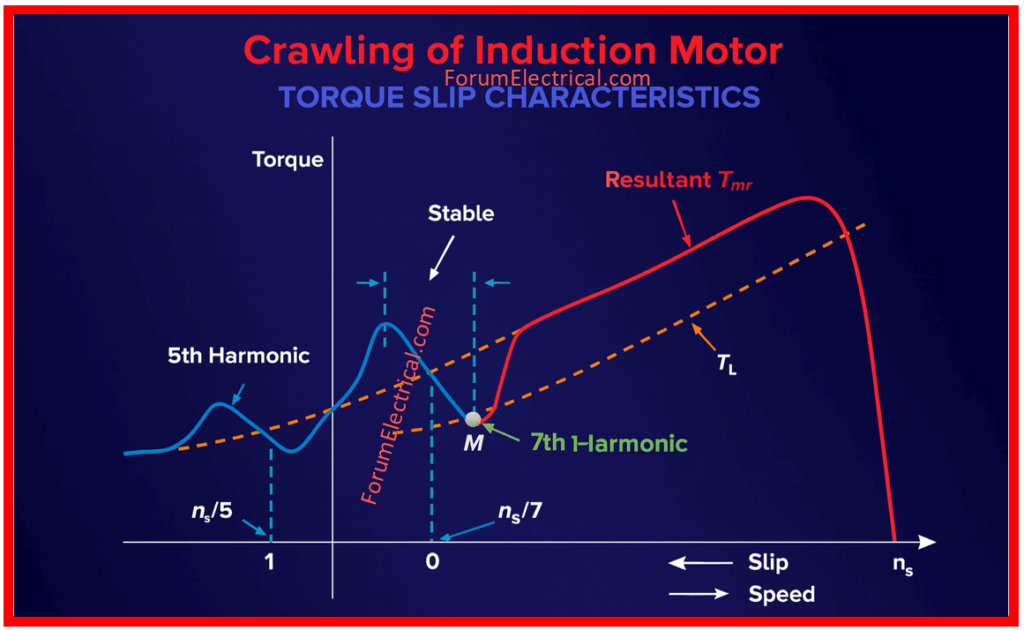
Crawling happens in an induction motor whenever harmonics are generated.
Crawling happens mostly while the motor is running at one-seventh of its synchronous speed.
The induction motor crawled due to strange harmonics in the air gap between the stator & rotor.
It indicates that the seventh harmonic effect is present in the three-phase induction motor resulting in a crawling effect.
A common problem caused by the seventh harmonic is the formation of a forward rotating torque magnetic field at one-seventh the speed of the synchronous motor.
The motor has a maximum torque of just under 1/7 Ns. If it is sufficiently high the net torque is greater than the torque due to the line frequency when the slip at 1/7 Ns is large.
When the motor’s synchronous speed is less than 1/7 crawling may occur.
Causes for Crawling in Induction Motors
Crawling in an induction motor can occur for a wide range of causes including the following:
- It may be induced by the presence of the space harmonics in the air gap flux.
- Air gap harmonics can emerge as a result of unequal distribution of the Stator winding.
- The variation in air gap reluctance can be attributed to the slots in the stator and rotor.
- Crawling happens primarily at low speeds typically when the motor operates at less than a particular percentage of its maximum speed.
- A high level magnetic core generates unequal torque resulting in unusual motion.
- Insufficient voltage can cause crawling because it prevents the formation of a correct magnetic field resulting in inefficiency.
Effects of Crawling in Induction Motors
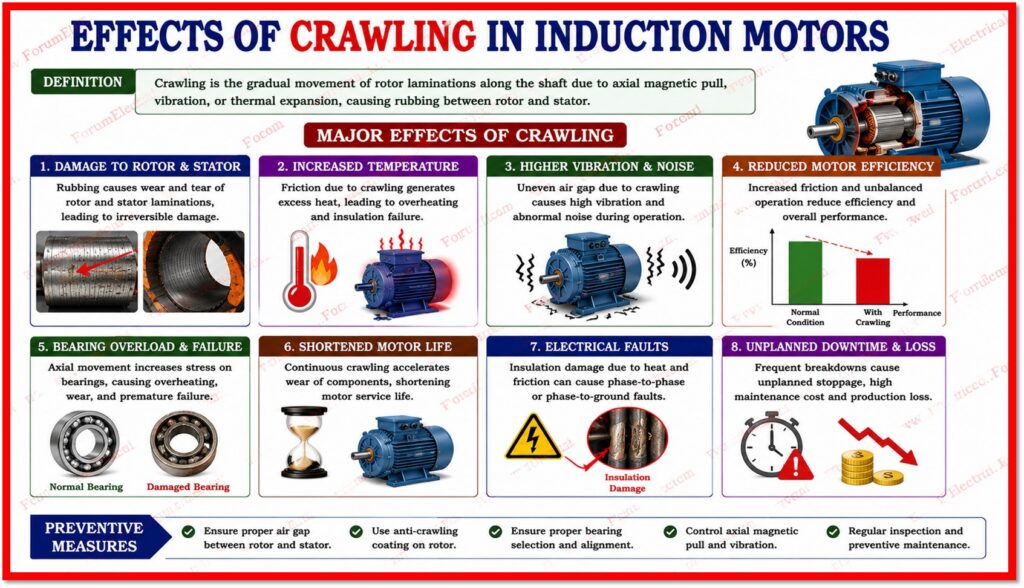
- Crawling reduces the efficiency of induction motors.
- The irregular motion produces a strange noise making operation difficult.
How to prevent Crawling in an Induction Motor?
Crawling is less common in induction motors due to their strong starting torque.
Crawling and cogging in cage rotor motors can be avoided by selecting a proper coil span and slightly bending the rotor teeth.
Crawling may be avoided or decreased by selecting the proper combination of stator and rotor slots.
IS 12615:2018 supports design methods that minimize harmonic losses and operational difficulties such as crawling.
Cogging of Induction Motor
Cogging is the resistance shown by an induction motor when it starts and runs smoothly.
When cogging happens the motor makes jerky motions at the start of the operation making it harder to achieve smooth motion.
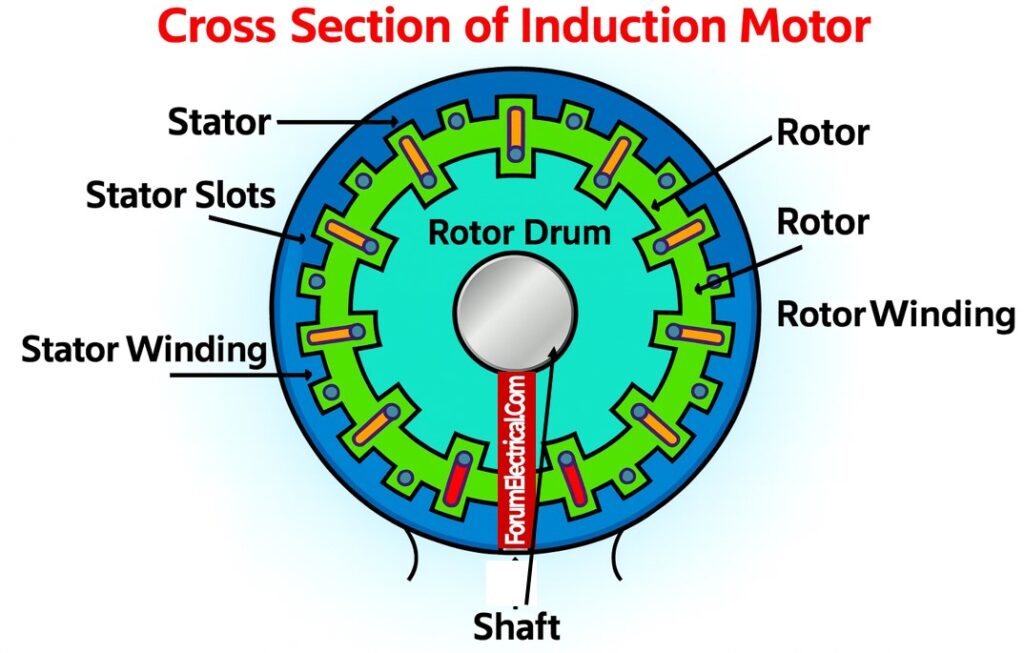
When rotor slots match stator slots, they align in such a way that stator slots become locked up with rotor slots causing blockage.
To resolve this issue, the number of slots on the stator and rotor should not be the same.
Causes for Cogging in Induction Motors
Cogging in an induction motor can occur for a wide range of causes including the following:
- Cogging is most common in motors that use permanent magnets in the rotor resulting in improper magnet alignment and resistance during startup.
- Rotor design is important in preventing clogging especially in permanent magnets.
- When rotor slots match stator slots, they align in such a way that stator slots become locked up with rotor slots causing blockage.
- Uneven air gaps can also cause cogging.
Effects of Cogging in Induction Motors
- Cogging makes it difficult to operate an induction motor smoothly.
- To overcome cogging we require higher torque which leads to an increase in power consumption.
How to prevent Cogging in an Induction Motor?
There are several methods that may be taken to fix the cogging problem.
- The number of slots in both the stator and rotor should not be equal.
- Skewing the arrangement of the rotor slots allows them to be oriented through the rotation axis.
IEC 60034-1 specifies performance criteria, torque characteristics and harmonic effects on crawling and cogging.
Difference between Crawling and Cogging
Crawling vs Cogging
| Parameter | Crawling | Cogging |
| Definition | A condition where the induction motor runs at a speed much lower than its synchronous speed (typically around 1/7th). | A condition where the motor fails to start at all even when supply is given. |
| Cause | Occurs due to the presence of harmonics (especially the 7th harmonic) in the supply voltage or air gap flux. | Occurs due to magnetic locking between the rotor and stator teeth (slot alignment). |
| Effect | The motor runs slowly with jerky motion and reduced torque. | The motor does not start and remains stationary despite voltage applied. |
| Motor Speed | Very low but non-zero (around 1/7th of synchronous speed). | Zero speed which makes the motor remain stationary. |
| Harmonics Involvement | Caused by 7th harmonic (or other harmonic torque effects). | Not caused by harmonics but by mechanical/electromagnetic locking. |
| Remedy | Use proper coil pitch and distribution factor. Avoid harmonic-rich supply. Use skewed rotor slots | Skew rotor slots. Change the number of stator or rotor slots. Use proper slot combination |
| Type of Problem | Related to harmonic torque. | Related to slot alignment and magnetic locking. |
| Torque Characteristic | Presence of harmonic torque dips causes multiple speed points. | No torque development at standstill due to slot locking. |

