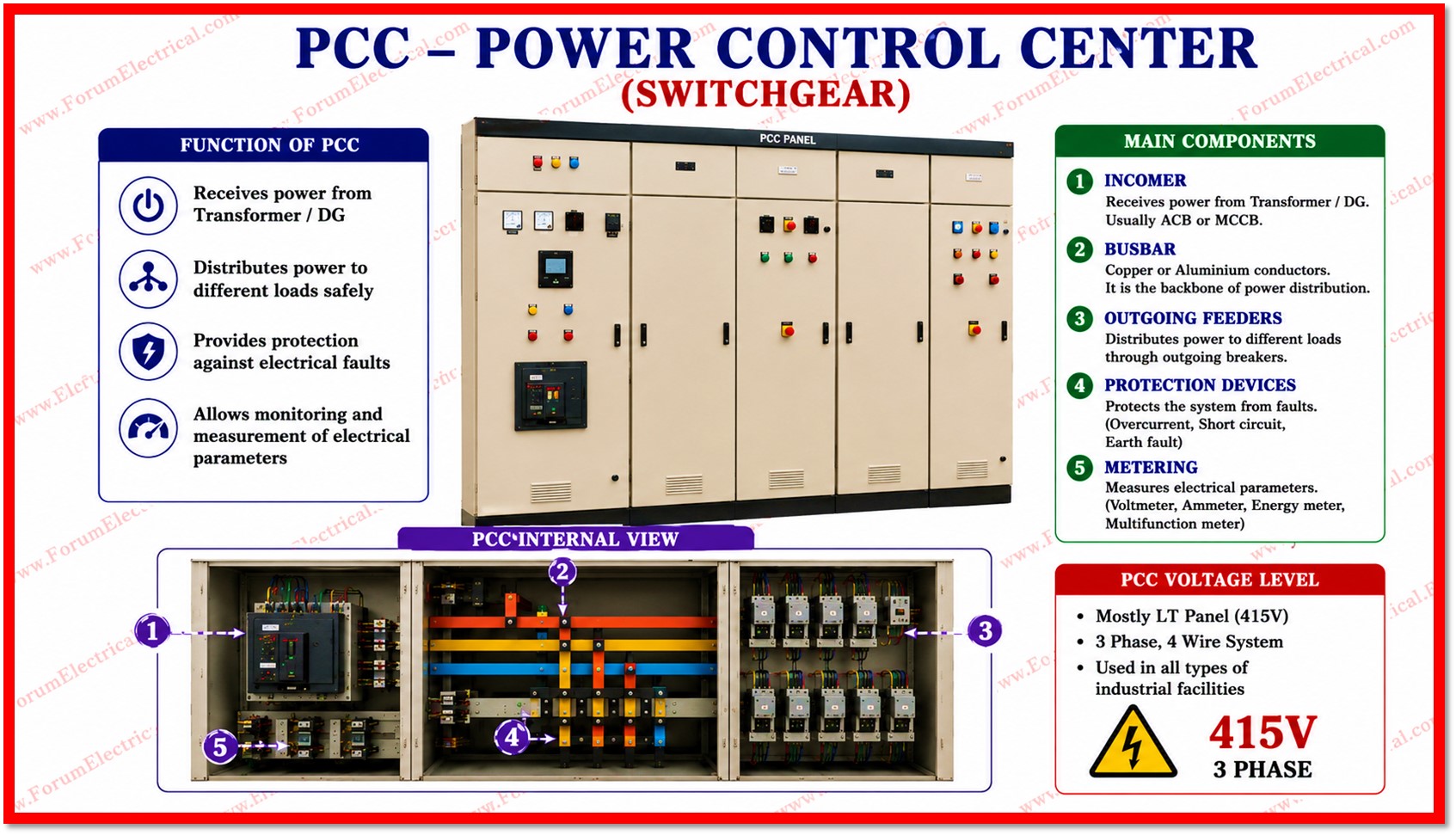
What is a Power Control Center (PCC)?
A Power Control Center (PCC) commonly referred as switchgear (or) a primary distribution board is a centralized electrical panel assembly that forms the primary interface across the incoming utility supply & the downstream distribution network within an industrial (or) commercial facility.
- What is a Power Control Center (PCC)?
- Position in the Power Distribution
- Components of a PCC
- Protection Coordination
- 1). Over Current Protection
- 2). Earth Fault Protection
- 3). Under Voltage & Over Voltage Protection
- 4). Short Circuit Withstand
- Metering and Energy Monitoring
- Installation, Commissioning & Maintenance
- Conclusion
It is usually described as the backbone of the industrial power distribution systems and primarily in ensuring safe, reliable and efficient electrical supply to all downstream loads.
The PCC receives high voltage (HV) (or) medium voltage (MV) power from the main transformer & steps it down for the controlled distribution.
It houses all the
- Primary protective,
- Metering and
- Switching equipment
necessary to manage the power flow across the facility.
PCC acts as the nerve center of an electrical installation providing
- Circuit isolation,
- Fault protection,
- Load monitoring and
- Safe switching capability in a single integrated enclosure.
Position in the Power Distribution
In a typical industrial power distribution power flows from the utility grid via a high voltage (HV) transformer which steps down the voltage to a suitable level (commonly 415V or 11kV depending on the size).
This stepped down supply is then fed into the PCC where it is metered, protected & distributed to various downstream systems.
The PCC typically serves as the point of supply for the following downstream systems.
Motor Control Centers (MCC)
Motor Control Centers (MCC) is for controlling all electric motors & driven equipment.
Lighting Distribution Panels
Lighting distribution panels are for illumination of the circuits across the facility.
HVAC Systems
HVAC systems for the purpose of heating, ventilation and air conditioning equipment.
UPS Panels
UPS panels for the uninterruptible power supplies for all essential and sensitive loads.
Industrial Machines & Process Equipment
These include CNC machines, presses and conveyors among other types of industrial machines and processing equipment.
Capacitor Banks
Capacitor banks is for the power factor correction
This structure ensures that faults in any downstream section are contained locally that is preventing cascading failures that could affect the entire system.
Components of a PCC
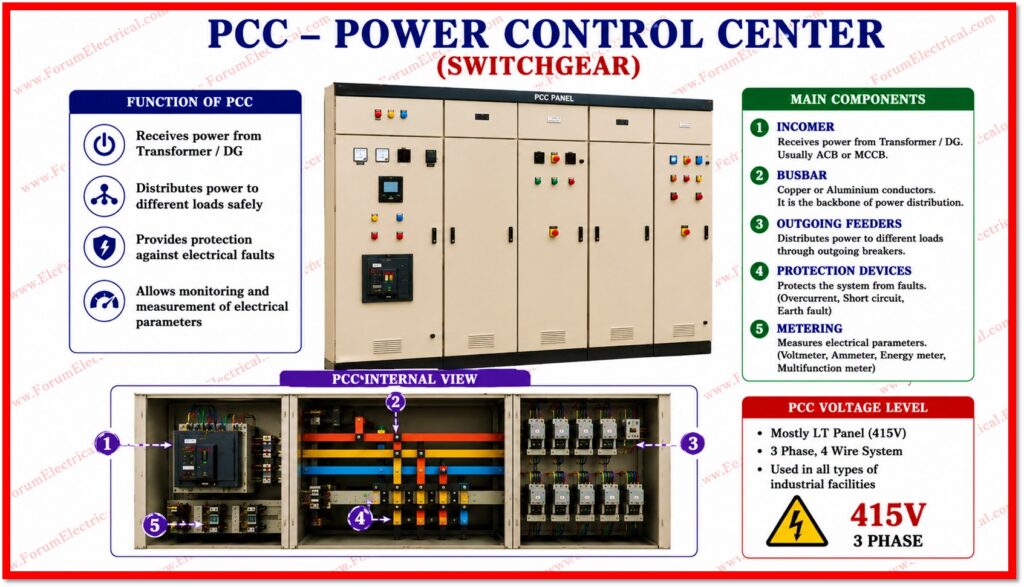
A PCC is a sophisticated assembly comprising several key components each serving a specific function in the safe & efficient management of the electrical power.
The primary components and the functions that they perform are outlined in the table that follows.
| Component | Description & Function |
|---|---|
| Incomer Section | Receives the incoming power from the transformer. Houses the main circuit breaker (ACB or MCCB) & current transformers (CTs) for metering. This is the entry point for the complete distribution system. |
| Busbars | Solid copper (or) aluminium conductors that distribute power from the receiver to all outgoing feeders. Sized based on full load current (FLC) and short circuit withstand requirements per IEC 61439 (or) equivalent standards. |
| Outgoing Feeders | Individual circuit breakers (or) fused switches that feed power to downstream panels (MCCs, LDBs, UPS, HVAC). Each feeder is rated for its specific load & includes short circuit protection. |
| Protection Devices | Includes Air Circuit Breakers (ACBs), Moulded Case Circuit Breakers (MCCBs), Earth fault relays, Over-current relays and Surge protection devices (SPDs). These devices detect and isolate faults rapidly. |
| Metering Units | Energy meters, Current transformers (CTs), Voltage transformers (VTs) and Power analysers that provide real time monitoring of voltage, current, power factor and energy consumption. |
| Control and Indication | Selector switches, Push buttons, Indicator lamps (LEDs) and Mimic diagrams that let operators monitor system status and manually regulate it. |
| Bus Tie Section | In dual busbar configurations the bus tie breaker enables the interconnection of 2 busbars providing redundancy & flexible load management during maintenance (or) fault conditions. |
Protection Coordination
One of the most important aspects of PCC design is the protection scheme.
Protection coordination ensures that in case of a fault only the nearest upstream protective device operates thereby minimizing the extent of the outage.
This principle known as selective coordination (or) discrimination requires careful study of time current characteristics of all the protective devices.
1). Over Current Protection
Over current relays (OCRs) are set to detect sustained over currents caused by overloads (or) phase faults.
The relay trip time is inversely proportional to the magnitude of the fault current as defined by the inverse definite minimum time (IDMT) characteristic per IEC 60255.
2). Earth Fault Protection
Earth fault relays detect the current flowing through the earth path due to insulation failure (or) accidental contact.
These relays are set at a lower threshold than over current relays & operate faster to prevent personnel injury & equipment damage.
3). Under Voltage & Over Voltage Protection
Voltage monitoring relays protect the sensitive equipment from supply abnormalities.
Under voltage conditions can cause motor stalling & overheating while over voltage can damage insulation & electronics.
The PCC includes automatic disconnection under abnormal voltage conditions.
4). Short Circuit Withstand
It is important that the PCC enclosure and its internal components have a rating that allows them to withstand the potential short circuit current (Icc) at the place of installation without suffering any damage from either mechanical (or) thermal forces.
This is expressed as the rated short-time withstand current (Icw) per IEC 61439-1.
Metering and Energy Monitoring
Modern PCCs integrate advanced metering infrastructure (AMI) to support the energy management & power quality monitoring.
Key metering parameters include:
- Active Power (kW) & Reactive Power (kVAR) is to monitor demand and loading.
- Power Factor (PF) is to assess reactive compensation requirements.
- Energy Consumption (kWh) is for billing, auditing and load profiling.
- Voltage THD & Current THD is primarily for attaining the proper power quality assessment.
- Demand Metering is for peak demand tracking & tariff optimization.
These meters are typically integrated with a SCADA system (or) building energy management system (BEMS) via
- Modbus RTU,
- Modbus TCP/IP or
- IEC 61850 communication protocols
enabling remote monitoring & data logging.
Installation, Commissioning & Maintenance
Proper installation of a PCC is essential to its safe operation and longevity.
Site preparation should account for
- Cable entry provisions,
- Bus duct connections,
- Ventilation requirements and
- Seismic anchoring where applicable.
During commissioning all protection relay settings should be verified, CT & VT polarities confirmed and insulation resistance (IR) tests conducted on all cables & bus sections.
Routine maintenance of a PCC includes
- Periodic thermal imaging to detect the loose connections & overloaded conductors,
- Contact resistance measurements on the circuit breakers,
- Calibration of metering instruments and
- Testing of protection relays using primary (or) secondary injection methods.
A well maintained PCC can deliver a service life exceeding 25 years.
Conclusion
Any industrial / large commercial electrical system requires a Power Control Center (PCC).
The PCC delivers safe, reliable and efficient power to every load in the facility by integrating power receipt, busbar distribution, outgoing feeder control, complete protection and real-time metering into a single panel assembly.
Its design requires strict international standards, thorough protective coordination & regular maintenance to maintain optimal performance during its operational life.
The PCC incorporates
- Smart metering,
- Digital protection relays &
- IoT-enabled monitoring
as industrial facilities become more complex and energy intensive, strengthening its function as the core of modern industrial power distribution.

 panel works, its key components, protection features and applications in industrial and commercial power distribution systems. Ideal for engineers and technicians.)