Protection systems in power networks are essential for the safe and dependable operation of electrical equipment that includes
- Purpose
- Applicable Standards
- Equipments Required
- Test Procedure
- Stability & Sensitivity Test
- Procedure
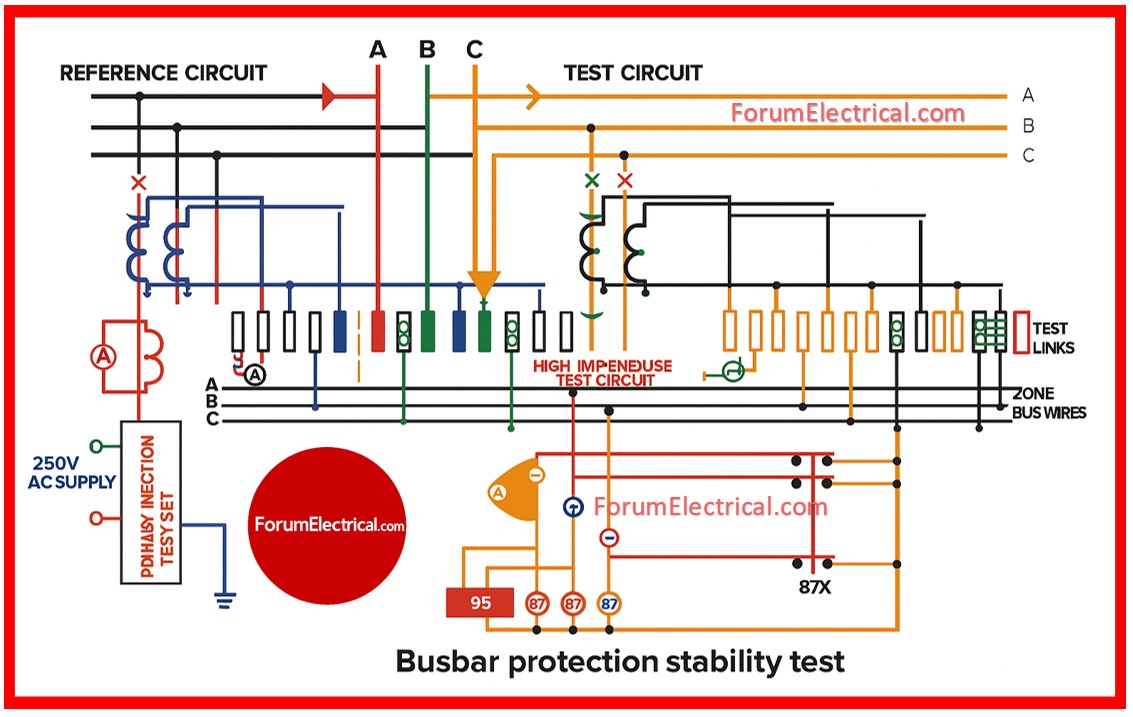
- Busbar Differential Protection: Sensitivity Test
- Biased Differential Protection: Stability Test
- Transformer Differential Protection: Stability Test
- Transformer Differential Protection: Sensitivity Test
- Pilot Wire Protection: End-to-End Test
- Conclusion
- Transformers,
- Busbars and
- Transmission lines.
These systems are designed to identify abnormal conditions (which might include internal faults, short circuits (or) inappropriate operating currents) & isolate the faulty portion in order to avoid equipment damage, system instability (or) safety risks.
Before commissioning and on a regular basis following that the protective mechanisms must be tested to ensure that they function properly under both normal & fault conditions.
This post describes the objectives, necessary test instruments and thorough test procedures for popular protection systems such as
- Differential protection,
- Distance protection &
- Pilot wire protection.
Purpose
The fundamental objective of protection function testing is to ensure that specific protection schemes (such as differential and distance protection) work as intended in all operational conditions.
The tests below assist:
> Check the correct relay operation before & after commissioning.
> Demonstrate system stability under through-fault conditions.
> Confirm the sensitivity to internal problems within the protected zone.
> Check CT polarity & wiring connections.
> Validate the end-to-end communication and functionality of pilot wire protection methods.
Applicable Standards
IEC 60255-3 / IEEE C37.91 – Differential protection testing.
IEC 60834 – Teleprotection & pilot wire systems.
IEEE C37 Series – Protection relays and relay schemes.
Equipments Required
To conduct the tests effectively the following devices and equipment are required:
- Primary Injection Test Kit – for injecting large currents directly into CT circuits.
- Secondary Injection Test Kit – Simulates relay inputs with the controlled currents and voltages.
- Clamp Meter – used for non-intrusive current measuring.
- Digital multimeter – used to measure voltage, resistance & continuity.
Test Procedure
Stability & Sensitivity Test
Unit protection procedures that includes differential protection are based on the current balancing principle between CTs at the protected zone’s boundaries.
Stability Test: Verifies that the protection is stable & does not operate over through-faults (external faults).
Sensitivity Test: Confirms that the protection works properly for internal defects in the protected zone.
Procedure
- Inject primary current via one set of CTs, with one current flowing inward & the other outward.
- If the CTs are properly connected, there should be no operating current at the relay terminals.
- For sensitivity testing, use either:
- Reverse the polarity of one CT.
- Inject primary current via only one CT in the set.
- An operational current at relay terminals should be observed to ensure proper sensitivity.
Busbar Differential Protection: Sensitivity Test
- Connect the circuit. (For high-impedance differential relays).
- Determine the minimal primary current necessary to run the relay if all CTs are get connected within the protective zone.
- Gradually increase the injected primary current till the relay starts operating.
- All values should be recorded on the test form provided.

Biased Differential Protection: Stability Test
To perform the test, inject current into 1 set of CTs simultaneously reversing the polarity of another CT secondary.
- Connect the circuit.
- Inject at least half of the primary operational current.
- At the relay, measure the CT secondary current as well as the differential current.
- A zero differential current value implies proper CT wiring and good stability performance.

Transformer Differential Protection: Stability Test
- Connect the test equipment.
- Apply test voltage to one transformer winding as the opposite winding is short-circuited following the differential CT.
- Ensure that the test voltage is applied before the differential CT.
- Measure the CT secondary currents.
- At the relay terminals, only via-current must be measured.
- A small (or) zero differential current indicates an appropriate connection.
- Repeat the test with the minimum & maximum tap settings.
- Please keep consideration that differences in tap changers may result in a slight differential current.

Transformer Differential Protection: Sensitivity Test
- Repeat the setup described previously.
- Reverse the polarity of one side’s CT (Current Transformer) secondary (all phases).
- The relay should detect an operating differential current indicating sensitivity.
Pilot Wire Protection: End-to-End Test
Pilot wire protection methods necessitate accurate wiring & coordination between the 2 ends of a protected feeder.
The end-to-end test ensures a proper connection & functional response.
Procedure:
- Perform the procedure in accordance with the manufacturer’s guidelines.
- Confirm the pilot wire’s continuity & correct connections to the remote end.
- Inject test current from one side & check relay functionality on both ends.
- Simulate single-end feed circumstances to ensure proper operation.
- Ensure that all findings fall within the specified tolerance limits.
Conclusion
Protection function testing is an important part of commissioning & maintaining a reliable power system.
By completing stability & sensitivity tests on busbar & transformer differential protection, as well as end-to-end checks on the pilot wire protection, engineers may confirm that:
- The relays are correctly connected & wired.
- External defects do not cause the protection systems to fail.
- Protection systems are sensitive enough to identify internal faults.
- Communication-based protection mechanisms are reliable.

