 with this complete RMU Maintenance Checklist. Covers inspection, testing, SF6 checks, protection systems and preventive maintenance procedures for electrical distribution systems.)
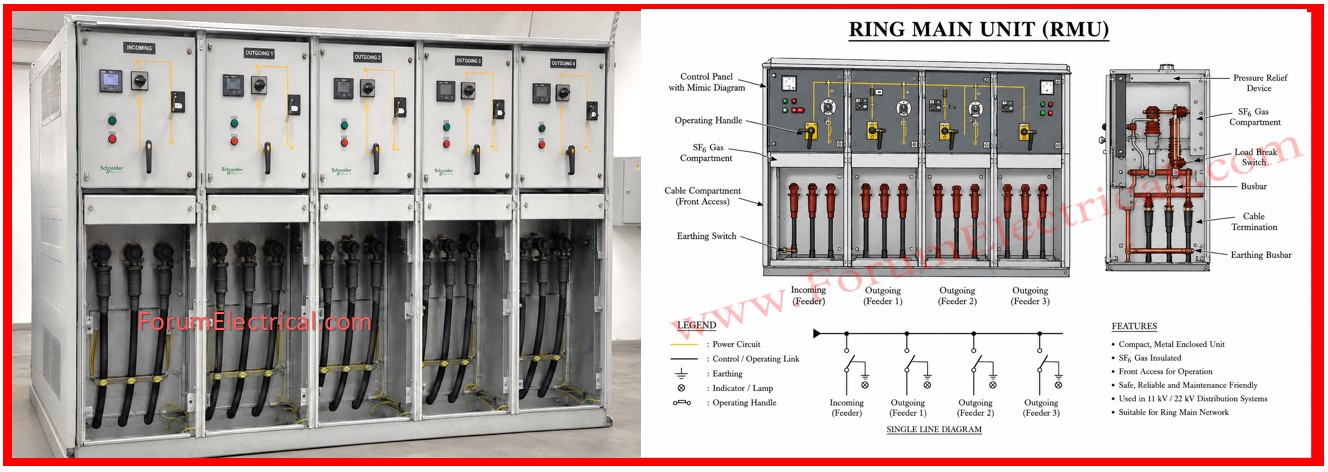
This Ring Main Unit (RMU) maintenance checklist is a structured and detailed technical document used during the RMU installation, commissioning and routine maintenance of medium voltage (MV) RMU switchgear.
It gives a systematic detailed method statement for field engineers and commissioning personnel to verify the mechanical integrity, electrical performance and operational safety procedure of RMU equipment before energization (or) return to service.
The checklist details 6 primary inspection domains:
1). Installation & Erection,
2). Operating Mechanism,
3). Visual Inspection & Labelling,
4). Functional Testing,
5). Metering,
6). Protection and
7). Electrical Testing.
Installation Information
The installation information captures all essential equipment identification and site data required for asset management, maintenance scheduling and warranty tracking.
The fields below should be completed before any inspection activity starts.
| EQUIPMENT & SITE IDENTIFICATION | |||
| Customer | |||
| Plant | |||
| Date | |||
| Job No | |||
| Equipment Manufacture | |||
| Tag No. | |||
| Voltage Rating | |||
| Current Rating | |||
| Configure | |||
| Serial No. | |||
Installation & Erection
The installation and erection phase is essential to ensuring the structural and electrical integrity of the RMU.
All mechanical fixing, busbar connections, cable terminations and earthing systems should comply with the manufacturers installation instructions and applicable standards such as IEC 62271-200.
The following checklist verifies that the panel has been correctly erected, coupled and internally assembled before any energization attempt.
Operating Mechanism
The operating mechanism controls the switching of the
- Disconnecting Switch (DS),
- Load Break Switch (LBS),
- Earthing Switch (ES) and
- Circuit Breaker (CB).
Each mechanism must be verified for smooth, positive and latched operation in both the OPEN and CLOSE positions.
Mechanical interlocks between the earthing switch and the main switch must prevent simultaneous closure.
All spring charged (or) stored energy mechanisms should be verified for correct charge and release without hesitation.
Visual Inspection & Labelling
A thorough visual inspection makes the baseline condition of the equipment and confirms compliance with safety labelling requirements mandated by IEC 62271-200 and local electrical regulations.
All labels, symbols and indicators must be legible, correctly positioned and resistant to the environmental conditions of the installation site.
The cubicle interior must be free of foreign objects, debris, moisture (or) signs of insulation damage before energization.
Functional Test
Functional testing verifies that all
- Control circuits,
- Indication systems,
- Interlocks and
- Auxiliary devices
operate correctly under simulated service conditions before live commissioning.
Tests are performed at rated control voltage (typically 24 V DC, 110 V DC 230 V AC) and should confirm that all functions respond within manufacturer-specified timings.
Any discrepancy across designed and observed functions should be analyzed and resolved before energization.
Metering
Metering equipment provides continuous monitoring of key electrical parameters during normal operation.
All meters fitted in the RMU should be calibrated and confirmed operational before the unit is placed into service.
The SF6 gas density gauge is an essential safety instrument and should always be within the manufacturer’s specified operating band at ambient temperature before the compartment is energized.
Protection
Protection relays protects the RMU and connected network from
- Overcurrent,
- Earth fault and
- Voltage fluctuations.
Where protection relays are fitted their settings should be verified against the approved protection coordination study before commissioning.
Relay injection testing (secondary injection) is typically performed by a specialist protection engineer using calibrated test equipment and all results must be documented & retained with the protection settings record.
Electrical Testing
Electrical testing provides quantitative verification of insulation integrity, contact resistance and SF6 gas condition.
All tests must be performed with equipment de-energized and isolated using calibrated test instruments with valid calibration certificates.
Test results should be compared against acceptance criteria and manufacturers minimum values.
Any result outside acceptance limits should be analysed and the equipment should not be energized until the defect is resolved and re-tested.
Insulation Test: IR Megger Test Results
The following table records the results of the insulation resistance (IR) test performed using a DC megohmmeter (Megger).
The minimum acceptable insulation resistance per NETA 2007 is 20 GOhm. All 6 phase combinations should be tested.
The test voltage and duration should be recorded alongside each measurement.
Testing must be performed with all voltage transformers and surge arresters disconnected (or) temporarily removed to avoid damage.
Acceptance Criteria: Minimum 20 GOhm per NETA 2007 at rated test voltage. Test performed at ambient temperature and record ambient °C in Remarks.
| S.No | Phase Test | Voltage (kV) | Time (min) | Result (Ohm) |
| 1 | L1 – L2 | |||
| 2 | L2 – L3 | |||
| 3 | L3 – L1 | |||
| 4 | L1 – GROUND | |||
| 5 | L2 – GROUND | |||
| 6 | L3 – GROUND |