
Soft starters are the more important components in current industrial applications providing wide range of advantages such as lowering mechanical stress on the motors and increasing the energy efficiency.
- What is Soft Starters?
- Soft Starter Selection Considerations
- Step-1: Motor Specifications
- Step-2: Load Type
- Step-3: Control Features
- Step-4: Environmental Conditions
- Step-5: Communication & Integration
- Step-6: Safety and Protection
- Key Considerations when choosing a Soft Starter
- Motor Characteristics
- Load Characteristics
- Supply Characteristics
- Soft Start Features
- Simplified Calculation
- FLC Calculation
- Starting Current Calculation
- Soft Starter Selection
- Verify Supply Capacity
- Additional Considerations
Choosing the correct soft starter for the particular industrial requirements can have a major impact on the operating efficiency & equipment longevity.
This in-depth procedure will help you to understand the significant considerations to consider when selecting the appropriate soft starter for the operations.
What is Soft Starters?
Soft starters are devices that governs the acceleration of an electric motor resulting in a smooth and also progressive ramp-up of speed.
Unlike direct-on-line starters soft starts limit the initial surge of current and torque hence reducing mechanical stress and also electrical disturbances.
Choosing the correct soft starter is essential for achieving
- Maximum performance,
- Efficiency and
- Lifetime for the motor and load.
Here is the step-by-step procedure to help you to choose the most suitable soft starter complete with calculations and important factors.
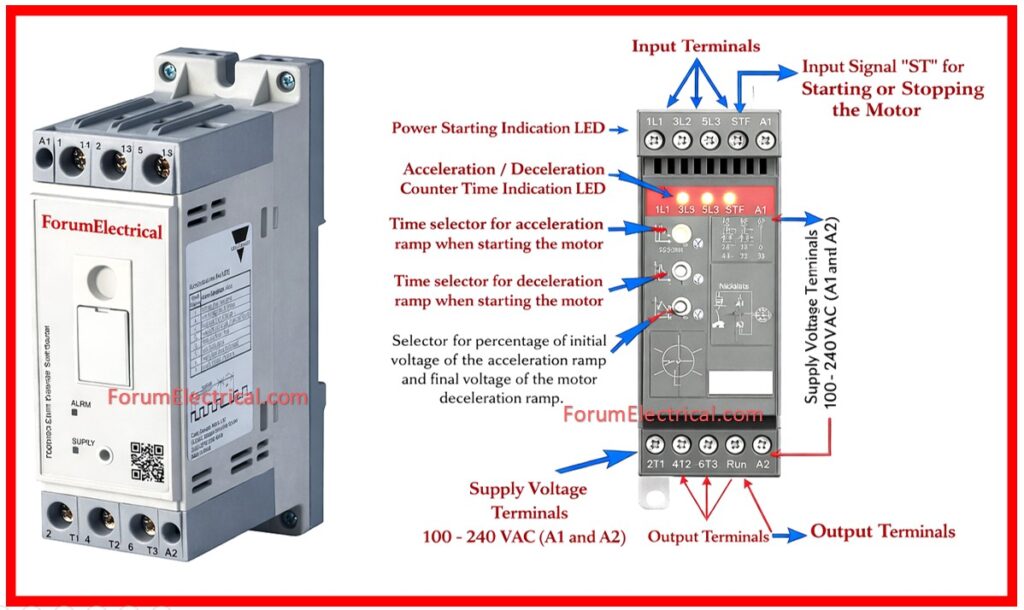
Soft Starter Selection Considerations
Step-1: Motor Specifications
Power Rating
To properly manage the load, ensure that the soft starter meets the motor’s power rating (kW or HP).
Voltage & Current
The soft starter must be compatible with the motor’s voltage and current specifications.
Step-2: Load Type
Application Type
Determine whether the load is continuous, variable (or) high inertia. Pumps, conveyors and fans may need unique soft starter features.
Starting Conditions
Consider the motor’s starting circumstances such as frequency and load torque.
Step-3: Control Features
Ramp Time
Look for the customizable ramp time settings to control the motor acceleration and also slowdown based on the processing requirements.
Current Limiting
Soft starters with current limiting characteristics helps to avoid overcurrent conditions maintaining both the motor & the electrical network.
Step-4: Environmental Conditions
Temperature
Ensure that the soft starter may operate efficiently within the industrial ambient temperature range.
Protection Ratings
Check the IP rating of the soft starter to verify that it can survive adverse environmental conditions including dust, moisture and corrosion.
Step-5: Communication & Integration
Connectivity
Modern soft starters usually contain connectivity features that allow for integration with control systems and remote monitoring.
Compatibility
Ensure that existing control systems such as PLCs (or) SCADA systems can be seamlessly integrated and controlled.
Step-6: Safety and Protection
Built-in Protections
Check for soft starters that includes overload, short circuit & phase loss protection.
Compliance
Ensure that the soft starter meets the applicable industry standards & certifications for the safety & performance.
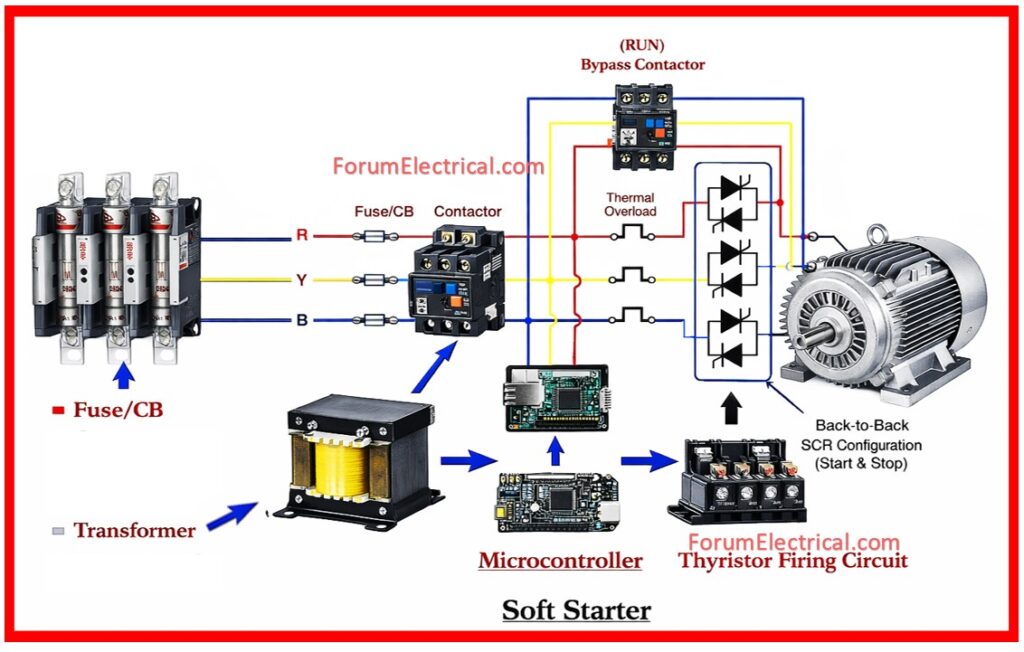
Key Considerations when choosing a Soft Starter
Motor Characteristics
Full Load Current (FLC)
The soft starter should need to accommodate the motor’s FLC.
FLC Formula
Full Load Current (FLC) = (P x 1000) / (√3 x V x PF x η)
Example
For a 30 kW motor (400V, PF = 0.85, η = 92%), the FLC is approximately 49.5 A calculated as (30 x 1000) / (√3 x 400 x 0.85 x 0.92).
Locked Rotor Current (LRC)
A soft starter can reduce the inrush current from 6 – 8 x FLC to 2 – 4 x FLC.
Duty Cycle
The thermal performance of the soft starter is impacted by the frequent starts.
Load Characteristics
Torque Requirements
The torque requirements vary depending on the load type (for example: pumps, fans and conveyors).
Load Inertia
High-inertia loads require more initial energy and duration.
Supply Characteristics
Voltage and Frequency
Match the motor to the supply voltage (for example, 400V, 50Hz).
Starting Current
Verify that the electrical power supply network is capable of managing the necessary starting current for motor.
Soft Start Features
Current Limiting and Voltage Ramp
Soft starter helps to reduce startup current while ensuring smooth acceleration.
Bypass Contactor
Bypass Contactor reduces heat dissipation after the motor reaches full speed.
Protection Features
Soft starter prevents overload, overcurrent & phase loss problems.
Simplified Calculation
FLC Calculation
Full Load Current (FLC) = (P x 1000) / (√3 x V x PF x η)
Example: For a 30 kW motor – FLC ≈ 49.5 A
Starting Current Calculation
Starting Current = Full Load Current (FLC) x Starting Factor (eg: 3 for soft starters).
Example: 49.5 x 3 = 148.5 A
Soft Starter Selection
Select a soft starter rated ≥ Full Load Current (FLC) (eg: for 49.5 A, select ≥ 50 A).
Verify Supply Capacity
Ensure that the network can manage the starting current without experiencing significant voltage drop.
Additional Considerations
Environment
Verify that the ambient temperature and altitude are sufficient for the soft starter operation.
Enclosure
Enclosure ensure it provides enough protection for the operational environment.
By following these steps and conducting the appropriate calculations you may choose the most suitable soft starter for your motor’s performance, efficiency and safety.

