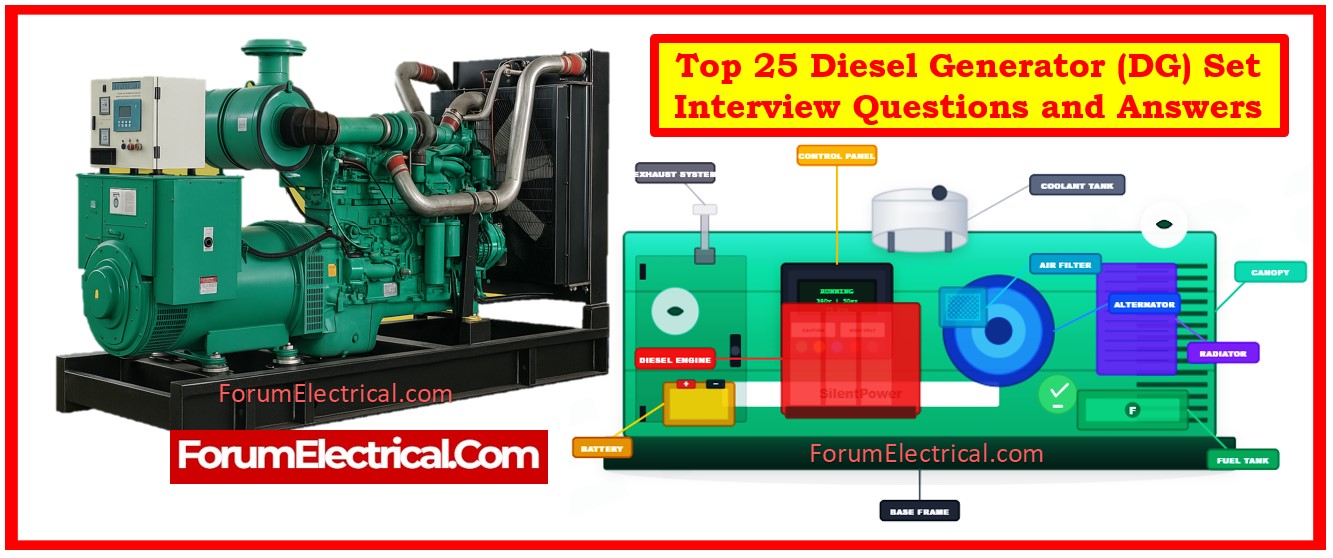
1). What is a DG set?
A Diesel Generator (DG) set consists of a
- A diesel engine and
- An alternator
that generates electrical power when the grid is unavailable.
2). What are the main components of a DG set?
A DG set mainly consists of:
Diesel Engine – Diesel Engine converts chemical energy of fuel into mechanical energy.
Alternator – Alternator converts mechanical energy into electrical energy.
Fuel System – Fuel system supplies diesel to the engine.
Cooling System – Cooling system maintains optimal engine temperature.
Lubrication System – Lubrication system reduces friction between moving parts.
Battery & Starting System – Battery & starting system helps in starting the engine.
Control Panel – Control panel monitors and controls generator parameters.
Base Frame & Canopy – Base frame & canopy provides support and noise protection.
3). What is the working principle of a DG set?
A DG set operates on the principle of electromagnetic induction.
The alternator shaft is rotated by the diesel engine generating electricity when the magnetic field passes through the alternator’s conductors.
4). What type of engine is used in DG sets?
DG sets employ a compression ignition (CI) diesel engine in which air is compressed to a high temperature & fuel is injected to start combustion.
5). What is the function of the alternator in a DG set?
The alternator turns the engine’s mechanical energy into electrical energy by applying Faraday’s law of electromagnetic induction.
6). What are the different types of DG sets based on application?
The DG sets are classified as follows:
- Standby (or) Emergency DG Sets.
- Prime Power DG Sets.
- Continuous Power DG Sets
7). What are the main ratings of DG sets?
DG sets are ranked according to:
kVA (Kilovolt-Ampere) denotes apparent power rating.
kW (Kilowatt) denotes active power rating.
Power factor (often 0.8 lagging)
8). How is DG set capacity determined?
The DG capacity is calculated using the total connected load, motor starting current and diversity factor. To calculate the kVA rating divide the total load in kW by 0.8 (PF).
9). What is the formula to convert kVA to kW?
Formula: kW = kVA X Power
Ex: 100 kVA x 0.8 = 80 kW.
10). What is the function of AVR (Automatic Voltage Regulator)?
The AVR maintains the alternator’s output voltage by adjusting the excitation current to the rotor field winding.
11). What is the function of governor in a DG set?
The governor keeps the engine speed constant regardless of load fluctuations resulting in a consistent frequency output.
12). What is meant by load sharing in DG sets?
Load sharing refers to two or more DG sets operating in parallel, distributing the total electrical load proportionally depending on their capacity.
13). What are the conditions required for DG sets to run in parallel?
Parallel operation requires DG sets to have:
- Same voltage
- Similar Phase Sequence
- Same frequency &
- Phase Angle Synchronization
14). What are common protection systems in DG sets?
DG sets have protections such as:
- Overload Protection
- Over-Speed Protection
- High water temperature protection
- Low Oil Pressure Protection
- Under/Overvoltage and Frequency Protection
15). What is the significance of the neutral grounding in DG sets?
Neutral grounding establishes a fault current path, promotes protection coordination and improves system safety during earth faults.
16). What are the typical starting methods for DG sets?
Manual Start (Push Button)
Auto Start through AMF Panel (Automatic Mains Failure)
Remote Start/Stop Systems
17). What is an AMF panel?
An Automatic Mains Failure (AMF) Panel activates the DG set during a power outage and shuts it off when power is restored.
18). What is a Synchronizing Panel?
A Synchronizing Panel ensures that numerous DG sets operate safely in parallel by synchronizing the voltage, frequency & phase sequence before connection.
19). What is DG set efficiency?
The efficiency of a DG set is calculated as the ratio of output electrical energy to input fuel energy.
Efficiency = Output Power (kW) / Input Fuel Power (kW) X 100
20). What type of fuel is used in DG sets?
The majority of DG sets use High-Speed Diesel (HSD) because of its high calorific value & combustion efficiency.
21). What is the role of a fuel filter in a DG set?
The fuel filter removes
- Dust,
- Dirt and
- Water particles
from diesel before it enters the injection pump & injectors.
22). What is the function of a radiator in DG sets?
The radiator absorbs surplus heat from the coolant keeping the engine temperature within acceptable limits.
23). What are the causes of black smoke in DG sets?
Black smoke implies incomplete combustion caused by:
- Clogged air filter
- Overloading
- Faulty injectors
- Low turbocharger pressure.
24). What are the causes of white smoke in DG sets?
White smoke results from unburned fuel which is usually created by:
- Low compression,
- Cold engine start &
- Water in the fuel.
25). What are the common DG set maintenance activities?
Checking and changing engine oil
Cleaning air and fuel filters
Checking battery voltage and electrolyte
Inspecting belts and hoses
Monitoring coolant level &
Testing AVR and control panel

 Set Interview Questions and Answers for AE/JE. Learn DG working, components, maintenance and protection systems.)