
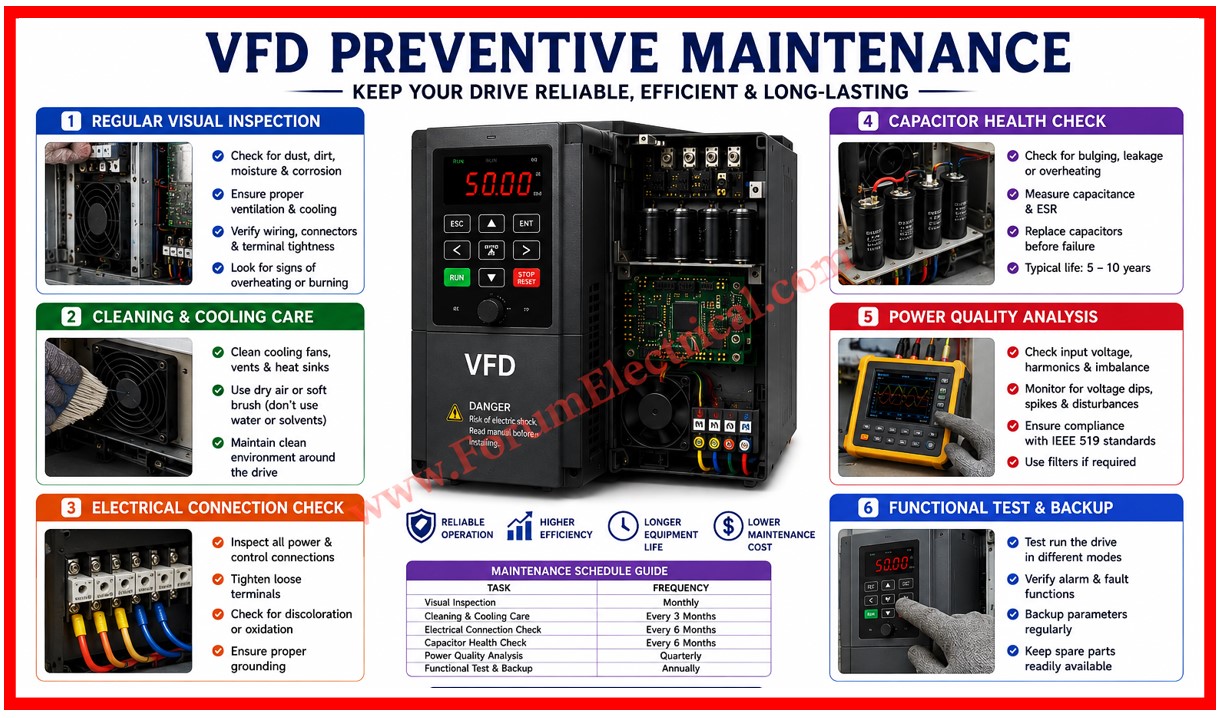
Variable Frequency Drives (VFDs) are the essential components in modern industrial and commercial applications that is controlling motor speed and energy consumption.
Implementing a comprehensive preventive maintenance procedure for VFD drives is essential to
- Ensure optimal performance,
- Minimize unexpected downtime and
- Reduce overall operational costs.
This post gives you a detailed information on VFD maintenance schedules, procedures & best practices.
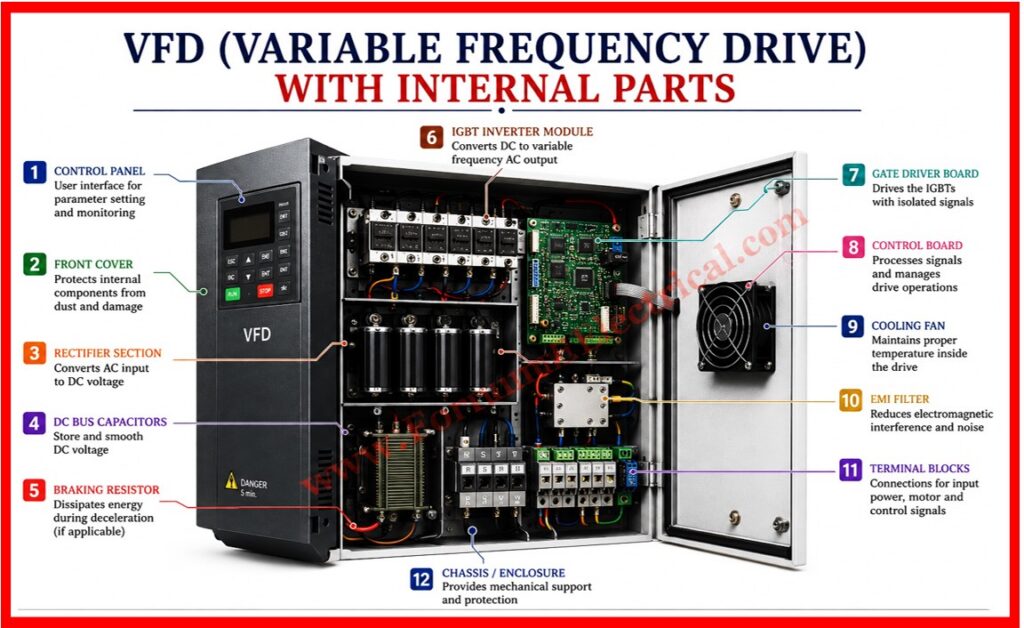
VFD Preventive Maintenance Schedule
The National Electrical Manufacturers Association (NEMA) classifies VFDs into a number of types. The majority of VFDs are either NEMA 1 (or) NEMA 12.
A structured maintenance schedule is the basic of effective VFD management.
The following timeline should be adapted based on the specific equipment, operating conditions and manufacturer recommendations.
Daily VFD Maintenance
• Monitor the VFD display panel for any error codes (or) warning indicators.
• Observe for any unusual noises (or) vibrations from the electrical drive unit.
• Check the cooling fan operation & also verify proper airflow.
• Document any operational abnormalities in maintenance logs.
Weekly Preventive Maintenance
• Inspect power supply connections for loose terminals (or) corrosion.
• Verify the output wiring integrity & insulation condition.
• Test all emergency stop functionality & control circuits.
• Review the temperature readings & ensure cooling system efficiency.
Monthly VFD Maintenance Procedures
• Clean the air filters & intake vents to prevent/avoid dust accumulation.
• Examine the cabinet ventilation and also ambient temperature conditions.
• Conduct thermal imaging to detect any hotspots (or) component degradation.
• Test backup power systems and UPS (uninterruptible power supply).
Quarterly & Annual VFD Maintenance
• Perform a comprehensive electrical insulation tests.
• Inspect and replace the electrolytic capacitors if required.
• Verify the firmware updates and control system functionality.
• Conduct full system performance testing and their calibration.
Essential VFD Maintenance Procedures
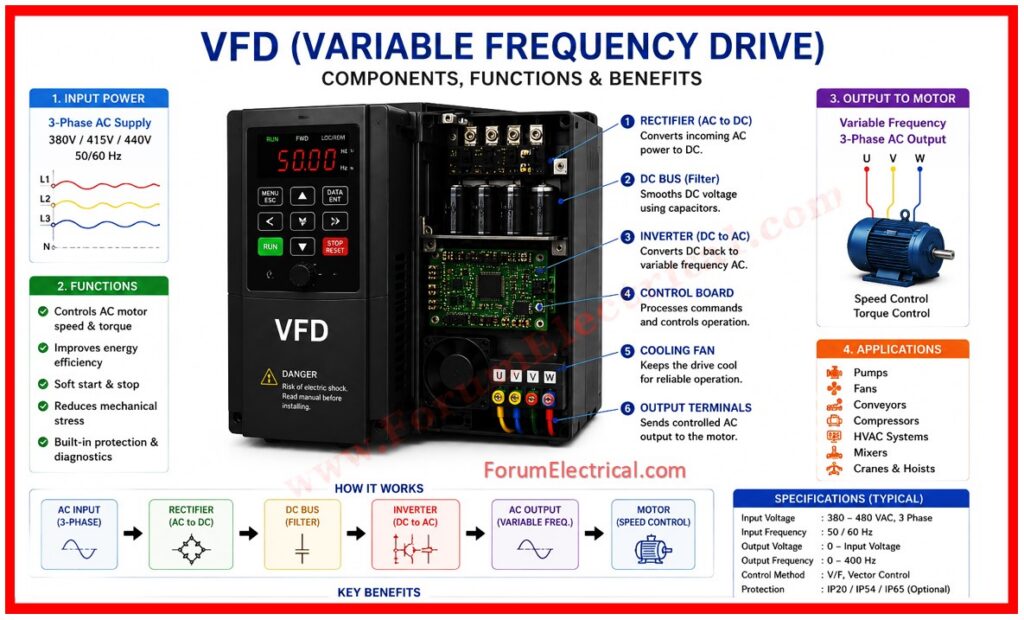
Thermal Management and Cooling
Proper heat dissipation is essential for every VFD longevity.
Inadequate cooling may lead to premature component failure and reduced drive efficiency.
Maintain an ambient temperatures between 0°C and 40°C that ensure adequate ventilation clearances and regularly (time interval) clean cooling fans and filters.
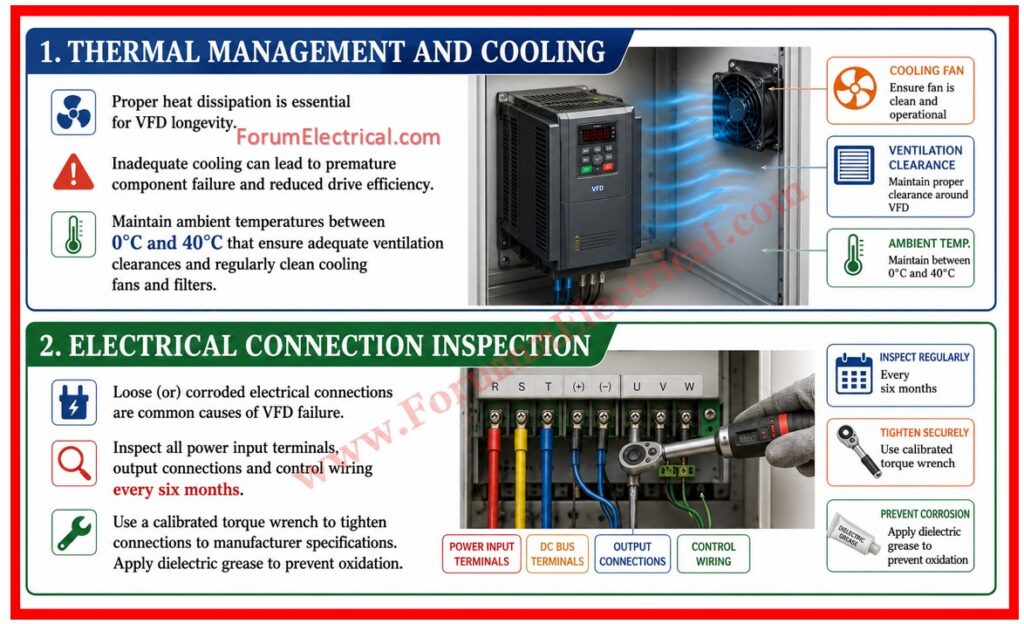
Electrical Connection Inspection
Loose (or) corroded electrical connections are common causes of VFD failure.
Inspect all power input terminals, output connections and control wiring every six months.
Use a calibrated torque wrench to tighten connections to manufacturer specifications.
Apply dielectric grease to prevent the oxidation.
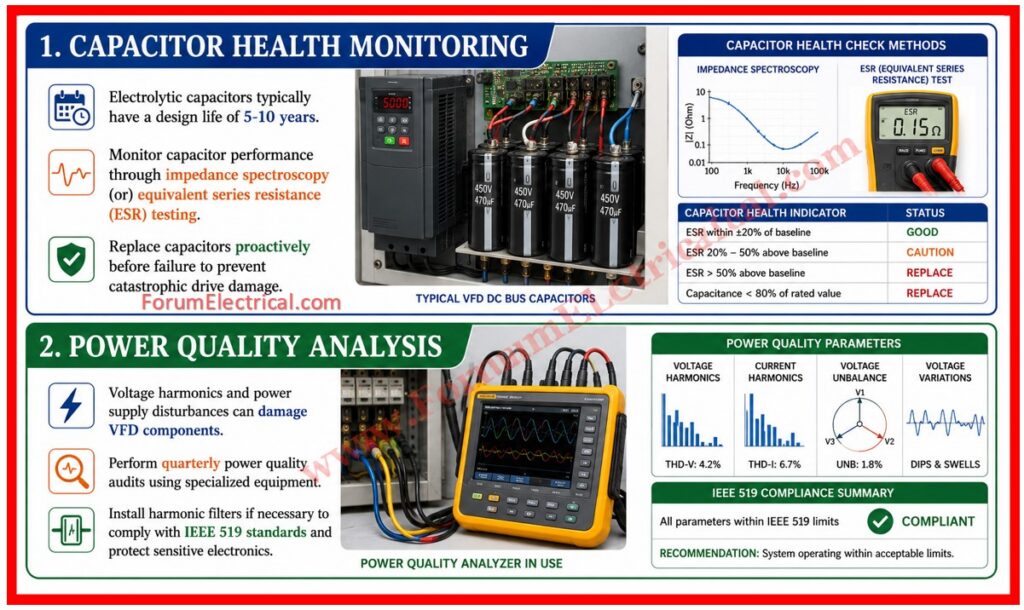
Capacitor Health Monitoring
Electrolytic capacitors are typically have a design life of 5-10 years.
Monitor the capacitor performance through impedance spectroscopy (or) equivalent series resistance (ESR) testing.
Replace the capacitors proactively before failure to avoid catastrophic drive damage.
Power Quality Analysis
Voltage harmonics & power supply disturbances can damage VFD components.
Perform quarterly power quality audits using a specialized equipment. Install harmonic filters if needed to comply with IEEE 519 standards and protect the sensitive electronics.
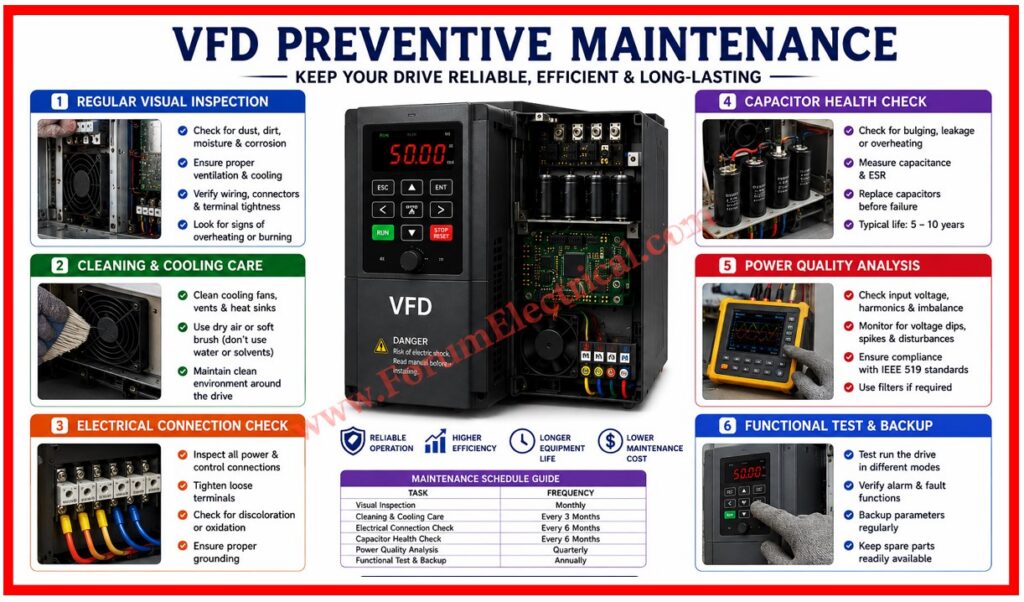
VFD Maintenance Schedule Table
Utilize this reference table to ensure comprehensive maintenance coverage which includes:
| Frequency | Task | Priority |
| Daily | Monitor error codes and display panel | Essential |
| Weekly | Inspect electrical connections | High |
| Monthly | Clean filters and cooling vents | High |
| Quarterly | Electrical insulation testing | Medium |
| Annual | Full system performance testing | High |
VFD Maintenance Best Practices
Environmental Protection
Deploy VFDs in climate controlled enclosures away from the moisture, dust and corrosive substances.
Maintain a relative humidity between 35% & 80% to avoid condensation and electrical short circuits.
Use hermetic seals and also protective covers in harsh industrial environments.
Documentation
Maintain a detailed maintenance logs including dates, work performed, parts replaced & technician names.
Document all the error codes, performance variations and environmental conditions.
Use the computerized maintenance management systems (CMMS) to track maintenance history (Maintenance schedule log) and predict the failure patterns.
Training & Competency
Ensure a maintenance personnel to complete the manufacturer approved training programs.
Certification in electrical systems, power electronics and VFD programming is essential.
Update the training annually as technology evolves and new equipment is periodically installed.
Spare Parts Management
Stock the essential replacement components including
- Capacitors,
- Cooling fans and
- Control modules.
Establish a proper relationships with reliable suppliers to minimize procurement delays.
Maintain inventory management practices to balance the availability against the storage costs.
Common VFD Problems and Prevention
Thermal Overload & Heat Damage
Problem
• VFD shuts down because of excessive internal temperature.
• Components degrade & lifespan reduces.
Prevention
• Monitor ambient temperatures and also improve ventilation.
• Clean the cooling fans and filters monthly to maintain a proper airflow.
Electrical Failures & Short Circuits
Problem
• Loose connections may cause intermittent faults.
• Power surges damage the internal circuitry.
Prevention
• Inspect and torque all connections quarterly.
• Install the surge suppressors and harmonic filtering equipment.
Capacitor Degradation
Problem
• Electrolytic capacitors dry out and fail.
• Complete drive failure occurs if not replaced.
Prevention
• Test capacitor ESR values every 12 months.
• Replace the capacitors proactively before any failure.
Advantages of VFD Preventive Maintenance
• Increased equipment reliability & also extended operational lifespan.
• Reduced emergency repair costs & production downtime.
• Improved energy efficiency & lower utility bills.
• Better safety compliance & regulatory adherence.
• Enhanced equipment performance & their product quality.
Do VFDs require Maintenance?
There is a lot of airborne dust & debris in commercial and industrial environments which could build up over a VFD and impair its operation.
Regardless of the type of VFD chassis frequent cleaning is necessary to prevent this. Its fans and heat sink need to be kept clean at all times.
Conclusion
A proper VFD preventive maintenance procedure is essential for industrial and commercial operations.
By following the maintenance schedules, procedures and best practices that is outlined in this comprehensive schedule we can maximize equipment reliability, reduce the unexpected downtime and optimize the operational efficiency.
- Regular VFD inspections,
- Thermal monitoring,
- Electrical testing of VFD and
- Documentation
create a base for long term VFD performance and cost savings.