
What is an Electrical Fastener?
Electrical fastener is a mechanical components that hold
- Conductors,
- Devices,
- Enclosures and
- Support hardware
securely in place within an electrical system.
- What is an Electrical Fastener?
- Why Fastener Selection Important in Electrical Work?
- Types of Electrical Fasteners
- 1). Terminal Screws
- 2). Wire Nuts (Twist-On Connectors)
- 3). Split-Bolt Connectors
- 4). Cable Clamps and Connectors
- 5). Self-Tapping & Sheet Metal Screws
- 6). Machine Screws and Bolts
- 7). Toggle Bolts and Anchors
- 8). Set Screws
- Comparison Table
- Material Considerations
- Standards and Compliance
- Installation Best Practices
- Conclusion
Although they rarely receive the same attention as wiring, circuit breakers (or) switchgear, fasteners are essential to system safety and reliability.
A poorly chosen (or) improperly installed fastener can lead to loose connections, arcing, overheating, corrosion and ultimately equipment failure (or) fire.
This post gives a detailed technical overview of the major categories of electrical fasteners, their construction, typical applications and the criteria engineers and electricians utilize to select the right fastener for a given task.
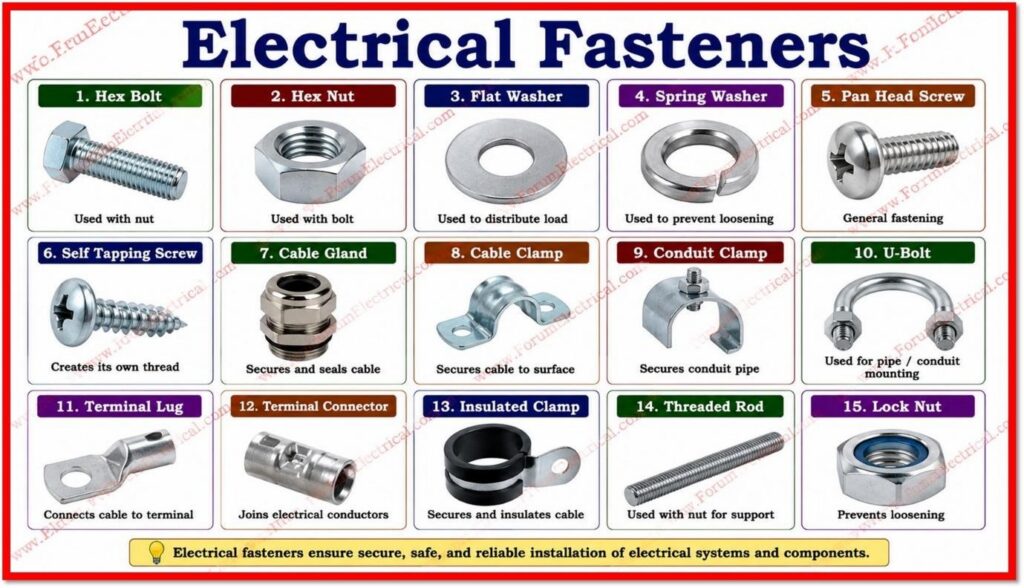
Why Fastener Selection Important in Electrical Work?
Unlike general mechanical fastening, electrical fastening often has to satisfy dual requirements: mechanical strength and electrical performance.
A fastener may need to carry current that maintain a low resistance contact under thermal cycling, resist corrosion in damp (or) outdoor environments, and comply with code requirements such as those set by the National Electrical Code (NEC) (or) IEC standards.
Material choice, plating, torque rating and connector geometry are therefore chosen deliberately rather than by convenience.
Types of Electrical Fasteners
The different types of electrical fasteners are
1). Terminal Screws
2). Wire Nuts (Twist-On Connectors)
3). Split-Bolt Connectors
4). Cable Clamps and Connectors
5). Self-Tapping & Sheet Metal Screws
6). Machine Screws and Bolts
7). Toggle Bolts and Anchors
8). Set Screws
1). Terminal Screws
Terminal screws are the small screws found on
- Switches,
- Outlets,
- Circuit breakers and
- Terminal blocks
that clamp a bare (or) stripped conductor beneath a metal plate (or) washer.
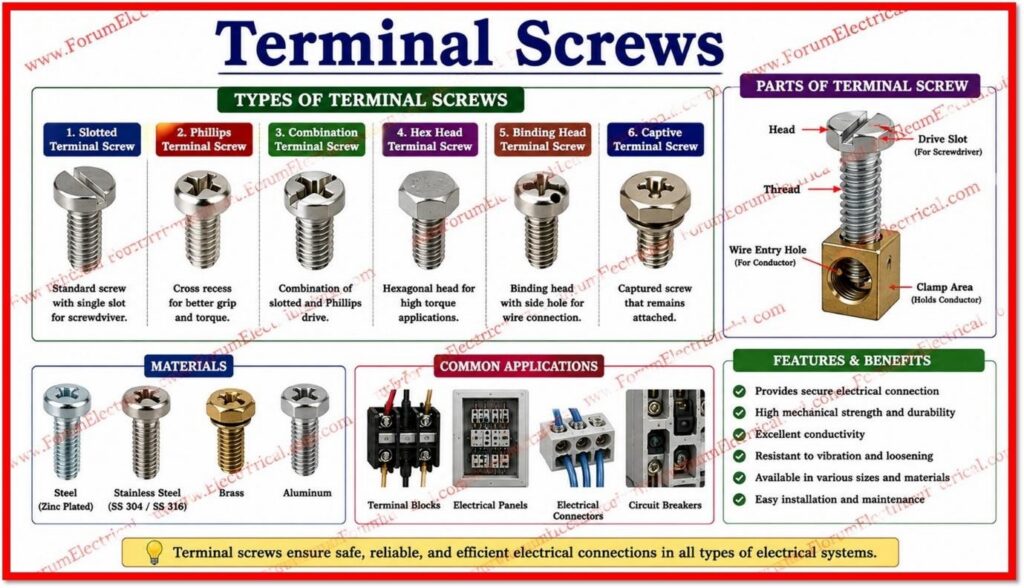
They are typically made of brass (or) plated steel to balance conductivity and strength.
Proper torque is essential that under tightening causes resistive heating at the joint while over-tightening can shear the conductor strands (or) strip the screw threads.
2). Wire Nuts (Twist-On Connectors)
Wire nuts are cone shaped plastic connectors with an internal tapered metal spring.
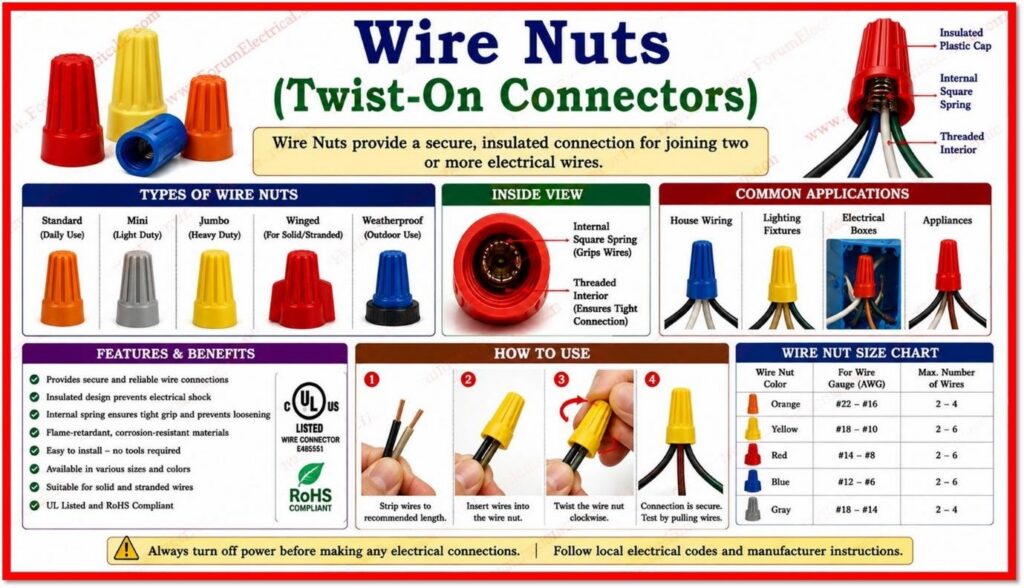
They are twisted onto the stripped ends of two or more conductors to mechanically join and insulate the splice simultaneously that are available in color coded sizes corresponding to conductor gauge and count, wire nuts are one of the most common fastening methods in residential and light commercial branch circuit wiring.
3). Split-Bolt Connectors
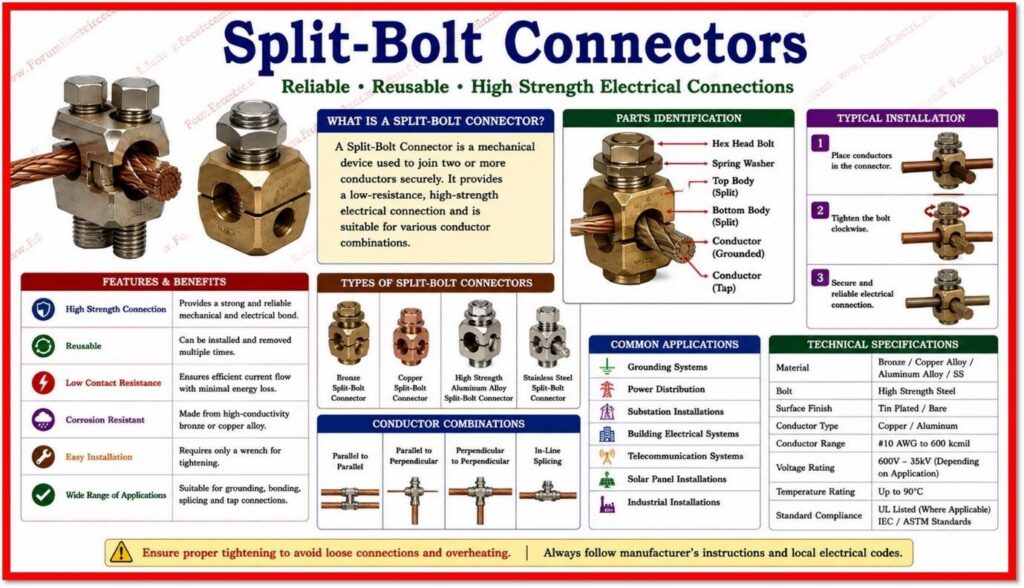
Split-bolt connectors are heavy duty copper alloy fasteners used to join (or) tap larger conductors particularly in service entrance, feeder and industrial applications.
The connector has a slotted body that accepts 2 conductors and a bolt is tightened to compress them together that is forming a strong low resistance electrical and mechanical bond.
These connections are typically taped (or) covered with an insulating cap after installation.
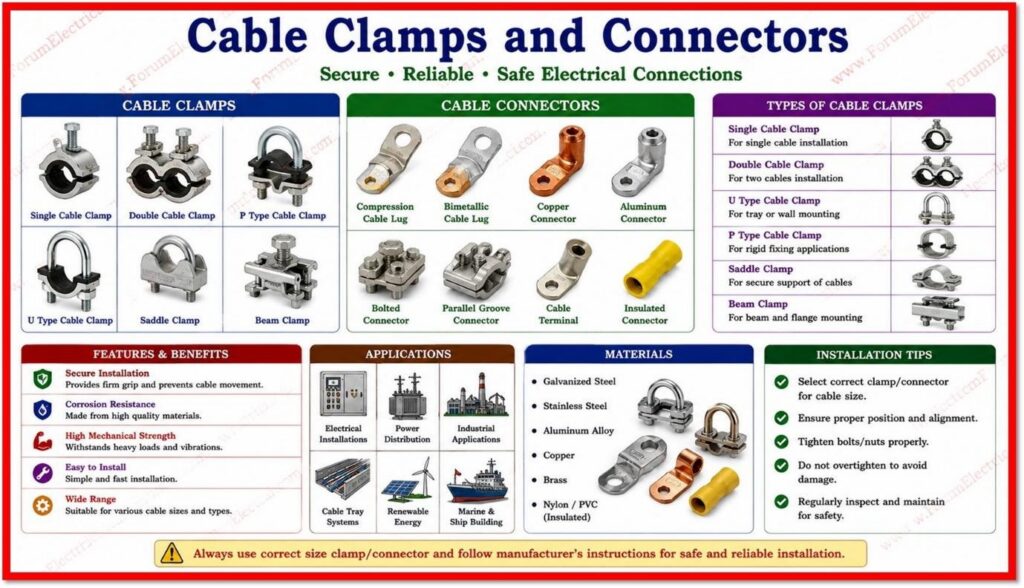
4). Cable Clamps and Connectors
Cable clamps secure cables and conduits to
- Junction boxes,
- Panels and
- Enclosures
that both anchoring the cable mechanically and in metallic applications, maintaining grounding continuity.
Common types include nonmetallic (NM) cable clamps for romex-style wiring, metallic clamp connectors for armored (or) metal-clad cable and conduit connectors that fasten rigid (or) flexible conduit to boxes.
5). Self-Tapping & Sheet Metal Screws
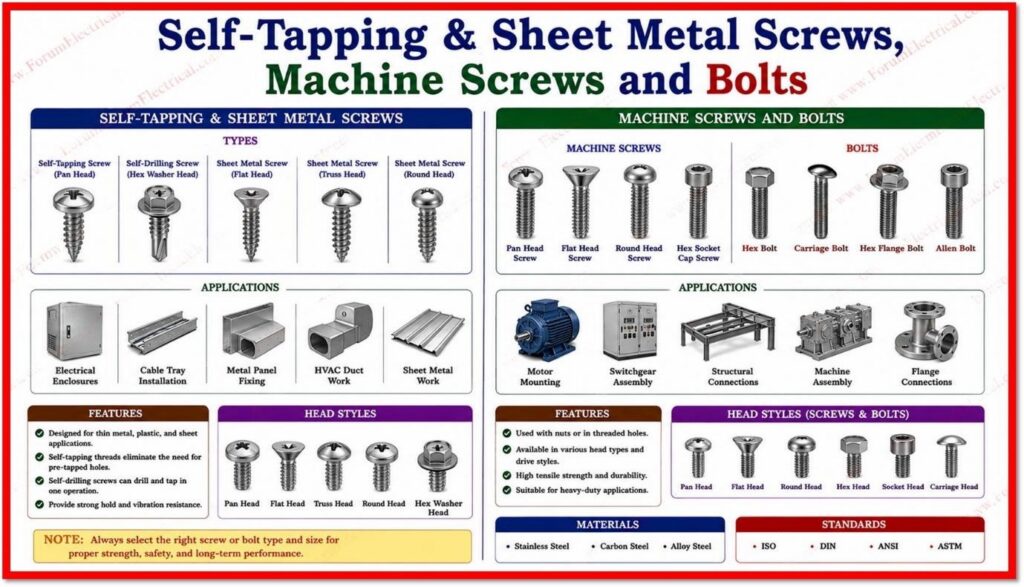
Self-tapping screws cut their own threads into pre-drilled (or) thin metal, making them useful for mounting devices, brackets and covers directly onto metal enclosures (or) panels without requiring a pre-threaded hole.
They are typically made from hardened steel with a corrosion resistant plating such as zinc.
6). Machine Screws and Bolts
Machine screws are used with pre-tapped holes (or) nuts for assembling panels, mounting components on chassis and securing bus bars.
In panelboards and switchgear, machine screws and bolts often need torque specifications published by the manufacturer since both under and over torqued bus connections are a leading cause of thermal failure in panels.
7). Toggle Bolts and Anchors
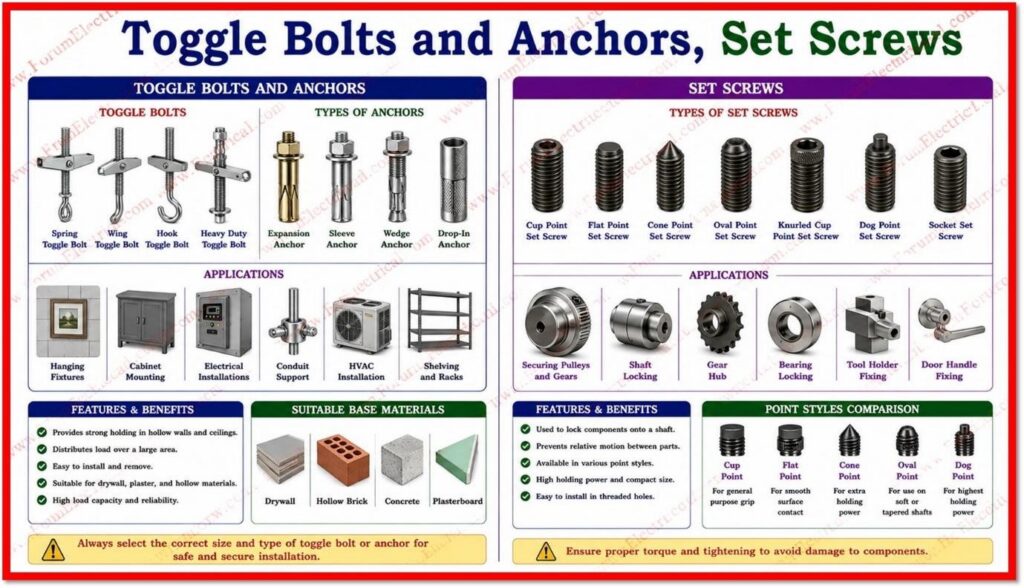
When mounting electrical boxes, fixtures (or) panels to hollow walls such as drywall, toggle bolts and similar anchors give secure fastening by expanding behind the wall surface.
These are common in retrofit installations where a stud is not available at the desired mounting location.
8). Set Screws
Set screws are small headless screws used within lugs, connectors and conduit fittings to secure a conductor (or) component in place by direct compression without a nut.
They are widely used in set screw type mechanical lugs for terminating stranded (or) solid conductors to bus bars and equipment terminals.
Comparison Table
| Fastener Type | Typical Material | Primary Application |
|---|---|---|
| Terminal Screws | Brass / Plated Steel | Securing conductors to devices and panels |
| Wire Nuts (Connectors) | Plastic shell, steel spring | Twisting and insulating spliced wires |
| Split-Bolt Connectors | Copper Alloy | High current tap and splice connections |
| Cable Clamps | Nylon / Metal | Securing cables to boxes and enclosures |
| Self-Tapping Screws | Hardened Steel | Mounting fixtures to metal enclosures |
| Machine Screws | Steel / Stainless Steel | Panel assembly and device mounting |
| Toggle Bolts | Zinc-Plated Steel | Mounting to hollow walls |
| Set Screws | Steel | Securing lugs and connectors onto conductors |
Material Considerations
The material of an electrical fastener directly affects both its mechanical durability and its electrical suitability.
Common materials include:
Brass
Brass is a good conductivity and corrosion resistance that is widely used for terminal screws and connectors.
Copper Alloy
Copper alloy is used where high current carrying capacity is required such as split bolts and lugs.
Zinc-Plated (or) Galvanized Steel
Zinc-plated (or) Galvanized steel provides strength with basic corrosion protection for structural & mounting fasteners.
Stainless Steel
Stainless steel is chosen for outdoor, marine (or) corrosive environments where long term durability is essential.
Aluminium Alloy
Aluminium alloy is occasionally used for weight-sensitive applications, though care is needed to avoid galvanic corrosion when paired with copper.
Standards and Compliance
Electrical fasteners used in regulated installations should typically meet recognized standards including UL Listing in North America, NEC torque and termination requirements and IEC 60999 for connecting devices in Europe and other regions.
Manufacturers publish torque specifications for terminal & lug connections that is adherence to these values during installation is important for both safety certification and long term reliability.
Installation Best Practices
- Always torque terminal screws and lugs to the manufacturers specified value using a calibrated torque screwdriver (or) wrench.
- Match fastener and connector ratings to conductor size, material and ampacity.
- Avoid mixing dissimilar metals directly (or) use compatible anti-oxidant compounds where required to avoid galvanic corrosion.
- Re-torque connections after an initial thermal cycle in high-vibration (or) high-load applications.
- Inspect fasteners periodically in outdoor, industrial (or) high-humidity environments for corrosion or loosening.
Conclusion
Electrical fasteners may be small components but their correct selection and installation underpin the safety & dependability of an entire electrical system.
From terminal screws and wire nuts in residential wiring to split bolts & torque-rated lugs in industrial power distribution, each fastener type is engineered for a specific mechanical and electrical work.
Understanding these categories, their materials and applicable standards allows engineers, electricians and maintenance professionals to make informed choices that reduce failures, minimize maintenance and keep electrical systems operating safely over their service life.

